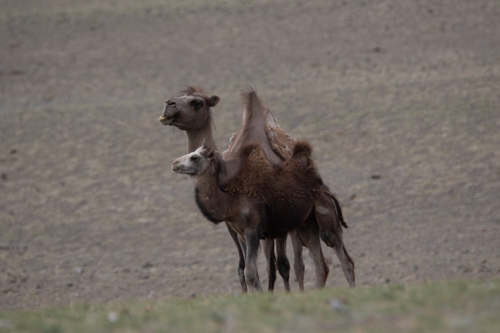
About the Domestic Bactrian Camel
The Bactrian camel (Camelus bactrianus), also known as the Mongolian camel, domestic Bactrian camel, two-humped camel or double-humped camel, is a camel native to the steppes of Central Asia. It has two humps on its back, in contrast to the single-humped dromedary. Its population of 2 million exists mainly in the domesticated form. Their name comes from the ancient historical region of Bactria.
The domesticated Bactrian camel has served as pack animals in inner Asia since ancient times. With its tolerance for cold, drought, and high altitudes, it enabled the travel of caravans on the Silk Road. Bactrian camels, whether domesticated or feral, are a separate species from the wild Bactrian camel (Camelus ferus), which is the only truly wild (as opposed to feral) species of camelid in the Old World. Domestic Bactrian camels do not descend from wild Bactrian camels, with the two species having split around 1 million years ago.
The Bactrian camel shares the genus Camelus with the dromedary (C. dromedarius) and the wild Bactrian camel (C. ferus). The Bactrian camel belongs to the family Camelidae. The ancient Greek philosopher Aristotle was the first European to describe the... Wikipedia →