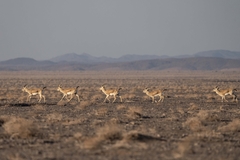
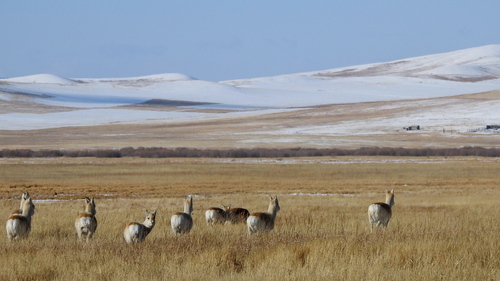
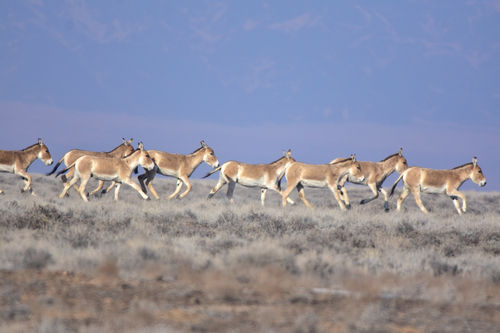
Goitered Gazelle

Goitered Gazelle

Gazella subgutturosa

Silhouette: Rebecca Groom · PhyloPic

LCNTVUVulnerableENCR
Daily sighting probability ~70% · Very likely
at Gobi Gurvansaikhan National Park

In 3 days >90%

32 Verified sightings at Gobi Gurvansaikhan National Park From 2019 to 2026
32 In 1 park
June Best month
☀️ Diurnal When it's spotted

About the Goitered Gazelle

The goitered gazelle (Gazella subgutturosa) or black-tailed gazelle is a gazelle native to Turkey, Georgia, Azerbaijan, Iran, parts of Iraq and Pakistan, Afghanistan, Tajikistan, Kyrgyzstan, Uzbekistan, Turkmenistan, Kazakhstan and in northwestern China and Mongolia. The specific name, meaning "full below the throat", refers to the male having an enlargement of the neck and throat during the mating season.

The goitered gazelle inhabits sands and gravel plains and limestone plateau. Large herds were also present in the Near East. Some 6,000 years ago, they were captured and killed with the help of desert kites. Rock art found in Jordan suggests that it was slaughtered ritually.

Its mating behaviour is polygynous and usually occurs in the early winter. It runs at high speed, without the leaping, bounding gait seen in other gazelle species. Throughout much of its range, the goitered gazelle migrates seasonally. Herds cover 10–30 km (6.2–18.6 mi) per day in the winter, with these distances being reduced to about 1–3 km (0.62–1.86 mi) in summer.

Several subspecies have been described, and four forms are distinguished... Wikipedia →

Global Distribution

Parks Where Found

# Park Country Daily sighting probability
1 Gobi Gurvansaikhan National Park 🇲🇳 Mongolia
~70%

More parks will be added in future updates.

Zoos & Centres Where Found

# Zoo / Centre Country
1 Mohamed bin Zayed Nature Reserve 🇧🇭 Bahrain In captivity
2 Tiergarten Am Tiergarten 28 in Nürnberg 🇩🇪 Germany In captivity
3 Shymkent Zoo 🇰🇿 Kazakhstan In captivity
4 Langenberg Wildlife Park 🇨🇭 Switzerland In captivity

Before you go

What are the chances of seeing a Goitered Gazelle in Gobi Gurvansaikhan National Park?

Very likely

About 70% of wildlife watchers report a Goitered Gazelle sighting in Gobi Gurvansaikhan National Park on a given day, based on 32 verified sightings from GBIF citizen-science data from 2019 to 2026. It is the 4th most-seen of the 12 mammals we can rate there. Over three days the chance rises to over 90%, if each day is a fresh chance.

What time of day is best to see a Goitered Gazelle?

Between 9 am and noon

Across all the parks we cover, that three-hour window holds the most Goitered Gazelle sightings with a recorded time, and about 7 in 10 of them come between 6 am and 6 pm: it is a daytime animal.

Where else can you see a Goitered Gazelle?

Only Gobi Gurvansaikhan National Park, in our data

Gobi Gurvansaikhan National Park is the only park on Wallace's Line with enough records to rate Goitered Gazelle sightings: about 70% of wildlife watchers there report one on a given day.

Which relatives of the Goitered Gazelle live in Gobi Gurvansaikhan National Park?

Same family: Bovidae

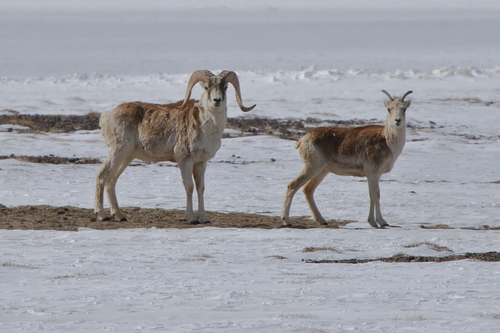
The closest relatives of the Goitered Gazelle that you can see in Gobi Gurvansaikhan National Park (family Bovidae, Bovids) are Siberian Ibex (about 80%), Argali (about 40%) and Mongolian Gazelle (about 40%), with each one's daily chance of a sighting.

Where does the Goitered Gazelle sighting chance come from?

GBIF citizen-science records

It is estimated from how often the Goitered Gazelle is recorded against all the mammals logged in Gobi Gurvansaikhan National Park (32 verified sightings from 2019 to 2026), calibrated against known sighting rates. Figures are rounded to the nearest 10% because citizen-science data supports honest approximations, not decimals, and months with records from fewer than five people show "—". How it works.

← Back to Gobi Gurvansaikhan National Park