Asian Wild Ass

Asian Wild Ass

Equus hemionus

Silhouette: Mercedes Yrayzoz (vectorized by T. Michael Keesey) · PhyloPic

LCNTNear ThreatenedVUENCR
Daily sighting probability ~40% · Likely
at Gobi Gurvansaikhan National Park

In 3 days ~80% in a week >90%

8 Verified sightings at Gobi Gurvansaikhan National Park From 2019 to 2026
8 In 1 park
May Best month
🌅 Crepuscular When it's spotted

About the Asian Wild Ass

The onager () (Equus hemionus), also known as hemione or Asiatic wild ass, is a species of the family Equidae native to Asia. A member of the subgenus Asinus, the onager was described and given its binomial name by German zoologist Peter Simon Pallas in 1775. Six subspecies are accepted.

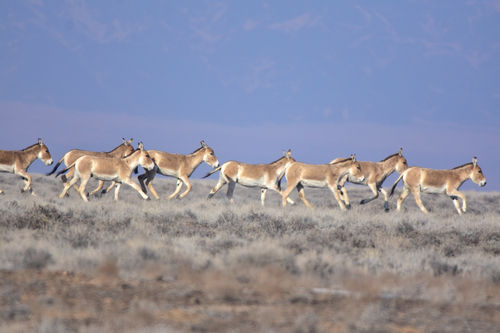
The onager is reddish-brown or yellowish-brown and has a broad dorsal stripe on the middle of the back. It weighs about 200–260 kg (440–570 lb) and reaches about 2.1 m (6 ft 11 in) head-body length. It is among the fastest mammals, capable of running 64–70 km/h (40–43 mph).

The onager had a wider range from southwest and central to northern Asia including the Levant region, Arabian Peninsula, Afghanistan and Siberia; the prehistoric European wild ass subspecies ranged through Europe until the Bronze Age. During the early 20th century, it lost most of its range in the Middle East and Eastern Asia and lives today in Iran, Kazakhstan, Uzbekistan, Turkmenistan, India, Mongolia and China. It inhabits deserts and arid regions, grasslands, plains, steppes, and savannahs. Like many other large grazing animals, its range has contracted greatly under the pressures of poaching and habitat loss. It has been classified as Near Threatened on the IUCN Red List in 2015. Two subspecies are extinct, two are endangered, and two are near threatened; its status in China is not well known. Wikipedia →
Global Distribution

Parks Where Found

# Park Country Daily sighting probability
1 Gobi Gurvansaikhan National Park 🇲🇳 Mongolia
~40%

More parks will be added in future updates.

Zoos & Centres Where Found

# Zoo / Centre Country
1 Kolmården Wildlife Park 🇸🇪 Sweden In captivity
2 Réserve africaine de Sigean 🇫🇷 France In captivity
3 The Wilds 🇺🇸 United States In captivity
4 Парк природи "Беремицьке" 🇺🇦 Ukraine In captivity
5 Lion Country Safari 🇺🇸 United States In captivity
6 Beijing Wildlife Park 🇨🇳 China In captivity
7 Tallinn Zoo 🇪🇪 Estonia In captivity
8 Bratislava Zoo 🇸🇰 Slovakia In captivity
9 Parc zoologique de Montpellier 🇫🇷 France In captivity
10 Chester Zoo 🇬🇧 United Kingdom In captivity
11 Greater Vancouver Zoo 🇨🇦 Canada In captivity
12 Fonghuanggu Bird and Ecology Park 🇹🇼 Taiwan In captivity
13 Wildlands 🇳🇱 Netherlands In captivity
14 Tierpark Ströhen 🇩🇪 Germany In captivity
15 Wilhelma 🇩🇪 Germany In captivity
16 Parc Zoologique et Botanique de Mulhouse 🇫🇷 France In captivity
17 Zoo Opole 🇵🇱 Poland In captivity
18 Soğanlı Zoo 🇹🇷 Türkiye In captivity
19 Zagreb Zoo 🇭🇷 Croatia In captivity
20 L'Oceanogràfic 🇪🇸 Spain In captivity
21 Odesa Zoo 🇺🇦 Ukraine In captivity
22 Eram Zoo 🇮🇷 Iran In captivity
23 Kinderbauernhof auf dem Görlitzer 🇩🇪 Germany In captivity
24 Blue Planet Aquarium 🇬🇧 United Kingdom In captivity
25 Cologne Zoo Aquarium 🇩🇪 Germany In captivity

Before you go

What are the chances of seeing an Asian Wild Ass in Gobi Gurvansaikhan National Park?

Likely

About 40% of wildlife watchers report an Asian Wild Ass sighting in Gobi Gurvansaikhan National Park on a given day, based on 8 verified sightings from GBIF citizen-science data from 2019 to 2026. It is the 6th most-seen of the 12 mammals we can rate there. Over three days the chance rises to about 80%, and over a week to over 90%, if each day is a fresh chance.

What time of day is best to see an Asian Wild Ass?

Between noon and 3 pm

Across all the parks we cover, that three-hour window holds the most Asian Wild Ass sightings with a recorded time, and about 7 in 10 of them come between 6 am and 6 pm: it is most active around dawn and dusk.

Where else can you see an Asian Wild Ass?

Only Gobi Gurvansaikhan National Park, in our data

Gobi Gurvansaikhan National Park is the only park on Wallace's Line with enough records to rate Asian Wild Ass sightings: about 40% of wildlife watchers there report one on a given day.

Where does the Asian Wild Ass sighting chance come from?

GBIF citizen-science records

It is estimated from how often the Asian Wild Ass is recorded against all the mammals logged in Gobi Gurvansaikhan National Park (8 verified sightings from 2019 to 2026), calibrated against known sighting rates. Figures are rounded to the nearest 10% because citizen-science data supports honest approximations, not decimals, and months with records from fewer than five people show "—". How it works.

← Back to Gobi Gurvansaikhan National Park