Mongolian Jird

Mongolian Jird

Meriones unguiculatus

Silhouette: Daniel Stadtmauer · PhyloPic

LCLeast ConcernNTVUENCR
Daily sighting probability ~80% · Very likely
at Gobi Gurvansaikhan National Park

In 3 days >90%

39 Verified sightings at Gobi Gurvansaikhan National Park From 2019 to 2026
39 In 1 park
June Best month
🌅 Crepuscular When it's spotted

About the Mongolian Jird

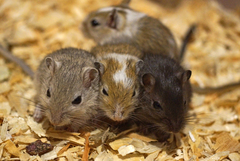
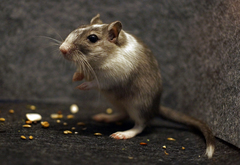
The Mongolian gerbil, also referred to as the Mongolian jird (Meriones unguiculatus), is a rodent belonging to the subfamily Gerbillinae. Their body size is typically 110–135 mm (4+1⁄4–5+1⁄4 in), with a 95–120 mm (3+3⁄4–4+3⁄4 in) tail, and body weight 60–130 g (2–4+1⁄2 oz), with adult males larger than females. The animal is used in science for research or kept as a small house pet. Their use in science dates back to the later half of the 19th century, but they only started to be kept as pets in the English-speaking world after 1954, when they were brought to the United States. However, their use in scientific research has fallen out of favor.

The first known mention of gerbils came in 1866, by Father Armand David, who sent "yellow rats" to the French National Museum of Natural History in Paris, from northern China. They were named Gerbillus unguiculatus by the scientist Alphonse Milne-Edwards in 1867.

There is a popular misconception about the meaning of this scientific name, appearing both in printed works and in websites, due to the genus Meriones sharing the name with Greek warrior Meriones in Homer's Iliad; however, translations like "clawed warrior... Wikipedia →

Global Distribution

Parks Where Found

# Park Country Daily sighting probability
1 Gobi Gurvansaikhan National Park 🇲🇳 Mongolia
~80%

More parks will be added in future updates.

Zoos & Centres Where Found

# Zoo / Centre Country
1 Zoo Pilsen 🇨🇿 Czechia In captivity
2 Kyiv Zoo 🇺🇦 Ukraine In captivity
3 Budapest Zoo & Botanical Garden 🇭🇺 Hungary In captivity
4 Japan Monkey Centre 🇯🇵 Japan In captivity
5 The Juana's Market 🇦🇷 Argentina In captivity
6 Тульский экзотариум (новая экспозиция) 🇷🇺 Russia In captivity

Before you go

What are the chances of seeing a Mongolian Jird in Gobi Gurvansaikhan National Park?

Very likely

About 80% of wildlife watchers report a Mongolian Jird sighting in Gobi Gurvansaikhan National Park on a given day, based on 39 verified sightings from GBIF citizen-science data from 2019 to 2026. It is the 2nd most-seen of the 12 mammals we can rate there. Over three days the chance rises to over 90%, if each day is a fresh chance.

What time of day is best to see a Mongolian Jird?

Between 2 and 5 am

Across all the parks we cover, that three-hour window holds the most Mongolian Jird sightings with a recorded time, and about 6 in 10 of them come between 6 pm and 6 am: it is most active around dawn and dusk.

Where else can you see a Mongolian Jird?

Only Gobi Gurvansaikhan National Park, in our data

Gobi Gurvansaikhan National Park is the only park on Wallace's Line with enough records to rate Mongolian Jird sightings: about 80% of wildlife watchers there report one on a given day.

Where does the Mongolian Jird sighting chance come from?

GBIF citizen-science records

It is estimated from how often the Mongolian Jird is recorded against all the mammals logged in Gobi Gurvansaikhan National Park (39 verified sightings from 2019 to 2026), calibrated against known sighting rates. Figures are rounded to the nearest 10% because citizen-science data supports honest approximations, not decimals, and months with records from fewer than five people show "—". How it works.

← Back to Gobi Gurvansaikhan National Park