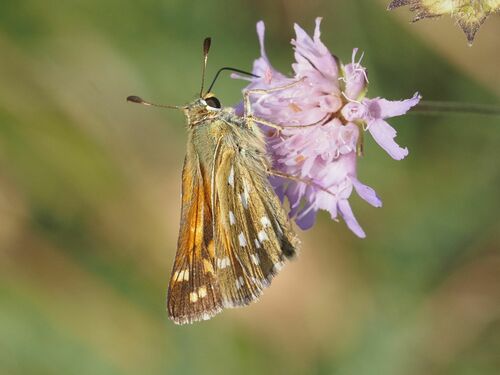
Essex Skipper

Essex Skipper

Thymelicus lineola

Daily sighting probability ~10% · With luck
at Grand Teton National Park

In 3 days ~40% in a week ~70%

44 Verified sightings at Grand Teton National Park From 2019 to 2026
579 In all 17 parks
July Best month
☀️ Diurnal When it's spotted

About the Essex Skipper

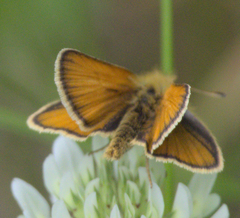
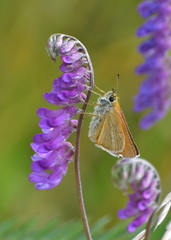
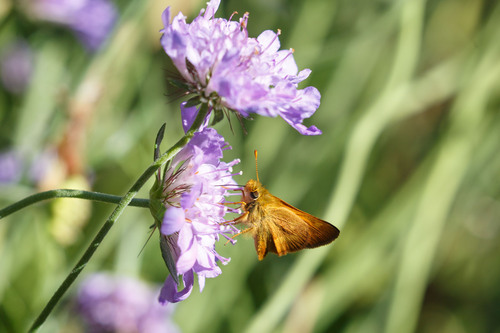
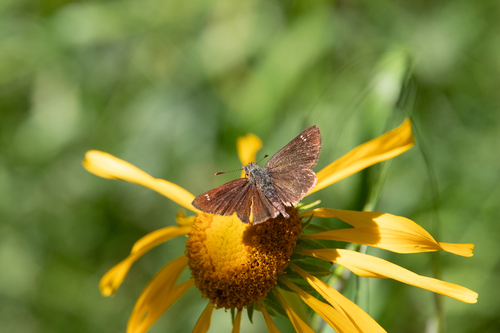
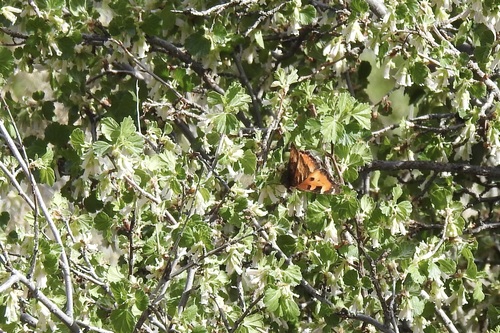
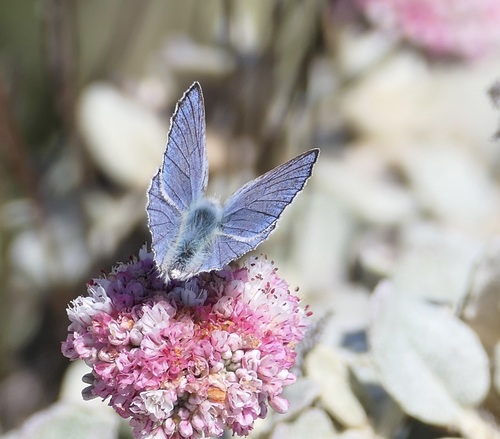
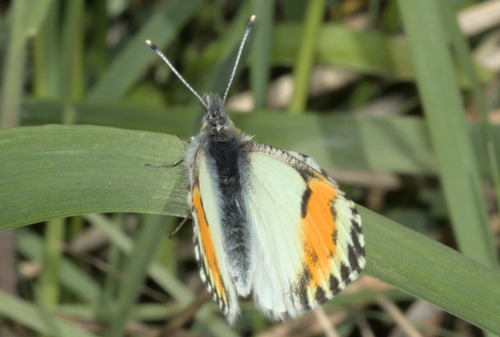
Thymelicus lineola, known in Europe as the Essex skipper and in North America as the European skipper, is a species of butterfly in the family Hesperiidae. With a wingspan of 2.5 to 2.9 cm (0.98 to 1.14 in), it is very similar in appearance to the small skipper, Thymelicus sylvestris. They can be told apart by the forward-facing flattish part of the antenna tip: in the Essex Skipper this face is black, whereas in the Small Skipper it is orange or brown. In males, there is a difference in the scent mark. In Essex Skipper this is a fine, straight, short dark line on the forewing, parallel to the wing edge; in the Small Skipper males, this line is bolder and bent. This butterfly occurs throughout much of the Palaearctic region. Its range is from southern Scandinavia through Europe to North Africa and east to Central Asia. It was only identified in the UK in 1889, and its range is expanding both in England and in northern Europe. In North America, this butterfly was accidentally introduced in 1910 via London, Ontario and has spread across southern Canada and into several northern US states. In many parts of the Northeastern United States it is the most abundant skipper. Wikipedia →

Global Distribution

Parks Where Found

# Park Country Daily sighting probability
1 Elk Island National Park 🇨🇦 Canada
~30%
2 Gros Morne National Park 🇨🇦 Canada
~30%
3 Mercantour National Park 🇫🇷 France
~20%
4 Vanoise National Park 🇫🇷 France
~20%
5 Yellowstone National Park 🇺🇸 United States
~20%
6 Ecrins National Park 🇫🇷 France
~20%
7 Riding Mountain National Park 🇨🇦 Canada
~20%
8 Aigüestortes National Park 🇪🇸 Spain
~10%
9 Grand Teton National Park 🇺🇸 United States
~10%
10 Glacier National Park 🇺🇸 United States
~10%
11 Jasper National Park 🇨🇦 Canada
~10%
12 Hohe Tauern National Park 🇦🇹 Austria
~10%
13 Pyrénées National Park 🇫🇷 France
~10%
14 Bavarian Forest National Park 🇩🇪 Germany
~10%
15 Wadden Sea National Park 🇩🇪 Germany
~10%
16 Cévennes National Park 🇫🇷 France
~10%
17 Banff National Park 🇨🇦 Canada
~10%

Cities Where Found

# City Country Daily sighting probability
1 Helsinki 🇫🇮 Finland
~20%
2 Edmonton 🇨🇦 Canada
~10%
3 Kharkiv 🇺🇦 Ukraine
~10%
4 Calgary 🇨🇦 Canada
~10%
5 Birmingham 🇬🇧 United Kingdom
~10%
6 London 🇬🇧 United Kingdom
~10%
7 Toronto 🇨🇦 Canada
~10%
8 Minneapolis [Saint Paul] 🇺🇸 United States
~10%
9 Budapest 🇭🇺 Hungary
~10%
10 Warsaw 🇵🇱 Poland
~10%

Before you go

What are the chances of seeing an Essex Skipper in Grand Teton National Park?

With luck

About 10% of wildlife watchers report an Essex Skipper sighting in Grand Teton National Park on a given day, based on 44 verified sightings from GBIF citizen-science data from 2019 to 2026. It is the 26th most-seen of the 140 insects we can rate there. Over three days the chance rises to about 40%, and over a week to about 70%, if each day is a fresh chance.

When is the best time to see an Essex Skipper in Grand Teton National Park?

July

In that month about 30% of wildlife watchers report an Essex Skipper in Grand Teton National Park on a given day, against under 5% in September to June, the lowest months. That is one of Grand Teton National Park's driest months, with about 20 mm of rain against 85 mm in December.

What time of day is best to see an Essex Skipper?

Between noon and 3 pm

Across all the parks we cover, that three-hour window holds the most Essex Skipper sightings with a recorded time, and about 9 in 10 of them come between 6 am and 6 pm: it is a daytime animal.

Which relatives of the Essex Skipper live in Grand Teton National Park?

Same family: Hesperiidae

The closest relatives of the Essex Skipper that you can see in Grand Teton National Park (family Hesperiidae, Skippers) are Woodland Skipper (about 10%), Russet Skipperling (about 10%) and Common Branded Skipper (about 10%), with each one's daily chance of a sighting.

Where does the Essex Skipper sighting chance come from?

GBIF citizen-science records

It is estimated from how often the Essex Skipper is recorded against all the insects logged in Grand Teton National Park (44 verified sightings from 2019 to 2026), calibrated against known sighting rates. Figures are rounded to the nearest 10% because citizen-science data supports honest approximations, not decimals, and months with records from fewer than five people show "—". How it works.


← Back to Grand Teton National Park