Orchid Dupe Wasp

Orchid Dupe Wasp

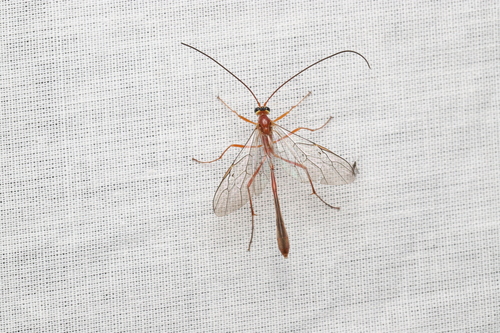
Lissopimpla excelsa

Daily sighting probability ~10% · With luck
at Great Otway National Park

In 3 days ~30% in a week ~50%

26 Verified sightings at Great Otway National Park From 2019 to 2026
97 In all 7 parks
November Best month
☀️ Diurnal When it's spotted

About the Orchid Dupe Wasp

Lissopimpla excelsa, commonly known as the orchid dupe wasp, is a wasp of the family Ichneumonidae native to Australia. Although also found in New Zealand, where it is known as the dusky-winged ichneumonid, it has probably been introduced there. However, another source states that it may be native to New Zealand.

It pollinates all five Australian members of the orchid genus Cryptostylis. The male wasp mistakes the flower parts for a female wasp and attempts to copulate with it. Although the different species can occur together, they appear to inhibit cross-fertilisation and no hybrids are found in nature. This discovery was made by Australian naturalist Edith Coleman in 1928. The term "pseudocopulation" has since been coined to describe the phenomenon. The mimicking of flowers to resemble female wasp parts has since been recorded in other orchid genera.

Although termed pseudocopulation, vigorous copulation does occur, and the male wasp ejaculates enough so that the emissions are visible to the naked eye on the flower parts. A 2008 field study showed these to contain wasp sperm. The flowers of Cryptostylis orchids and female wasp body parts are very similar in colour when viewed under a hymenopteran visual system, despite looking unlike to human eyes. Although the colours that ichneumon wasps see are unknown, bees and wasps have similar perception with green, blue and ultraviolet wavelengths. The Cryptostylis flowers have no smell detectable to humans, but have been shown to have an odour which attracts the wasp. Pseudocopulation with the orchid Cryptostylis subulata occurs in New Zealand.

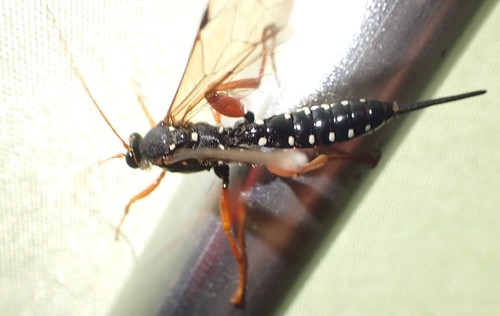
The orchid dupe wasp was first described by Italian entomologist Achille Costa in 1864 as Pimpla excelsa, before being placed in (and becoming the type species of) the new genus Lissopimpla in 1889 by Joseph Kriechbaumer, who called it Lissopimpla octo-guttata Kriechb. It was also known for many years as Lissopimpla semipunctata, however Costa's name has priority and hence is the correct name. The head, mesosoma, legs and apical segments of the metasoma are red-brown, the first four segments of the metasoma are black with paired large white spots, and the wings are a dark smoky brown except at the apex of the fore wings. Like all members of its family, L. excelsa is parasitic. One species it preys upon is the noctuid moth pest species Helicoverpa armigera. Wikipedia →

Global Distribution

Parks Where Found

# Park Country Daily sighting probability
1 Wilsons Promontory National Park 🇦🇺 Australia
~10%
2 Grampians National Park 🇦🇺 Australia
~10%
3 Kosciuszko National Park 🇦🇺 Australia
~10%
4 Great Otway National Park 🇦🇺 Australia
~10%
5 Blue Mountains National Park 🇦🇺 Australia
~10%
6 Lamington National Park 🇦🇺 Australia
~10%
7 Springbrook National Park 🇦🇺 Australia
~10%

Cities Where Found

# City Country Daily sighting probability
1 Brisbane 🇦🇺 Australia
~10%
2 Melbourne 🇦🇺 Australia
~10%
3 Sydney 🇦🇺 Australia
~10%
4 Perth 🇦🇺 Australia
~10%
5 Auckland 🇳🇿 New Zealand
~10%

Before you go

What are the chances of seeing an Orchid Dupe Wasp in Great Otway National Park?

With luck

About 10% of wildlife watchers report an Orchid Dupe Wasp sighting in Great Otway National Park on a given day, based on 26 verified sightings from GBIF citizen-science data from 2019 to 2026. It is the 77th most-seen of the 418 insects we can rate there. Over three days the chance rises to about 30%, and over a week to about 50%, if each day is a fresh chance.

When is the best time to see an Orchid Dupe Wasp in Great Otway National Park?

November to January

In those months about 20% of wildlife watchers report an Orchid Dupe Wasp in Great Otway National Park on a given day, against under 5% in March to September, the lowest months.

What time of day is best to see an Orchid Dupe Wasp?

Between 11 am and 2 pm

Across all the parks we cover, that three-hour window holds the most Orchid Dupe Wasp sightings with a recorded time, and about 8 in 10 of them come between 6 am and 6 pm: it is a daytime animal.

Is Great Otway National Park the best place to see an Orchid Dupe Wasp?

Among the best

Of the 7 parks where we can rate Orchid Dupe Wasp sightings, Great Otway National Park ranks 4th at about 10%, level with the leaders once rounded. The best odds are in Wilsons Promontory National Park (Australia, about 10%), Grampians National Park (Australia, about 10%) and Kosciuszko National Park (Australia, about 10%).

Which relatives of the Orchid Dupe Wasp live in Great Otway National Park?

Same family: Ichneumonidae

The closest relatives of the Orchid Dupe Wasp that you can see in Great Otway National Park (family Ichneumonidae, Ichneumonid Wasps) are Cream-Spotted Ichneumon (about 10%) and Dicamptus fuscicornis (about 10%), with each one's daily chance of a sighting.

Where does the Orchid Dupe Wasp sighting chance come from?

GBIF citizen-science records

It is estimated from how often the Orchid Dupe Wasp is recorded against all the insects logged in Great Otway National Park (26 verified sightings from 2019 to 2026), calibrated against known sighting rates. Figures are rounded to the nearest 10% because citizen-science data supports honest approximations, not decimals, and months with records from fewer than five people show "—". How it works.

← Back to Great Otway National Park