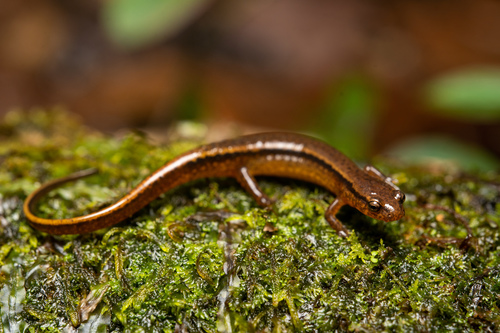
Cave Salamander

Cave Salamander

Eurycea lucifuga

Silhouette: Andy Wilson · PhyloPic

LCLeast ConcernNTVUENCR Endemic
Daily sighting probability ~10% · With luck
at Great Smoky Mountains National Park

In 3 days ~20% in a week ~30%

8 Verified sightings at Great Smoky Mountains National Park From 2019 to 2026
8 In 1 park
September Best month
☀️ Diurnal When it's spotted

About the Cave Salamander

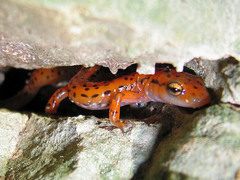
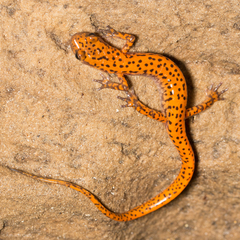
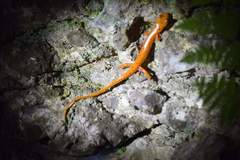
The cave salamander or spotted-tail salamander (Eurycea lucifuga) is a species of brook salamander in the family Plethodontidae. It is well known for living in and around caves in the southeast United States. Adult cave salamanders are bright orange with black spots. This species is, somewhat vaguely, referred to by the common name of 'cave salamander'; however, it is not restricted to caves, but is known for inhabiting surface-level, terrestrial, woodland habitats, as well.

The cave salamander is a relatively large lungless salamander, ranging in total length from 10 to 20 cm (4 to 8 in). The tail makes up a significant proportion of the total length, up to 60–65%. Post-metamorphic individuals have orange to reddish orange backs and a pale, unmarked ventral surface. The dorsal surface of the body is heavily marked with irregularly spaced spots and dashes. The limbs of the cave salamander are long. There are 14–15 costal grooves on the side of the body. This species has a prehensile tail.

The name 'cave salamander' can be confusing because the term is also used more generally to describe cave-dwelling salamanders. Despite its name, the cave... Wikipedia →

Global Distribution

Parks Where Found

# Park Country Daily sighting probability
1 Great Smoky Mountains National Park 🇺🇸 United States
~10%

More parks will be added in future updates.

Closest Relatives at Great Smoky Mountains National Park

Before you go

What are the chances of seeing a Cave Salamander in Great Smoky Mountains National Park?

With luck

About 10% of wildlife watchers report a Cave Salamander sighting in Great Smoky Mountains National Park on a given day, based on 8 verified sightings from GBIF citizen-science data from 2019 to 2026. It is the 32nd most-seen of the 36 amphibians we can rate there. Over three days the chance rises to about 20%, and over a week to about 30%, if each day is a fresh chance.

When is the best time to see a Cave Salamander in Great Smoky Mountains National Park?

May–July and September–October

In those months about 10% of wildlife watchers report a Cave Salamander in Great Smoky Mountains National Park on a given day, against under 5% in August and November–April, the lowest months.

What time of day is best to see a Cave Salamander?

Between 10 am and 1 pm

Across all the parks we cover, that three-hour window holds the most Cave Salamander sightings with a recorded time, and about 8 in 10 of them come between 6 am and 6 pm: it is a daytime animal.

Where else can you see a Cave Salamander?

Only Great Smoky Mountains National Park, in our data

Great Smoky Mountains National Park is the only park on Wallace's Line with enough records to rate Cave Salamander sightings: about 10% of wildlife watchers there report one on a given day.

Where does the Cave Salamander sighting chance come from?

GBIF citizen-science records

It is estimated from how often the Cave Salamander is recorded against all the amphibians logged in Great Smoky Mountains National Park (8 verified sightings from 2019 to 2026), calibrated against known sighting rates. Figures are rounded to the nearest 10% because citizen-science data supports honest approximations, not decimals, and months with records from fewer than five people show "—". How it works.

← Back to Great Smoky Mountains National Park