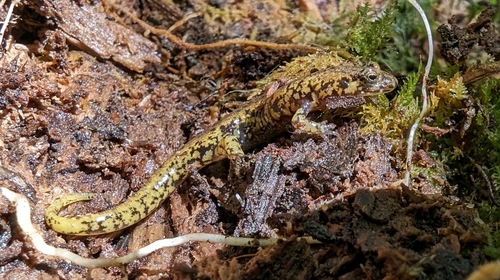
Red Salamander

Red Salamander

Pseudotriton ruber

Silhouette: PhyloPic

LCLeast ConcernNTVUENCR
Daily sighting probability ~30% · Possible
at Great Smoky Mountains National Park

In 3 days ~70% in a week ~90%

195 Verified sightings at Great Smoky Mountains National Park From 2019 to 2026
239 In all 2 parks
March Best month
☀️ Diurnal When it's spotted

About the Red Salamander

The red salamander (Pseudotriton ruber) is a species of salamander in the family Plethodontidae (lungless salamanders) endemic to the Eastern United States. Its skin is brown, orange or red with random black spots. Semiaquatic adults and aquatic larvae live in temperate forests, small creeks, bogs, ponds, intermittent streams, and freshwater springs. Overall this species is common and widespread, but locally it has declined because of habitat loss and it is considered threatened in Indiana and New York. Red salamanders eat insects, earthworms, spiders, small crustaceans, snails, and smaller salamanders. To eat, they extend their tongue to capture prey on the tip of it and retract it back into their mouths. The red salamander, as a member of the family Plethodontidae (lungless salamanders) lacks lungs and respires through its skin.

The Pseudotriton ruber is a medium-large salamander, with adults ranging from 4.3 to 7.1 in (11–18 cm) in total length. It has a relatively stout body with 16–18 coastal grooved sides. Its back varies in color from an orange-brownish tint to a bright red, depending on its age. Like other salamanders, the red salamander seems to lose its... Wikipedia →

Global Distribution

Parks Where Found

# Park Country Daily sighting probability
1 Great Smoky Mountains National Park 🇺🇸 United States
~30%
2 Shenandoah National Park 🇺🇸 United States
~20%

Zoos & Centres Where Found

# Zoo / Centre Country
1 Riverbanks Zoo 🇺🇸 United States In captivity
2 Ralph Perkins II Wildlife Center and Woods Garden 🇺🇸 United States In captivity
3 Tennessee Aquarium 🇺🇸 United States In captivity

Closest Relatives at Great Smoky Mountains National Park

Before you go

What are the chances of seeing a Red Salamander in Great Smoky Mountains National Park?

Possible

About 30% of wildlife watchers report a Red Salamander sighting in Great Smoky Mountains National Park on a given day, based on 195 verified sightings from GBIF citizen-science data from 2019 to 2026. It is the 8th most-seen of the 36 amphibians we can rate there. Over three days the chance rises to about 70%, and over a week to about 90%, if each day is a fresh chance.

When is the best time to see a Red Salamander in Great Smoky Mountains National Park?

March to June

In those months about 40% of wildlife watchers report a Red Salamander in Great Smoky Mountains National Park on a given day, against under 5% in January, the lowest month.

What time of day is best to see a Red Salamander?

Between 10 am and 1 pm

Across all the parks we cover, that three-hour window holds the most Red Salamander sightings with a recorded time, and about 8 in 10 of them come between 6 am and 6 pm: it is a daytime animal.

Is Great Smoky Mountains National Park the best place to see a Red Salamander?

Yes

Of the 2 parks where we can rate Red Salamander sightings, Great Smoky Mountains National Park has the highest daily chance: about 30%. Next come Shenandoah National Park (United States, about 20%).

Where does the Red Salamander sighting chance come from?

GBIF citizen-science records

It is estimated from how often the Red Salamander is recorded against all the amphibians logged in Great Smoky Mountains National Park (195 verified sightings from 2019 to 2026), calibrated against known sighting rates. Figures are rounded to the nearest 10% because citizen-science data supports honest approximations, not decimals, and months with records from fewer than five people show "—". How it works.

← Back to Great Smoky Mountains National Park