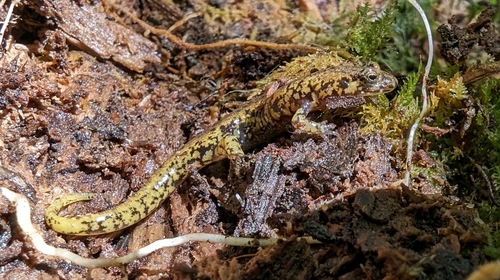
Seal Salamander

Seal Salamander

Desmognathus monticola

Silhouette: Beth Reinke · PhyloPic

LCLeast ConcernNTVUENCR
Daily sighting probability ~40% · Likely
at Great Smoky Mountains National Park

In 3 days ~80% in a week >90%

366 Verified sightings at Great Smoky Mountains National Park From 2019 to 2026
555 In all 2 parks
February Best month
☀️🌙 Day & Night When it's spotted

About the Seal Salamander

The seal salamander (Desmognathus monticola) is a species of lungless salamander that is endemic to the Eastern United States. The seal salamander can be found from southwestern Pennsylvania and south through Appalachian Mountains areas of high elevation in West Virginia, western Maryland, western and northern Virginia, eastern Kentucky, western North Carolina, eastern Tennessee, western South Carolina, and northern Georgia to central Alabama. There are also disjunctive populations in southern Alabama as well as at the very western end of the Florida panhandle. In the north of its range, it has not been observed north or west of the Ohio River.

An introduced population is present in Benton County, Arkansas. This population was first found in 2003 and occurs at higher densities than first thought. This is a possible conservation concern for the native ecosystem.

Its habitat includes rocky mountain streams, spring-fed brooks in the ravines of deciduous forests, muddy sections of streams and seepages. The total adult population size of the species is assumed to exceed 100,000. The genus name Desmognathus refers to the characteristic bundle... Wikipedia →

Global Distribution

Parks Where Found

# Park Country Daily sighting probability
1 Great Smoky Mountains National Park 🇺🇸 United States
~40%
2 Shenandoah National Park 🇺🇸 United States
~40%

Zoos & Centres Where Found

# Zoo / Centre Country
1 Lisbon Oceanarium 🇵🇹 Portugal In captivity

Closest Relatives at Great Smoky Mountains National Park

Before you go

What are the chances of seeing a Seal Salamander in Great Smoky Mountains National Park?

Likely

About 40% of wildlife watchers report a Seal Salamander sighting in Great Smoky Mountains National Park on a given day, based on 366 verified sightings from GBIF citizen-science data from 2019 to 2026. It is the 4th most-seen of the 36 amphibians we can rate there. Over three days the chance rises to about 80%, and over a week to over 90%, if each day is a fresh chance.

When is the best time to see a Seal Salamander in Great Smoky Mountains National Park?

February

In that month about 60% of wildlife watchers report a Seal Salamander in Great Smoky Mountains National Park on a given day, against about 20% in January, the lowest month.

What time of day is best to see a Seal Salamander?

Between 10 am and 1 pm

Across all the parks we cover, that three-hour window holds the most Seal Salamander sightings with a recorded time, and about 6 in 10 of them come between 6 am and 6 pm: it is seen both by day and at night.

Is Great Smoky Mountains National Park the best place to see a Seal Salamander?

Yes

Of the 2 parks where we can rate Seal Salamander sightings, Great Smoky Mountains National Park has the highest daily chance: about 40%. Next come Shenandoah National Park (United States, about 40%).

Which relatives of the Seal Salamander live in Great Smoky Mountains National Park?

Same genus: Desmognathus

The closest relatives of the Seal Salamander that you can see in Great Smoky Mountains National Park (genus Desmognathus, Dusky Salamanders) are Imitator Salamander (about 40%), Pygmy Salamander (about 30%) and Cherokee Mountain Dusky Salamander (about 30%), with each one's daily chance of a sighting.

Where does the Seal Salamander sighting chance come from?

GBIF citizen-science records

It is estimated from how often the Seal Salamander is recorded against all the amphibians logged in Great Smoky Mountains National Park (366 verified sightings from 2019 to 2026), calibrated against known sighting rates. Figures are rounded to the nearest 10% because citizen-science data supports honest approximations, not decimals, and months with records from fewer than five people show "—". How it works.

← Back to Great Smoky Mountains National Park