Imitator Salamander

Imitator Salamander

Desmognathus imitator

Silhouette: Beth Reinke · PhyloPic

LCNTNear ThreatenedVUENCR Endemic
Daily sighting probability ~40% · Likely
at Great Smoky Mountains National Park

In 3 days ~80% in a week >90%

485 Verified sightings at Great Smoky Mountains National Park From 2019 to 2026
485 In 1 park
May Best month
☀️ Diurnal When it's spotted

About the Imitator Salamander

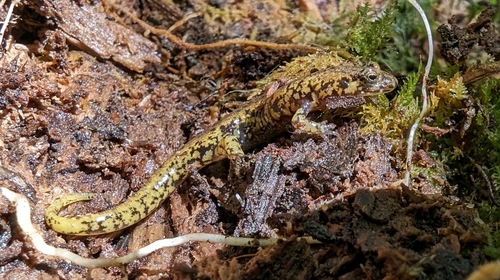
The imitator salamander (Desmognathus imitator) is a species of salamander in the family Plethodontidae. It is endemic to the Appalachian Mountains in the southeastern United States. The imitator salamander is dark brown or blackish, sometimes with a pale intermittent stripe down its back and a pale line joining eye to jaw. It often has red or orange cheek patches and its hind legs are more stocky than its forelegs.

The imitator salamander is found in the Appalachian Mountains in Tennessee and North Carolina at elevations more than 900 m (3,000 ft) above sea level. Its range extends from the Great Smoky Mountains in the north to the Plott Balsams and the Great Balsam Mountains in the south. Its habitat is the banks of streams, wet rocks, and the forest floor at higher altitudes. It shares its range with the Ocoee salamander (Desmognathus ocoee) but is usually found closer to water.

The imitator salamander is not toxic but is thought to be a Batesian mimic of the red-cheeked salamander (Plethodon jordani), a noxious species. Adult imitator salamanders hide during the day and emerge at night to forage for small invertebrates... Wikipedia →

Global Distribution

Parks Where Found

# Park Country Daily sighting probability
1 Great Smoky Mountains National Park 🇺🇸 United States
~40%

More parks will be added in future updates.

Closest Relatives at Great Smoky Mountains National Park

Before you go

What are the chances of seeing an Imitator Salamander in Great Smoky Mountains National Park?

Likely

About 40% of wildlife watchers report an Imitator Salamander sighting in Great Smoky Mountains National Park on a given day, based on 485 verified sightings from GBIF citizen-science data from 2019 to 2026. It is the 5th most-seen of the 36 amphibians we can rate there. Over three days the chance rises to about 80%, and over a week to over 90%, if each day is a fresh chance.

When is the best time to see an Imitator Salamander in Great Smoky Mountains National Park?

May and July

In those months about 50% of wildlife watchers report an Imitator Salamander in Great Smoky Mountains National Park on a given day, against under 5% in December and January, the lowest months.

What time of day is best to see an Imitator Salamander?

Between 10 am and 1 pm

Across all the parks we cover, that three-hour window holds the most Imitator Salamander sightings with a recorded time, and about 8 in 10 of them come between 6 am and 6 pm: it is a daytime animal.

Where else can you see an Imitator Salamander?

Only Great Smoky Mountains National Park, in our data

Great Smoky Mountains National Park is the only park on Wallace's Line with enough records to rate Imitator Salamander sightings: about 40% of wildlife watchers there report one on a given day.

Which relatives of the Imitator Salamander live in Great Smoky Mountains National Park?

Same genus: Desmognathus

The closest relatives of the Imitator Salamander that you can see in Great Smoky Mountains National Park (genus Desmognathus, Dusky Salamanders) are Seal Salamander (about 40%), Pygmy Salamander (about 30%) and Cherokee Mountain Dusky Salamander (about 30%), with each one's daily chance of a sighting.

Where does the Imitator Salamander sighting chance come from?

GBIF citizen-science records

It is estimated from how often the Imitator Salamander is recorded against all the amphibians logged in Great Smoky Mountains National Park (485 verified sightings from 2019 to 2026), calibrated against known sighting rates. Figures are rounded to the nearest 10% because citizen-science data supports honest approximations, not decimals, and months with records from fewer than five people show "—". How it works.

← Back to Great Smoky Mountains National Park