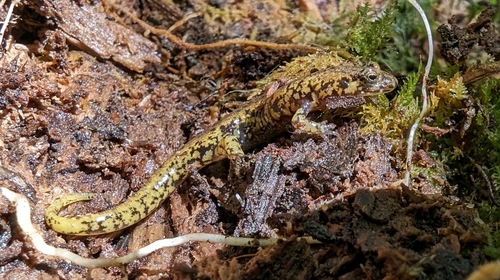
Pygmy Salamander

Pygmy Salamander

Desmognathus wrighti

Silhouette: Beth Reinke · PhyloPic

LCNTNear ThreatenedVUENCR Endemic
Daily sighting probability ~30% · Possible
at Great Smoky Mountains National Park

In 3 days ~70% in a week ~90%

368 Verified sightings at Great Smoky Mountains National Park From 2019 to 2026
368 In 1 park
May Best month
☀️ Diurnal When it's spotted

About the Pygmy Salamander

The pygmy salamander (Desmognathus wrighti) is a species of salamander in the family Plethodontidae. It is endemic to the United States in the southern Appalachians in North Carolina and Tennessee. Desmognathus wrighti is a member of the family Plethodontidae and is commonly known as the pygmy salamander. As the name suggest the pygmy salamander is the smallest of the nineteen species in the genus Desmognathus. D. wrighti undergoes direct development and does not have a free-living larval stage. Only two other taxa in Desmognathus, D. aeneus and D. organi, exhibit direct development along with the pygmy salamander. In the genus Desmognathus, body size, habitat preferences, and patterns used by males during courtship are quite variable. D. wrighti courtship is noted by the male biting and seizing its partner in order to provide them with a chemical stimulus. The pygmy salamander can be found in the southern Appalachians of the United States in western North Carolina and eastern Tennessee. Geographical distribution of the Desmognathus wrighti is fragmented and the highest abundance of the species can be found at high elevations in spruce and fir tree forest.

Desmognathus... Wikipedia →

Global Distribution

Parks Where Found

# Park Country Daily sighting probability
1 Great Smoky Mountains National Park 🇺🇸 United States
~30%

More parks will be added in future updates.

Closest Relatives at Great Smoky Mountains National Park

Before you go

What are the chances of seeing a Pygmy Salamander in Great Smoky Mountains National Park?

Possible

About 30% of wildlife watchers report a Pygmy Salamander sighting in Great Smoky Mountains National Park on a given day, based on 368 verified sightings from GBIF citizen-science data from 2019 to 2026. It is the 9th most-seen of the 36 amphibians we can rate there. Over three days the chance rises to about 70%, and over a week to about 90%, if each day is a fresh chance.

When is the best time to see a Pygmy Salamander in Great Smoky Mountains National Park?

April to June

In those months about 40% of wildlife watchers report a Pygmy Salamander in Great Smoky Mountains National Park on a given day, against under 5% in December and January, the lowest months.

What time of day is best to see a Pygmy Salamander?

Between 1 and 4 pm

Across all the parks we cover, that three-hour window holds the most Pygmy Salamander sightings with a recorded time, and about 9 in 10 of them come between 6 am and 6 pm: it is a daytime animal.

Where else can you see a Pygmy Salamander?

Only Great Smoky Mountains National Park, in our data

Great Smoky Mountains National Park is the only park on Wallace's Line with enough records to rate Pygmy Salamander sightings: about 30% of wildlife watchers there report one on a given day.

Which relatives of the Pygmy Salamander live in Great Smoky Mountains National Park?

Same genus: Desmognathus

The closest relatives of the Pygmy Salamander that you can see in Great Smoky Mountains National Park (genus Desmognathus, Dusky Salamanders) are Seal Salamander (about 40%), Imitator Salamander (about 40%) and Cherokee Mountain Dusky Salamander (about 30%), with each one's daily chance of a sighting.

Where does the Pygmy Salamander sighting chance come from?

GBIF citizen-science records

It is estimated from how often the Pygmy Salamander is recorded against all the amphibians logged in Great Smoky Mountains National Park (368 verified sightings from 2019 to 2026), calibrated against known sighting rates. Figures are rounded to the nearest 10% because citizen-science data supports honest approximations, not decimals, and months with records from fewer than five people show "—". How it works.

← Back to Great Smoky Mountains National Park