Spring Salamander

Spring Salamander

Gyrinophilus porphyriticus

Silhouette: C. Camilo Julián-Caballero · PhyloPic

LCLeast ConcernNTVUENCR
Daily sighting probability ~40% · Likely
at Great Smoky Mountains National Park

In 3 days ~80% in a week >90%

370 Verified sightings at Great Smoky Mountains National Park From 2019 to 2026
431 In all 2 parks
May Best month
☀️🌙 Day & Night When it's spotted

About the Spring Salamander

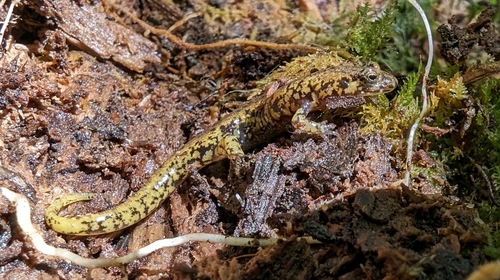
The spring salamander (Gyrinophilus porphyriticus) is a species of salamander in the family Plethodontidae (lungless salamanders). It is found in Canada and the United States. The genus, Gyrinophilus, means "tadpole lover" and refers to the long period of time it spends as a gilled larva before maturing. The specific epithet, porphyriticus, is Latin from Greek, meaning the color of porphyry, a purple stone, and this salamander has also been called the purple salamander.

Its natural habitats are temperate forests, rivers, swamps, freshwater marshes, freshwater springs, inland karsts, and caves. In addition to insects, spiders, mites, millipedes, centipedes, slugs, snails, annelid worms, and other small invertebrates, the fairly large spring salamander may also consume smaller stream dwelling salamanders and their eggs, such as two-lined and dusky salamanders, as well as pygmy, ocoee, Jordan's, southern red-backed, southern Appalachian, and red salamanders. They are also known to be cannibalistic.

They are considered salamander specialists in some areas, such as the mountains of North Carolina, where between 40 and 50% of their adult diets may consist of other salamanders. Although deforestation is a potential threat, the spring salamander occurs in many protected areas and is not listed as threatened in the IUCN Red List. Wikipedia →

Global Distribution

Parks Where Found

# Park Country Daily sighting probability
1 Great Smoky Mountains National Park 🇺🇸 United States
~40%
2 Shenandoah National Park 🇺🇸 United States
~20%

Zoos & Centres Where Found

# Zoo / Centre Country
1 Ralph Perkins II Wildlife Center and Woods Garden 🇺🇸 United States In captivity

Closest Relatives at Great Smoky Mountains National Park

Before you go

What are the chances of seeing a Spring Salamander in Great Smoky Mountains National Park?

Likely

About 40% of wildlife watchers report a Spring Salamander sighting in Great Smoky Mountains National Park on a given day, based on 370 verified sightings from GBIF citizen-science data from 2019 to 2026. It is the 3rd most-seen of the 36 amphibians we can rate there. Over three days the chance rises to about 80%, and over a week to over 90%, if each day is a fresh chance.

When is the best time to see a Spring Salamander in Great Smoky Mountains National Park?

March and May

In those months about 60% of wildlife watchers report a Spring Salamander in Great Smoky Mountains National Park on a given day, against about 30% in August–September and December, the lowest months.

What time of day is best to see a Spring Salamander?

Between 10 am and 1 pm

Across all the parks we cover, that three-hour window holds the most Spring Salamander sightings with a recorded time, and about 7 in 10 of them come between 6 am and 6 pm: it is seen both by day and at night.

Is Great Smoky Mountains National Park the best place to see a Spring Salamander?

Yes

Of the 2 parks where we can rate Spring Salamander sightings, Great Smoky Mountains National Park has the highest daily chance: about 40%. Next come Shenandoah National Park (United States, about 20%).

Which relatives of the Spring Salamander live in Great Smoky Mountains National Park?

Same family: Plethodontidae

The closest relatives of the Spring Salamander that you can see in Great Smoky Mountains National Park (family Plethodontidae, Lungless Salamanders) are Blue Ridge Two-lined Salamander (about 50%), Red-cheeked Salamander (about 50%) and Seal Salamander (about 40%), with each one's daily chance of a sighting.

Where does the Spring Salamander sighting chance come from?

GBIF citizen-science records

It is estimated from how often the Spring Salamander is recorded against all the amphibians logged in Great Smoky Mountains National Park (370 verified sightings from 2019 to 2026), calibrated against known sighting rates. Figures are rounded to the nearest 10% because citizen-science data supports honest approximations, not decimals, and months with records from fewer than five people show "—". How it works.

← Back to Great Smoky Mountains National Park