Four-toed Salamander

Four-toed Salamander

Hemidactylium scutatum

Silhouette: C. Camilo Julián-Caballero · PhyloPic

LCLeast ConcernNTVUENCR
Daily sighting probability <5% · Rare
at Great Smoky Mountains National Park

In 3 days ~10% in a week ~20%

7 Verified sightings at Great Smoky Mountains National Park From 2019 to 2026
43 In all 2 parks
February Best month
☀️ Diurnal When it's spotted

About the Four-toed Salamander

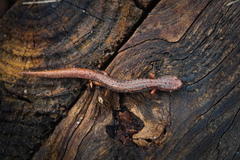
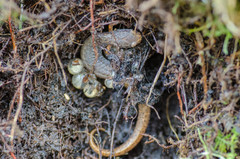
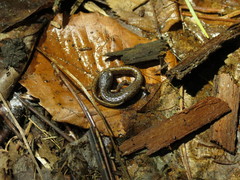
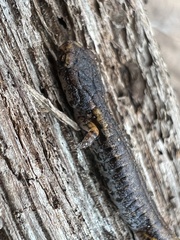
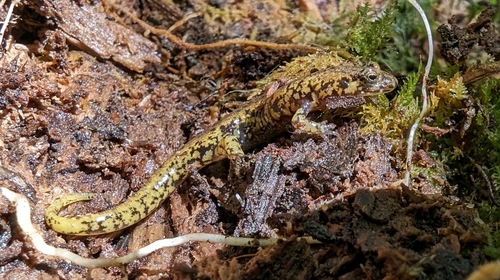
The four-toed salamander (Hemidactylium scutatum) is a lungless salamander native to eastern North America. It is the only species of the monotypic genus Hemidactylium. The four-toed salamander can be recognized by its white underbelly sprinkled with black dots. Its back varies from orange-brownish to red-brownish; its flanks are grayish. The body and the limbs are elongated. The snout is short, and the eyes are prominent. The tail color is usually brighter than the back, and you can observe a constriction at the body/tail junction. The posterior limbs have four toes (hence its name), a good identification criterion but hard to use in the field. This species rarely exceeds 10 cm (3.9 in) in length. In the breeding season (late October to early December) males have enlarged premaxillary teeth and truncated squarish snouts, which are round in females. The juveniles show a tail shorter than the body.

The four-toed salamander can be easily mistaken for the redback salamander (Plethodon cinereus) in the wild. The redback salamander's underbelly has more numerous black markings. Unlike the four-toed salamander, the redback salamander has no constriction at the tail base... Wikipedia →

Global Distribution

Parks Where Found

# Park Country Daily sighting probability
1 Acadia National Park 🇺🇸 United States
~10%
2 Great Smoky Mountains National Park 🇺🇸 United States
<5%

Closest Relatives at Great Smoky Mountains National Park

Before you go

What are the chances of seeing a Four-toed Salamander in Great Smoky Mountains National Park?

Rare

Under 5% of wildlife watchers report a Four-toed Salamander sighting in Great Smoky Mountains National Park on a given day, based on 7 verified sightings from GBIF citizen-science data from 2019 to 2026. It is the 36th most-seen of the 36 amphibians we can rate there. Over three days the chance rises to about 10%, and over a week to about 20%, if each day is a fresh chance.

When is the best time to see a Four-toed Salamander in Great Smoky Mountains National Park?

February and March

In those months about 10% of wildlife watchers report a Four-toed Salamander in Great Smoky Mountains National Park on a given day, against under 5% in April to January, the lowest months.

What time of day is best to see a Four-toed Salamander?

Between 10 am and 1 pm

Across all the parks we cover, that three-hour window holds the most Four-toed Salamander sightings with a recorded time, and about 7 in 10 of them come between 6 am and 6 pm: it is a daytime animal.

Is Great Smoky Mountains National Park the best place to see a Four-toed Salamander?

2nd of 2

Of the 2 parks where we can rate Four-toed Salamander sightings, Great Smoky Mountains National Park ranks 2nd at under 5%. The best odds are in Acadia National Park (United States, about 10%).

Which relatives of the Four-toed Salamander live in Great Smoky Mountains National Park?

Same family: Plethodontidae

The closest relatives of the Four-toed Salamander that you can see in Great Smoky Mountains National Park (family Plethodontidae, Lungless Salamanders) are Blue Ridge Two-lined Salamander (about 50%), Red-cheeked Salamander (about 50%) and Spring Salamander (about 40%), with each one's daily chance of a sighting.

Where does the Four-toed Salamander sighting chance come from?

GBIF citizen-science records

It is estimated from how often the Four-toed Salamander is recorded against all the amphibians logged in Great Smoky Mountains National Park (7 verified sightings from 2019 to 2026), calibrated against known sighting rates. Figures are rounded to the nearest 10% because citizen-science data supports honest approximations, not decimals, and months with records from fewer than five people show "—". How it works.

← Back to Great Smoky Mountains National Park