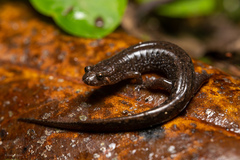
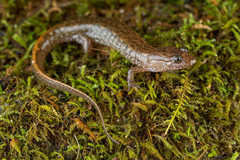
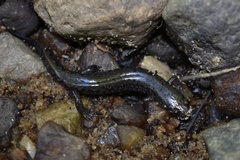
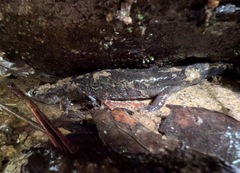
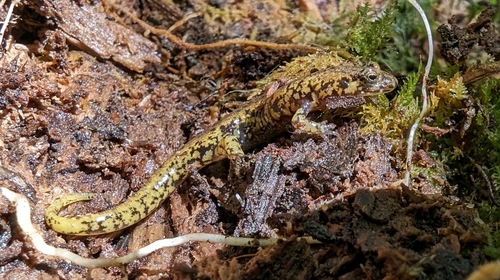
Spotted Dusky Salamander

Spotted Dusky Salamander

Desmognathus conanti

Silhouette: Beth Reinke · PhyloPic

LCLeast ConcernNTVUENCR
Daily sighting probability ~20% · Possible
at Great Smoky Mountains National Park

In 3 days ~40% in a week ~70%

96 Verified sightings at Great Smoky Mountains National Park From 2019 to 2026
96 In 1 park
May Best month
☀️ Diurnal When it's spotted

About the Spotted Dusky Salamander

The spotted dusky salamander (Desmognathus conanti) is a species of salamander in the family Plethodontidae. It is endemic to the United States. Desmognathus conanti was described in 1958 by Douglas A. Rossman, but was later reclassified as a subspecies of the northern dusky salamander (D. fuscus). However, numerous genetic and morphological studies since then have affirmed it as being a distinct species and it was elevated to full specific status in 1996. In addition, genetic studies indicate that D. conanti is paraphyletic with respect to the Santeetlah dusky salamander (D. santeelah), which lies nested within it; thus, D. conanti itself likely represents a species complex of multiple undescribed cryptic species.

Desmognathus conanti has a wide range in the southeastern and south-central United States, ranging from southern Illinois south to the panhandle of Florida, and west to Louisiana and southern Arkansas. They are semiaquatic, typically

inhabit cool, forested seeps or streams/streamsides. Desmognathus conanti is a medium sized salamander, between 35-40 mm in body length at sexual maturity and is moderately stout with... Wikipedia →

Global Distribution

Parks Where Found

# Park Country Daily sighting probability
1 Great Smoky Mountains National Park 🇺🇸 United States
~20%

More parks will be added in future updates.

Zoos & Centres Where Found

# Zoo / Centre Country
1 Georgia Aquarium 🇺🇸 United States In captivity

Closest Relatives at Great Smoky Mountains National Park

Before you go

What are the chances of seeing a Spotted Dusky Salamander in Great Smoky Mountains National Park?

Possible

About 20% of wildlife watchers report a Spotted Dusky Salamander sighting in Great Smoky Mountains National Park on a given day, based on 96 verified sightings from GBIF citizen-science data from 2019 to 2026. It is the 18th most-seen of the 36 amphibians we can rate there. Over three days the chance rises to about 40%, and over a week to about 70%, if each day is a fresh chance.

When is the best time to see a Spotted Dusky Salamander in Great Smoky Mountains National Park?

January and May

In those months about 30% of wildlife watchers report a Spotted Dusky Salamander in Great Smoky Mountains National Park on a given day, against under 5% in November, the lowest month.

What time of day is best to see a Spotted Dusky Salamander?

Between 1 and 4 pm

Across all the parks we cover, that three-hour window holds the most Spotted Dusky Salamander sightings with a recorded time, and about 8 in 10 of them come between 6 am and 6 pm: it is a daytime animal.

Where else can you see a Spotted Dusky Salamander?

Only Great Smoky Mountains National Park, in our data

Great Smoky Mountains National Park is the only park on Wallace's Line with enough records to rate Spotted Dusky Salamander sightings: about 20% of wildlife watchers there report one on a given day.

Which relatives of the Spotted Dusky Salamander live in Great Smoky Mountains National Park?

Same genus: Desmognathus

The closest relatives of the Spotted Dusky Salamander that you can see in Great Smoky Mountains National Park (genus Desmognathus, Dusky Salamanders) are Seal Salamander (about 40%), Imitator Salamander (about 40%) and Pygmy Salamander (about 30%), with each one's daily chance of a sighting.

Where does the Spotted Dusky Salamander sighting chance come from?

GBIF citizen-science records

It is estimated from how often the Spotted Dusky Salamander is recorded against all the amphibians logged in Great Smoky Mountains National Park (96 verified sightings from 2019 to 2026), calibrated against known sighting rates. Figures are rounded to the nearest 10% because citizen-science data supports honest approximations, not decimals, and months with records from fewer than five people show "—". How it works.

← Back to Great Smoky Mountains National Park