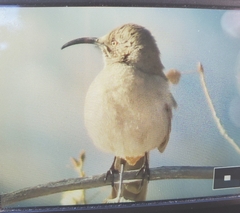
Crissal Thrasher

Crissal Thrasher

Toxostoma crissale

Silhouette: Sheatherius · PhyloPic

LCLeast ConcernNTVUENCR
Daily sighting probability <5% · Rare
at Guadalupe Mountains National Park

In 3 days ~10% in a week ~30%

38 Verified sightings at Guadalupe Mountains National Park From 2019 to 2026
1,087 In all 6 parks
September Best month
☀️ Diurnal When it's spotted

About the Crissal Thrasher

The crissal thrasher (Toxostoma crissale) is a large thrasher found in the Southwestern United States (western Texas, southern New Mexico, southern Arizona, southeastern California, extreme southern Nevada, and extreme southwestern Utah) to central Mexico.

The bird grows to 32 centimetres (13 in), and has a deeply curved bill. The eyes are dull yellow. Bird expert Roger Tory Peterson described its singing as sweeter and less spasmodic than other thrashers. It can be found near desert streams in dense underbrush, mesquite thickets, willows, scrub oak, high elevations in manzanita, and in the low desert near canyon chaparral. The bird seldom flies in the open. As such, the crissal thrasher rarely flies, preferring to walk or run around its territory and will mostly run for cover when disturbed by a potential predator. The bird's name is derived from the characteristic bright coloring, in contrast to the balance of its plumage, of the area between its tail and vent—a region known as the crissum.

In the early years of the study of the birds of western North America, this species was confused with the California thrasher (Toxostoma redivivum), to which it... Wikipedia →

Sounds

Call0:40

United States · 2019

© Richard E. Webster · XC678944 · CC BY-NC-SA 4.0

Song0:39

United States · 2021

© Sue Riffe · XC616593 · CC BY-NC-SA 4.0

Call0:31

United States · 2020

© Bobby Wilcox · XC554780 · CC BY-NC-SA 4.0

Global Distribution

Parks Where Found

# Park Country Daily sighting probability
1 Big Bend National Park 🇺🇸 United States
~20%
2 Death Valley National Park 🇺🇸 United States
~10%
3 Guadalupe Mountains National Park 🇺🇸 United States
<5%
4 Saguaro National Park 🇺🇸 United States
<5%
5 Grand Canyon National Park 🇺🇸 United States
<5%
6 Zion National Park 🇺🇸 United States
<5%

Cities Where Found

# City Country Daily sighting probability
1 Las Vegas 🇺🇸 United States
<5%
2 Phoenix 🇺🇸 United States
<5%
3 Mesa 🇺🇸 United States
<5%

Before you go

What are the chances of seeing a Crissal Thrasher in Guadalupe Mountains National Park?

Rare

Under 5% of wildlife watchers report a Crissal Thrasher sighting in Guadalupe Mountains National Park on a given day, based on 38 verified sightings from GBIF citizen-science data from 2019 to 2026. It is the 84th most-seen of the 141 birds we can rate there. Over three days the chance rises to about 10%, and over a week to about 30%, if each day is a fresh chance.

When is the best time to see a Crissal Thrasher in Guadalupe Mountains National Park?

September

In that month about 20% of wildlife watchers report a Crissal Thrasher in Guadalupe Mountains National Park on a given day, against under 5% in January–August and October, the lowest months. That is one of Guadalupe Mountains National Park's wettest months, with about 40 mm of rain against 10 mm in April.

What time of day is best to see a Crissal Thrasher?

Between 8 and 11 am

Across all the parks we cover, that three-hour window holds the most Crissal Thrasher sightings with a recorded time, and about 9 in 10 of them come between 6 am and 6 pm: it is a daytime animal.

Is Guadalupe Mountains National Park the best place to see a Crissal Thrasher?

3rd of 6

Of the 6 parks where we can rate Crissal Thrasher sightings, Guadalupe Mountains National Park ranks 3rd at under 5%. The best odds are in Big Bend National Park (United States, about 20%) and Death Valley National Park (United States, about 10%).

Where does the Crissal Thrasher sighting chance come from?

GBIF citizen-science records

It is estimated from how often the Crissal Thrasher is recorded against all the birds logged in Guadalupe Mountains National Park (38 verified sightings from 2019 to 2026), calibrated against known sighting rates. Figures are rounded to the nearest 10% because citizen-science data supports honest approximations, not decimals, and months with records from fewer than five people show "—". How it works.

← Back to Guadalupe Mountains National Park