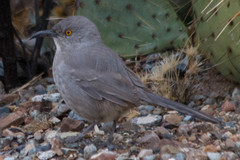
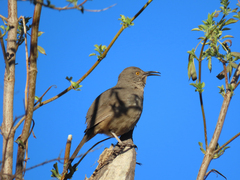
Curve-billed Thrasher

Curve-billed Thrasher

Toxostoma curvirostre

Silhouette: Sheatherius · PhyloPic

LCLeast ConcernNTVUENCR
Daily sighting probability ~10% · With luck
at Guadalupe Mountains National Park

In 3 days ~20% in a week ~50%

86 Verified sightings at Guadalupe Mountains National Park From 2019 to 2026
9,348 In all 5 parks
December Best month
☀️ Diurnal When it's spotted

About the Curve-billed Thrasher

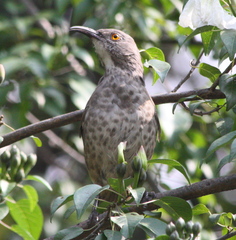
The curve-billed thrasher (Toxostoma curvirostre) is a medium-sized mimid native to most of Mexico and to the deserts of southwestern United States. It is a non-migratory species, and throughout most of its range it is the most common desert thrasher. Several subspecies have been classified since 1827, though there is no consensus on the number. Allopatric speciation is believed to have played a major role in the variations of the curve-billed. It is grey-brown overall with a slightly curved bill, and is similar in appearance to the related Bendire's thrasher. It generally resides in desert regions of the United States and Mexico, but can inhabit areas predominately populated by humans.

The demeanor of the curve-billed has been described as "shy and rather wild", but it allows humans to view it closely. It is very aggressive in driving out potential threats, whether competitors for food or predators of its chicks. The curve-billed thrasher sometimes mimics several other species, though not to the extent of other mimics. It has a variety of distinctive songs, and this extensive repertoire of melodies has led it to be known as cuicacoche (songbird) in Mexico. Wikipedia →

Sounds

Call0:19

United States · 2017

© Pat Goltz · XC1153772 · CC BY-NC-SA 4.0

Song0:20

Mexico · 2026

© Jules Evens · XC1091249 · CC BY-NC-SA 4.0

Dawn song0:09

United States · 2025

© David Tattersley · XC1000090 · CC BY-NC-SA 4.0

Global Distribution

Parks Where Found

# Park Country Daily sighting probability
1 Saguaro National Park 🇺🇸 United States
~70%
2 Reserva de la Biosfera Mariposa Monarca 🇲🇽 Mexico
~20%
3 Big Bend National Park 🇺🇸 United States
~20%
4 Cumbres de Monterrey National Park 🇲🇽 Mexico
~10%
5 Guadalupe Mountains National Park 🇺🇸 United States
~10%

Cities Where Found

# City Country Daily sighting probability
1 Phoenix 🇺🇸 United States
~80%
2 Mesa 🇺🇸 United States
~80%
3 Mexico City 🇲🇽 México
~50%
4 Puebla 🇲🇽 México
~50%
5 Guadalajara 🇲🇽 México
~40%
6 León 🇲🇽 México
~30%
7 Toluca 🇲🇽 México
~20%
8 San Luis Potosí 🇲🇽 México
~10%
9 San Antonio 🇺🇸 United States
<5%
10 Monterrey 🇲🇽 México
<5%

Before you go

What are the chances of seeing a Curve-billed Thrasher in Guadalupe Mountains National Park?

With luck

About 10% of wildlife watchers report a Curve-billed Thrasher sighting in Guadalupe Mountains National Park on a given day, based on 86 verified sightings from GBIF citizen-science data from 2019 to 2026. It is the 70th most-seen of the 141 birds we can rate there. Over three days the chance rises to about 20%, and over a week to about 50%, if each day is a fresh chance.

When is the best time to see a Curve-billed Thrasher in Guadalupe Mountains National Park?

December

In that month about 30% of wildlife watchers report a Curve-billed Thrasher in Guadalupe Mountains National Park on a given day, against under 5% in April to September, the lowest months.

What time of day is best to see a Curve-billed Thrasher?

Between 7 and 10 am

Across all the parks we cover, that three-hour window holds the most Curve-billed Thrasher sightings with a recorded time, and about 9 in 10 of them come between 6 am and 6 pm: it is a daytime animal.

Where does the Curve-billed Thrasher sighting chance come from?

GBIF citizen-science records

It is estimated from how often the Curve-billed Thrasher is recorded against all the birds logged in Guadalupe Mountains National Park (86 verified sightings from 2019 to 2026), calibrated against known sighting rates. Figures are rounded to the nearest 10% because citizen-science data supports honest approximations, not decimals, and months with records from fewer than five people show "—". How it works.

← Back to Guadalupe Mountains National Park