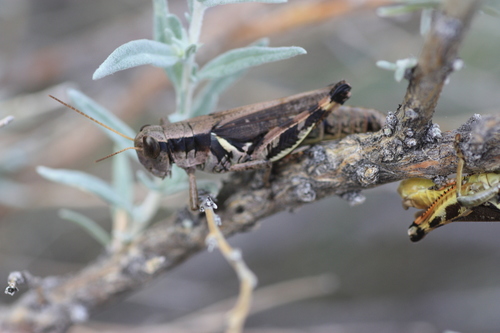
Northern Walkingstick

Northern Walkingstick

Diapheromera femorata

Daily sighting probability ~10% · With luck
at Guadalupe Mountains National Park

In 3 days ~30% in a week ~60%

5 Verified sightings at Guadalupe Mountains National Park From 2019 to 2026
127 In all 4 parks
September Best month
☀️ Diurnal When it's spotted

About the Northern Walkingstick

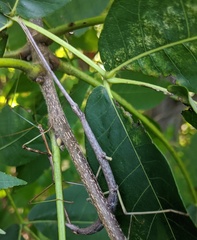
The common walkingstick or northern walkingstick (Diapheromera femorata) is a species of phasmid or stick insect found across North America. The average length of this species is 75 millimetres (3.0 inches) for males and 95 mm (3.7 in) for females.

The insect is found in deciduous forest throughout North America, where it eats many types of plant foliage. Even though the common walkingstick is a generalist it does tend to prefer foliage from oak and hazelnut trees. Localised clusters of these insects sometimes occur; however, the insects have no wings, and dispersal from tree to tree is limited.

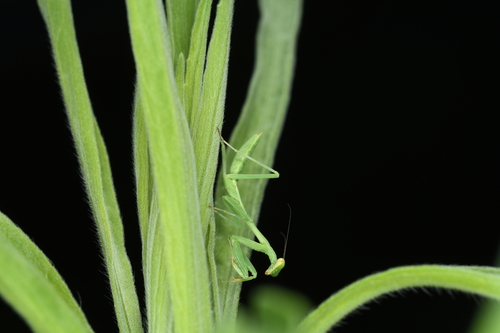
The common walkingstick is a slender, elongated insect that camouflages itself by resembling a twig. The sexes differ, with the male usually being brown and about 75 mm (3 in) in length while the female is greenish-brown, and rather larger at 95 mm (3.7 in). There are three pairs of legs, but at rest, the front pair is extended forward beside the antennae, forming an extension of the twig-like effect. Neither sex has wings, the antennae are two-thirds of the length of the body, and each of the cerci (paired appendages at the tip of the abdomen) has a single segment.

��2�... Wikipedia →

Global Distribution

Parks Where Found

# Park Country Daily sighting probability
1 Point Pelee National Park 🇨🇦 Canada
~20%
2 Shenandoah National Park 🇺🇸 United States
~10%
3 Guadalupe Mountains National Park 🇺🇸 United States
~10%
4 Great Smoky Mountains National Park 🇺🇸 United States
~10%

Cities Where Found

# City Country Daily sighting probability
1 Detroit 🇺🇸 United States
~10%
2 Toronto 🇨🇦 Canada
<5%
3 Washington 🇺🇸 United States
<5%
4 Baltimore 🇺🇸 United States
<5%
5 Montreal 🇨🇦 Canada
<5%
6 Boston 🇺🇸 United States
<5%
7 Chicago 🇺🇸 United States
<5%
8 Austin 🇺🇸 United States
<5%

Before you go

What are the chances of seeing a Northern Walkingstick in Guadalupe Mountains National Park?

With luck

About 10% of wildlife watchers report a Northern Walkingstick sighting in Guadalupe Mountains National Park on a given day, based on 5 verified sightings from GBIF citizen-science data from 2019 to 2026. It is the 49th most-seen of the 57 insects we can rate there. Over three days the chance rises to about 30%, and over a week to about 60%, if each day is a fresh chance.

When is the best time to see a Northern Walkingstick in Guadalupe Mountains National Park?

September

In that month about 30% of wildlife watchers report a Northern Walkingstick in Guadalupe Mountains National Park on a given day, against under 5% in December to July, the lowest months. That is one of Guadalupe Mountains National Park's wettest months, with about 40 mm of rain against 10 mm in April.

What time of day is best to see a Northern Walkingstick?

Between 10 am and 1 pm

Across all the parks we cover, that three-hour window holds the most Northern Walkingstick sightings with a recorded time, and about 8 in 10 of them come between 6 am and 6 pm: it is a daytime animal.

Is Guadalupe Mountains National Park the best place to see a Northern Walkingstick?

3rd of 4

Of the 4 parks where we can rate Northern Walkingstick sightings, Guadalupe Mountains National Park ranks 3rd at about 10%. The best odds are in Point Pelee National Park (Canada, about 20%) and Shenandoah National Park (United States, about 10%).

Where does the Northern Walkingstick sighting chance come from?

GBIF citizen-science records

It is estimated from how often the Northern Walkingstick is recorded against all the insects logged in Guadalupe Mountains National Park (5 verified sightings from 2019 to 2026), calibrated against known sighting rates. Figures are rounded to the nearest 10% because citizen-science data supports honest approximations, not decimals, and months with records from fewer than five people show "—". How it works.

← Back to Guadalupe Mountains National Park