Silvered Leaf Monkey

Silvered Leaf Monkey

Trachypithecus cristatus

Silhouette: Andy Wilson · PhyloPic

LCNTVUVulnerableENCR
Daily sighting probability ~30% · Possible
at Gunung Leuser National Park

In 3 days ~70% in a week ~90%

40 Verified sightings at Gunung Leuser National Park From 2019 to 2026
718 In all 5 parks
September Best month
🌅 Crepuscular When it's spotted

About the Silvered Leaf Monkey

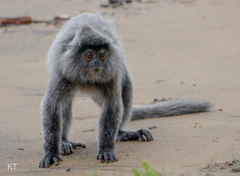
The silvery lutung (Trachypithecus cristatus), also known as the silvered leaf monkey or the silvery langur, is an Old World monkey. It is arboreal, living in coastal, mangrove, and riverine forests in Sumatra, Borneo, Java, as well as in parts of the southwestern Malay Peninsula, the Natuna Islands, and other nearby islands. It is the type species of its species group.

The silvery lutung is a medium-sized monkey with a long, non-prehensile tail. It has grey-tipped, dark brown or black fur, giving it a uniform silvery appearance. Unlike some related species, there are no paler markings on the face or body, except for a patch of whitish hair on the groin of females. A crest of fur runs along the top of the head, and the hair on the cheeks is long, often obscuring the ears. The hands and feet are hairless, with dark-coloured skin, and have opposable thumbs and toes.

Females range from 46 to 51 centimetres (18 to 20 in) in head-body length, with an average weight of 5.7 kilograms (13 lb) and a tail length of 67 to 75 centimetres (26 to 30 in). Males are slightly larger, from 50 to 58 centimetres (20 to 23 in) in length, with an average weight of 6.6 kilograms (15 lb... Wikipedia →

Sounds

Recording0:19

Malaysia · 2026

© Dixon Lau · iNaturalist · CC BY-NC 4.0

Global Distribution

Parks Where Found

# Park Country Daily sighting probability
1 Bako National Park 🇲🇾 Malaysia
~80%
2 Kinabatangan Wildlife Sanctuary 🇲🇾 Malaysia
~60%
3 Tanjung Puting National Park 🇮🇩 Indonesia
~40%
4 Gunung Leuser National Park 🇮🇩 Indonesia
~30%
5 Sepilok 🇲🇾 Malaysia
~20%

Zoos & Centres Where Found

# Zoo / Centre Country
1 San Diego Zoo 🇺🇸 United States In captivity
2 Columbus Zoo and Aquarium 🇺🇸 United States In captivity
3 Bronx Zoo 🇺🇸 United States In captivity
4 Zoo Knoxville 🇺🇸 United States In captivity
5 Saigon Zoo and Botanical Gardens 🇻🇳 Vietnam In captivity
6 Bandung Zoo 🇮🇩 Indonesia In captivity
7 Kung Fu Corals 🇺🇸 United States In captivity

Before you go

What are the chances of seeing a Silvered Leaf Monkey in Gunung Leuser National Park?

Possible

About 30% of wildlife watchers report a Silvered Leaf Monkey sighting in Gunung Leuser National Park on a given day, based on 40 verified sightings from GBIF citizen-science data from 2019 to 2026. It is the 6th most-seen of the 19 mammals we can rate there. Over three days the chance rises to about 70%, and over a week to about 90%, if each day is a fresh chance.

When is the best time to see a Silvered Leaf Monkey in Gunung Leuser National Park?

September

In that month about 60% of wildlife watchers report a Silvered Leaf Monkey in Gunung Leuser National Park on a given day, against under 5% in August, the lowest month. That is one of Gunung Leuser National Park's wettest months, with about 700 mm of rain against 150 mm in February.

What time of day is best to see a Silvered Leaf Monkey?

Between 10 am and 1 pm

Across all the parks we cover, that three-hour window holds the most Silvered Leaf Monkey sightings with a recorded time, and about 6 in 10 of them come between 6 am and 6 pm: it is most active around dawn and dusk.

Which relatives of the Silvered Leaf Monkey live in Gunung Leuser National Park?

Same family: Cercopithecidae

The closest relatives of the Silvered Leaf Monkey that you can see in Gunung Leuser National Park (family Cercopithecidae, Old World Monkeys) are Thomas’s Langur (about 80%), Crab-eating Macaque (about 70%) and Southern Pig-tailed Macaque (about 60%), with each one's daily chance of a sighting.

Where does the Silvered Leaf Monkey sighting chance come from?

GBIF citizen-science records

It is estimated from how often the Silvered Leaf Monkey is recorded against all the mammals logged in Gunung Leuser National Park (40 verified sightings from 2019 to 2026), calibrated against known sighting rates. Figures are rounded to the nearest 10% because citizen-science data supports honest approximations, not decimals, and months with records from fewer than five people show "—". How it works.

← Back to Gunung Leuser National Park