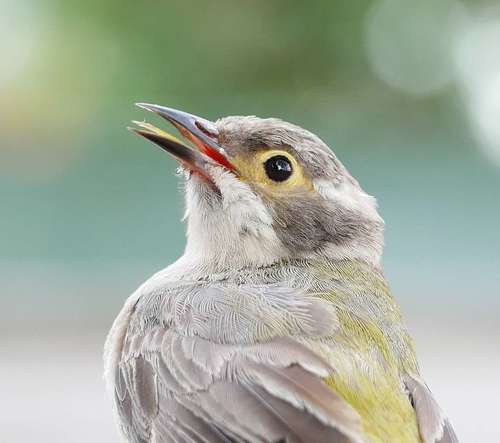
Black Honeyeater

Black Honeyeater

Sugomel niger

LCLeast ConcernNTVUENCR Endemic
Daily sighting probability ~10% · With luck
at Hattah-Kulkyne National Park

In 3 days ~20% in a week ~40%

100 Verified sightings at Hattah-Kulkyne National Park From 2019 to 2026
113 In all 2 parks
December Best month
☀️ Diurnal When it's spotted

About the Black Honeyeater

The black honeyeater (Sugomel nigrum) is a species of bird in the honeyeater family Meliphagidae and the sole species in the genus Sugomel. The black honeyeater exhibits sexual dimorphism, with the male being black and white while the female is a speckled grey-brown; immature birds look like the female. The species is endemic to Australia, and ranges widely across the arid areas of the continent, through open woodland and shrubland, particularly in areas where the emu bush and related species occur.

A nectar feeder, the black honeyeater has a long curved bill to reach the base of tubular flowers such as those of the emu bush. It also takes insects in the air, and regularly eats ash left behind at campfires. Cup-shaped nests are built in the forks of small trees or shrubs. The male engages in a soaring song flight in the mating season, but contributes little to nest-building or incubating the clutch of two or three eggs. Both sexes feed and care for the young. While the population appears to be decreasing, the black honeyeater is sufficiently numerous and widespread and hence is considered to be of least concern on the International Union for Conservation of Nature (IUCN)'s Red List of Endangered species. Wikipedia →

Sounds

Recording0:31

Australia · 2024

© OzGadabout · iNaturalist · CC BY-NC 4.0

Recording0:05

Australia · 2025

© JFM · iNaturalist · CC BY-NC 4.0

Recording0:10

Australia · 2023

© Tom Hunt · iNaturalist · CC BY-NC 4.0

Global Distribution

Parks Where Found

# Park Country Daily sighting probability
1 Hattah-Kulkyne National Park 🇦🇺 Australia
~10%
2 Uluru-Kata Tjuta National Park 🇦🇺 Australia
<5%

Before you go

What are the chances of seeing a Black Honeyeater in Hattah-Kulkyne National Park?

With luck

About 10% of wildlife watchers report a Black Honeyeater sighting in Hattah-Kulkyne National Park on a given day, based on 100 verified sightings from GBIF citizen-science data from 2019 to 2026. It is the 98th most-seen of the 170 birds we can rate there. Over three days the chance rises to about 20%, and over a week to about 40%, if each day is a fresh chance.

When is the best time to see a Black Honeyeater in Hattah-Kulkyne National Park?

December

In that month about 20% of wildlife watchers report a Black Honeyeater in Hattah-Kulkyne National Park on a given day, against under 5% in March–August and November, the lowest months.

What time of day is best to see a Black Honeyeater?

Between 8 and 11 am

Across all the parks we cover, that three-hour window holds the most Black Honeyeater sightings with a recorded time, and about 9 in 10 of them come between 6 am and 6 pm: it is a daytime animal.

Is Hattah-Kulkyne National Park the best place to see a Black Honeyeater?

Yes

Of the 2 parks where we can rate Black Honeyeater sightings, Hattah-Kulkyne National Park has the highest daily chance: about 10%. Next come Uluru-Kata Tjuta National Park (Australia, under 5%).

Which relatives of the Black Honeyeater live in Hattah-Kulkyne National Park?

Same family: Meliphagidae

The closest relatives of the Black Honeyeater that you can see in Hattah-Kulkyne National Park (family Meliphagidae, Honeyeaters) are Yellow-plumed Honeyeater (about 70%), Noisy Miner (about 60%) and Spiny-cheeked Honeyeater (about 60%), with each one's daily chance of a sighting.

Where does the Black Honeyeater sighting chance come from?

GBIF citizen-science records

It is estimated from how often the Black Honeyeater is recorded against all the birds logged in Hattah-Kulkyne National Park (100 verified sightings from 2019 to 2026), calibrated against known sighting rates. Figures are rounded to the nearest 10% because citizen-science data supports honest approximations, not decimals, and months with records from fewer than five people show "—". How it works.

← Back to Hattah-Kulkyne National Park