White-eared Honeyeater

White-eared Honeyeater

Nesoptilotis leucotis

Silhouette: Rachael Joakim · PhyloPic

LCLeast ConcernNTVUENCR Endemic
Daily sighting probability ~30% · Possible
at Hattah-Kulkyne National Park

In 3 days ~60% in a week ~90%

372 Verified sightings at Hattah-Kulkyne National Park From 2019 to 2026
3,171 In all 9 parks
July Best month
☀️ Diurnal When it's spotted

About the White-eared Honeyeater

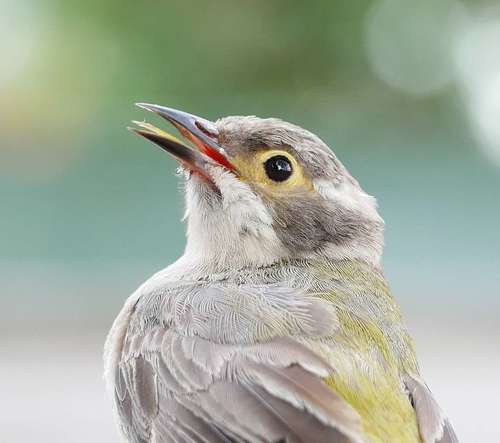
The white-eared honeyeater (Nesoptilotis leucotis) is a medium-sized honeyeater found in Australia. It is a member of the family Meliphagidae (honeyeaters and Australian chats) which has 190 recognised species with about half of them found in Australia. This makes them members of the most diverse family of birds in Australia. White-eared honeyeaters are easily identifiable by their olive-green body, black head and white ear-patch.

The white-eared honeyeater was first described by English ornithologist John Latham in 1801 as Turdus leucotis. It has been reclassified several times and was previously named Lichenostomus leucotis and Ptilotis leucotis torringtoni.

The white-eared honeyeater was previously placed in the genus Lichenostomus, but it was moved to Nesoptilotis after a molecular phylogenetic analysis, published in 2011, showed that the original genus was polyphyletic. It is a sister taxon to the yellow-throated honeyeater (N. flavicollis) that occurs in Tasmania, and they belong to a clade that contains the genera Entomyzon, Melithreptus, and Foulehaio.

There are two recognised subspecies: the nominate subspecies Nesoptilotis leucotis leucotis is found from eastern... Wikipedia →

Sounds

Call0:47

Australia · 2023

© Romuald Mikusek · XC1062617 · CC BY-NC-SA 4.0

Alarm call0:48

Australia · 2024

© Khristos Nizamis · XC917143 · CC BY-NC-ND 4.0

Song0:07

Australia · 2023

© Peter Boesman · XC859975 · CC BY-NC-ND 4.0

Global Distribution

Parks Where Found

# Park Country Daily sighting probability
1 Great Otway National Park 🇦🇺 Australia
~40%
2 Flinders Chase 🇦🇺 Australia
~40%
3 Kosciuszko National Park 🇦🇺 Australia
~30%
4 Grampians National Park 🇦🇺 Australia
~30%
5 Hattah-Kulkyne National Park 🇦🇺 Australia
~30%
6 Flinders Ranges National Park 🇦🇺 Australia
~20%
7 Blue Mountains National Park 🇦🇺 Australia
~10%
8 Wilsons Promontory National Park 🇦🇺 Australia
<5%
9 Royal National Park 🇦🇺 Australia
<5%

Cities Where Found

# City Country Daily sighting probability
1 Melbourne 🇦🇺 Australia
<5%
2 Sydney 🇦🇺 Australia
<5%

Before you go

What are the chances of seeing a White-eared Honeyeater in Hattah-Kulkyne National Park?

Possible

About 30% of wildlife watchers report a White-eared Honeyeater sighting in Hattah-Kulkyne National Park on a given day, based on 372 verified sightings from GBIF citizen-science data from 2019 to 2026. It is the 51st most-seen of the 170 birds we can rate there. Over three days the chance rises to about 60%, and over a week to about 90%, if each day is a fresh chance.

When is the best time to see a White-eared Honeyeater in Hattah-Kulkyne National Park?

July

In that month about 50% of wildlife watchers report a White-eared Honeyeater in Hattah-Kulkyne National Park on a given day, against about 10% in January and September, the lowest months.

What time of day is best to see a White-eared Honeyeater?

Between 1 and 4 pm

Across all the parks we cover, that three-hour window holds the most White-eared Honeyeater sightings with a recorded time, and nearly all of them come between 6 am and 6 pm: it is a daytime animal.

Which relatives of the White-eared Honeyeater live in Hattah-Kulkyne National Park?

Same family: Meliphagidae

The closest relatives of the White-eared Honeyeater that you can see in Hattah-Kulkyne National Park (family Meliphagidae, Honeyeaters) are Yellow-plumed Honeyeater (about 70%), Noisy Miner (about 60%) and Spiny-cheeked Honeyeater (about 60%), with each one's daily chance of a sighting.

Where does the White-eared Honeyeater sighting chance come from?

GBIF citizen-science records

It is estimated from how often the White-eared Honeyeater is recorded against all the birds logged in Hattah-Kulkyne National Park (372 verified sightings from 2019 to 2026), calibrated against known sighting rates. Figures are rounded to the nearest 10% because citizen-science data supports honest approximations, not decimals, and months with records from fewer than five people show "—". How it works.

← Back to Hattah-Kulkyne National Park