Spotted Grass Frog

Spotted Grass Frog

Limnodynastes tasmaniensis

Silhouette: Jose Carlos Arenas-Monroy · PhyloPic

LCLeast ConcernNTVUENCR Endemic
Daily sighting probability ~30% · Possible
at Hattah-Kulkyne National Park

In 3 days ~70% in a week ~90%

18 Verified sightings at Hattah-Kulkyne National Park From 2019 to 2026
54 In all 5 parks
July Best month
☀️🌙 Day & Night When it's spotted

About the Spotted Grass Frog

The spotted grass frog or spotted marsh frog (Limnodynastes tasmaniensis) is a terrestrial frog native to Australia. It is distributed throughout all of New South Wales and Victoria, eastern South Australia, the majority of Queensland, and eastern Tasmania. It is also naturalised in Western Australia, having been unintentionally introduced at Kununurra in the 1970s, apparently during the relocation of several hundred transportable homes from Adelaide.

The spotted grass frog was also formerly known as the "Marbled frog" in South Australia, although this common name is also used for Limnodynastes convexiusculus, a species of ground-dwelling frog native to northern and north-eastern Australia, and southern New Guinea.

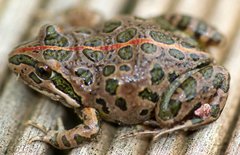
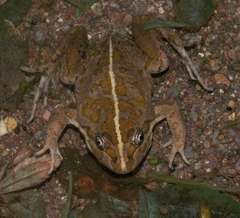
This frog reaches 45 mm (1.8 in) in length. Its colour ranges from light brown to olive-green, with large, irregular shaped, green or brown spots on its back. Occasionally it will have a thin, pale cream, yellow or bright orange stripe running from snout to vent. There is a raised pale stripe running from below the eye to the base of the arm. The arms and legs are spotted like the back, and the belly is white.

This frog is common... Wikipedia →

Sounds

Uncertain1:03

Australia · 2026

© Khristos Nizamis · XC1178181 · CC BY-NC-ND 4.0

Advertisement call0:59

Australia · 2013

© Marc Anderson · XC883179 · CC BY-NC-ND 4.0

Uncertain0:32

Australia · 2023

© Nick Talbot · XC901712 · CC BY-NC-SA 4.0

Global Distribution

Parks Where Found

# Park Country Daily sighting probability
1 Hattah-Kulkyne National Park 🇦🇺 Australia
~30%
2 Flinders Ranges National Park 🇦🇺 Australia
~30%
3 Flinders Chase 🇦🇺 Australia
~20%
4 Grampians National Park 🇦🇺 Australia
~10%
5 Kosciuszko National Park 🇦🇺 Australia
~10%

Cities Where Found

# City Country Daily sighting probability
1 Melbourne 🇦🇺 Australia
~10%

Zoos & Centres Where Found

# Zoo / Centre Country
1 Cleland Wildlife Park 🇦🇺 Australia In captivity

Before you go

What are the chances of seeing a Spotted Grass Frog in Hattah-Kulkyne National Park?

Possible

About 30% of wildlife watchers report a Spotted Grass Frog sighting in Hattah-Kulkyne National Park on a given day, based on 18 verified sightings from GBIF citizen-science data from 2019 to 2026. Over three days the chance rises to about 70%, and over a week to about 90%, if each day is a fresh chance.

When is the best time to see a Spotted Grass Frog in Hattah-Kulkyne National Park?

July

In that month about 50% of wildlife watchers report a Spotted Grass Frog in Hattah-Kulkyne National Park on a given day, against under 5% in March and December–January, the lowest months.

What time of day is best to see a Spotted Grass Frog?

Between noon and 3 pm

Across all the parks we cover, that three-hour window holds the most Spotted Grass Frog sightings with a recorded time, and about 6 in 10 of them come between 6 am and 6 pm: it is seen both by day and at night.

Is Hattah-Kulkyne National Park the best place to see a Spotted Grass Frog?

Yes

Of the 5 parks where we can rate Spotted Grass Frog sightings, Hattah-Kulkyne National Park has the highest daily chance: about 30%. Next come Flinders Ranges National Park (Australia, about 30%) and Flinders Chase (Australia, about 20%).

Where does the Spotted Grass Frog sighting chance come from?

GBIF citizen-science records

It is estimated from how often the Spotted Grass Frog is recorded against all the amphibians logged in Hattah-Kulkyne National Park (18 verified sightings from 2019 to 2026), calibrated against known sighting rates. Figures are rounded to the nearest 10% because citizen-science data supports honest approximations, not decimals, and months with records from fewer than five people show "—". How it works.

← Back to Hattah-Kulkyne National Park