


Completed



Black Rhinoceros
Diceros bicornis
Silhouette: Steven Traver · PhyloPic
- KingdomAnimalia (Animals)
- PhylumChordata (Chordates)
- ClassMammalia (Mammals)
- OrderPerissodactyla (Odd-toed Ungulates)
- FamilyRhinocerotidae (Rhinoceroses)
- GenusDiceros (Narrow-lipped Rhinoceroses)
- SpeciesDiceros bicornis (Black Rhinoceros)
In 3 days ~20% in a week ~40%
9 Verified sightings at Hluhluwe-Imfolozi Park From 2019 to 2026
923 In all 14 parks
August Best month
☀️ Diurnal When it's spotted
About the Black Rhinoceros
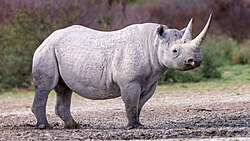
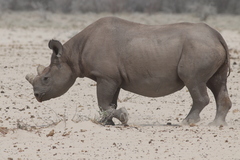
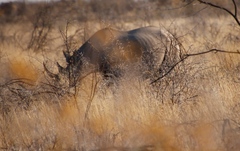
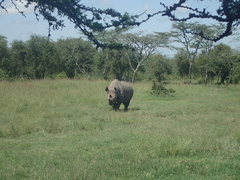
The black rhinoceros (Diceros bicornis), also called the black rhino or the hooked-lip rhinoceros, is a species of rhinoceros native to East and Southern Africa, including Angola, Botswana, Eswatini, Kenya, Lesotho, Malawi, Mozambique, Namibia, South Africa, Tanzania, Zambia, and Zimbabwe. Although the species is referred to as black, its colours vary from brown to grey. It is the only extant species of the genus Diceros.
The other rhinoceros native to Africa is the white rhinoceros (Ceratotherium simum). The word "white" in the name "white rhinoceros" is often said to be a misinterpretation of the Afrikaans word wyd (Dutch wijd) meaning wide, referring to its square upper lip, as opposed to the pointed or hooked lip of the black rhinoceros. These species are now sometimes referred to as the square-lipped (for white) or hook-lipped (for black) rhinoceros.
The species overall is classified as critically endangered (even though the south-western black rhinoceros is classified as near threatened) and is threatened by multiple factors including poaching and habitat reduction. Three subspecies have been declared extinct, including the western black rhinoceros, which was declared extinct by the International Union for Conservation of Nature (IUCN) in 2011. The IUCN estimates that 3,142 mature individuals remain in the wild. Wikipedia →
Recent sightings of Black Rhinoceros in Hluhluwe-Imfolozi Park
LIVEiNaturalistGlobal Distribution
Parks Where Found
| # | Park | Country | Daily sighting probability |
|---|---|---|---|
| 1 | Etosha National Park | 🇳🇦 Namibia | |
| 2 | Ngorongoro Conservation Area | 🇹🇿 Tanzania | |
| 3 | Lake Nakuru National Park | 🇰🇪 Kenya | |
| 4 | Nairobi National Park | 🇰🇪 Kenya | |
| 5 | Mkomazi National Park | 🇹🇿 Tanzania | |
| 6 | Tsavo West National Park | 🇰🇪 Kenya | |
| 7 | Liwonde National Park | 🇲🇼 Malawi | |
| 8 | Masai Mara National Reserve | 🇰🇪 Kenya | |
| 9 | Serengeti National Park | 🇹🇿 Tanzania | |
| 10 | Pilanesberg National Park | 🇿🇦 South Africa | |
| 11 | uMkhuze Game Reserve | 🇿🇦 South Africa | |
| 12 | Hluhluwe-Imfolozi Park | 🇿🇦 South Africa | |
| 13 | Kruger National Park | 🇿🇦 South Africa | |
| 14 | Addo Elephant National Park | 🇿🇦 South Africa |
Zoos & Centres Where Found
| # | Zoo / Centre | Country | |
|---|---|---|---|
| 1 | Disney's Animal Kingdom | 🇺🇸 United States | |
| 2 | Busch Gardens Tampa | 🇺🇸 United States | |
| 3 | Shedd Aquarium | 🇺🇸 United States | |
| 4 | Denver Zoo | 🇺🇸 United States | |
| 5 | Cleveland Metroparks Zoo | 🇺🇸 United States | |
| 6 | Cincinnati Zoo and Botanical Garden | 🇺🇸 United States | |
| 7 | California Academy of Sciences | 🇺🇸 United States | |
| 8 | Zoo de Doué | 🇫🇷 France | |
| 9 | Monarto Zoo | 🇦🇺 Australia | |
| 10 | Taronga Western Plains Zoo | 🇦🇺 Australia | |
| 11 | Zoo Miami | 🇺🇸 United States | |
| 12 | San Diego Zoo Safari Park | 🇺🇸 United States | |
| 13 | Living Desert Zoo and Gardens | 🇺🇸 United States | |
| 14 | Port Lympne Wild Animal Park | 🇬🇧 United Kingdom | |
| 15 | Columbus Zoo and Aquarium | 🇺🇸 United States | |
| 16 | Kansas City Zoo | 🇺🇸 United States | |
| 17 | Tallinn Zoo | 🇪🇪 Estonia | |
| 18 | Brookfield Zoo | 🇺🇸 United States | |
| 19 | Chester Zoo | 🇬🇧 United Kingdom | |
| 20 | Milwaukee County Zoo | 🇺🇸 United States | |
| 21 | Ree Park – Ebeltoft Safari | 🇩🇰 Denmark | |
| 22 | Yorkshire Wildlife Park | 🇬🇧 United Kingdom | |
| 23 | Cheyenne Mountain Zoo | 🇺🇸 United States | |
| 24 | Flamingo Land Resort | 🇬🇧 United Kingdom | |
| 25 | Folly Farm Adventure Park and Zoo | 🇬🇧 United Kingdom | |
| 26 | Wildpark Leipzig | 🇩🇪 Germany | |
| 27 | Africam Safari | 🇲🇽 Mexico | |
| 28 | Howletts Wild Animal Park | 🇬🇧 United Kingdom | |
| 29 | Saint Louis Zoo | 🇺🇸 United States | |
| 30 | San Francisco Zoo | 🇺🇸 United States | |
| 31 | Diergaarde Blijdorp | 🇳🇱 Netherlands | |
| 32 | Tanganyika Wildlife Park | 🇺🇸 United States | |
| 33 | Twycross Zoo | 🇬🇧 United Kingdom | |
| 34 | Zoologischer Garten Leipzig | 🇩🇪 Germany | |
| 35 | ZooTampa | 🇺🇸 United States | |
| 36 | Fort Worth Zoo | 🇺🇸 United States | |
| 37 | Gatorland | 🇺🇸 United States | |
| 38 | Oregon Zoo | 🇺🇸 United States | |
| 39 | Zoo du Bassin d'Arcachon | 🇫🇷 France | |
| 40 | Great Plains Zoo | 🇺🇸 United States | |
| 41 | Hanover Zoo | 🇩🇪 Germany | |
| 42 | Potter Park Zoo | 🇺🇸 United States | |
| 43 | Zoologischer Garten Magdeburg | 🇩🇪 Germany | |
| 44 | Honolulu Zoo | 🇺🇸 United States | |
| 45 | Ueno Zoo | 🇯🇵 Japan | |
| 46 | El Paso Zoo | 🇺🇸 United States | |
| 47 | Pittsburgh Zoo & Aquarium | 🇺🇸 United States | |
| 48 | Lincoln Park Zoo | 🇺🇸 United States | |
| 49 | Little Rock Zoo | 🇺🇸 United States | |
| 50 | Plaswijckpark | 🇳🇱 Netherlands |
Closest Relatives at Hluhluwe-Imfolozi Park





Before you go
What are the chances of seeing a Black Rhinoceros in Hluhluwe-Imfolozi Park?
With luck
About 10% of wildlife watchers report a Black Rhinoceros sighting in Hluhluwe-Imfolozi Park on a given day, based on 9 verified sightings from GBIF citizen-science data from 2019 to 2026. It is the 29th most-seen of the 29 mammals we can rate there. Over three days the chance rises to about 20%, and over a week to about 40%, if each day is a fresh chance.
When is the best time to see a Black Rhinoceros in Hluhluwe-Imfolozi Park?
March, June–August and October–December
In those months about 10% of wildlife watchers report a Black Rhinoceros in Hluhluwe-Imfolozi Park on a given day, against under 5% in January–February, April–May and September, the lowest months.
What time of day is best to see a Black Rhinoceros?
Between 4 and 7 pm
Across all the parks we cover, that three-hour window holds the most Black Rhinoceros sightings with a recorded time, and about 7 in 10 of them come between 6 am and 6 pm: it is a daytime animal.
Is Hluhluwe-Imfolozi Park the best place to see a Black Rhinoceros?
12th of 14
Of the 14 parks where we can rate Black Rhinoceros sightings, Hluhluwe-Imfolozi Park ranks 12th at about 10%. The best odds are in Etosha National Park (Namibia, about 70%), Ngorongoro Conservation Area (Tanzania, about 60%) and Lake Nakuru National Park (Kenya, about 40%). All parks ranked.
Where does the Black Rhinoceros sighting chance come from?
GBIF citizen-science records
It is estimated from how often the Black Rhinoceros is recorded against all the mammals logged in Hluhluwe-Imfolozi Park (9 verified sightings from 2019 to 2026), calibrated against known sighting rates. Figures are rounded to the nearest 10% because citizen-science data supports honest approximations, not decimals, and months with records from fewer than five people show "—". How it works.
