Croaking Cisticola

Croaking Cisticola

Cisticola natalensis

Silhouette: Sheatherius · PhyloPic

LCLeast ConcernNTVUENCR
Daily sighting probability ~10% · With luck
at Hluhluwe-Imfolozi Park

In 3 days ~30% in a week ~50%

51 Verified sightings at Hluhluwe-Imfolozi Park From 2019 to 2026
2,810 In all 21 parks
December Best month
☀️ Diurnal When it's spotted

About the Croaking Cisticola

The croaking cisticola (Cisticola natalensis) is an Old World warbler in the family Cisticolidae. It is a resident breeder in Africa south of the Sahara. The croaking cisticola is an insectivorous passerine that is found in rank grassland habitats, often near swamps or water. Male cisticolas are polygamous; the female builds a discreet nest deep in the grasses, often binding living leaves into the soft fabric of felted plant-down, cobwebs, and grass. The croaking cisticola's nest is a ball shape with a side entrance; 2-4 eggs are laid.

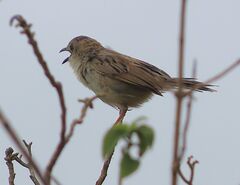
This is the largest cisticola. This warbler is grey-brown above, heavily streaked with black. The underparts are whitish, and the tail is broad, pale-tipped and flicked frequently. It has a chestnut wing-panel and a heavy bill. It is very similar to other members of its genus. It is best distinguished from its many African relatives by its size and froglike croaking breep-breep song. The song is always the easiest identification criterion for this genus. These birds are more easily heard than seen, and because of their small size (about 14 cm (5.5 in)) not always easy to recognise, particularly outside the breeding season when they seldom emerge from their grasses. Wikipedia →

Sounds

Song0:19

Congo (Democratic Republic) · 2025

© Deville Tanguy · XC1182141 · CC BY-NC-SA 4.0

Alarm call0:29

Zambia · 2026

© Magnus Wadstein · XC1101252 · CC BY-NC-SA 4.0

Call0:33

Malawi · 2017

© Peter Boesman · XC397950 · CC BY-NC-ND 4.0

Global Distribution

Parks Where Found

# Park Country Daily sighting probability
1 Kidepo Valley National Park 🇺🇬 Uganda
~50%
2 Queen Elizabeth National Park 🇺🇬 Uganda
~20%
3 Murchison Falls National Park 🇺🇬 Uganda
~20%
4 Akagera National Park 🇷🇼 Rwanda
~20%
5 iSimangaliso Wetland Park 🇿🇦 South Africa
~20%
6 Kafue National Park 🇿🇲 Zambia
~20%
7 Serengeti National Park 🇹🇿 Tanzania
~10%
8 Mikumi National Park 🇹🇿 Tanzania
~10%
9 Masai Mara National Reserve 🇰🇪 Kenya
~10%
10 Hluhluwe-Imfolozi Park 🇿🇦 South Africa
~10%
11 Nairobi National Park 🇰🇪 Kenya
~10%
12 Tarangire National Park 🇹🇿 Tanzania
~10%
13 uMkhuze Game Reserve 🇿🇦 South Africa
~10%
14 Gorongosa National Park 🇲🇿 Mozambique
~10%
15 Lake Mburo National Park 🇺🇬 Uganda
<5%
16 Mkomazi National Park 🇹🇿 Tanzania
<5%
17 Kruger National Park 🇿🇦 South Africa
<5%
18 Virunga National Park 🇨🇩 Democratic Republic of the Congo
<5%
19 Ngorongoro Conservation Area 🇹🇿 Tanzania
<5%
20 Arusha National Park 🇹🇿 Tanzania
<5%
21 Kibale National Park 🇺🇬 Uganda
<5%

Cities Where Found

# City Country Daily sighting probability
1 Harare 🇿🇼 Zimbabwe
~10%
2 Kampala 🇺🇬 Uganda
<5%

Before you go

What are the chances of seeing a Croaking Cisticola in Hluhluwe-Imfolozi Park?

With luck

About 10% of wildlife watchers report a Croaking Cisticola sighting in Hluhluwe-Imfolozi Park on a given day, based on 51 verified sightings from GBIF citizen-science data from 2019 to 2026. It is the 105th most-seen of the 220 birds we can rate there. Over three days the chance rises to about 30%, and over a week to about 50%, if each day is a fresh chance.

When is the best time to see a Croaking Cisticola in Hluhluwe-Imfolozi Park?

December

In that month about 40% of wildlife watchers report a Croaking Cisticola in Hluhluwe-Imfolozi Park on a given day, against under 5% in March and May–September, the lowest months. That is one of Hluhluwe-Imfolozi Park's wettest months, with about 110 mm of rain against 15 mm in June.

What time of day is best to see a Croaking Cisticola?

Between 7 and 10 am

Across all the parks we cover, that three-hour window holds the most Croaking Cisticola sightings with a recorded time, and about 9 in 10 of them come between 6 am and 6 pm: it is a daytime animal.

Which relatives of the Croaking Cisticola live in Hluhluwe-Imfolozi Park?

Same genus: Cisticola

The closest relatives of the Croaking Cisticola that you can see in Hluhluwe-Imfolozi Park (genus Cisticola, Cisticolas) are Rattling Cisticola (about 40%), Red-faced Cisticola (about 10%) and Zitting Cisticola (about 10%), with each one's daily chance of a sighting.

Where does the Croaking Cisticola sighting chance come from?

GBIF citizen-science records

It is estimated from how often the Croaking Cisticola is recorded against all the birds logged in Hluhluwe-Imfolozi Park (51 verified sightings from 2019 to 2026), calibrated against known sighting rates. Figures are rounded to the nearest 10% because citizen-science data supports honest approximations, not decimals, and months with records from fewer than five people show "—". How it works.

← Back to Hluhluwe-Imfolozi Park

