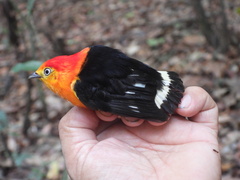
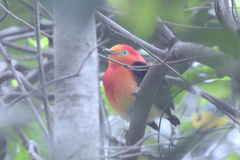
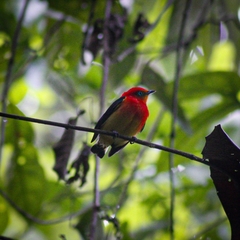
Band-tailed Manakin

Band-tailed Manakin

Pipra fasciicauda

Silhouette: Edwin Price · PhyloPic

LCLeast ConcernNTVUENCR
Daily sighting probability ~10% · With luck
at Iguazú National Park

In 3 days ~40% in a week ~70%

710 Verified sightings at Iguazú National Park From 2019 to 2026
2,646 In all 5 parks
May Best month
☀️ Diurnal When it's spotted

About the Band-tailed Manakin

The band-tailed manakin (Pipra fasciicauda) is a species of bird in the family Pipridae. It is a small, frugivorous passerine found in humid montane and lowland tropical forests throughout Argentina, Bolivia, Brazil, Paraguay, and Peru.

The band-tailed manakin forms a superspecies with its two congeners, the wire-tailed manakin (P. filicauda) and crimson-hooded manakin (P. aureola). The species was described to science by Carl Eduard Hellmayr in 1906. Its average generation length is approximately 3.73 years.

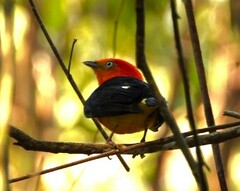
The band-tailed manakin is 10 to 11 cm (3.9 to 4.3 in) long and weighs 11.5 to 19 g (0.41 to 0.67 oz). The species is sexually dimorphic. Adult males of the nominate subspecies P. f. fasciicauda have a yellow face and throat; the rest of their head, nape, and upper mantle are red. The rest of their upperparts, wings, and tail are mostly black. They have a white base to the tail and a white patch on the inner webs of the... Wikipedia →

Sounds

Call0:39

Argentina · 2026

© Marcos E. Sosa · XC1142137 · CC BY-NC-SA 4.0

Song0:22

Brazil · 2024

© JAYRSON ARAUJO DE OLIVEIRA · XC932736 · CC BY-NC-SA 4.0

Canto0:55

Brazil · 2014

© Caio Brito · XC427817 · CC BY-NC-SA 4.0

Global Distribution

Parks Where Found

# Park Country Daily sighting probability
1 Tambopata National Reserve 🇵🇪 Peru
~20%
2 Iguaçu National Park 🇧🇷 Brazil
~20%
3 Iguazú National Park 🇦🇷 Argentina
~10%
4 Chapada dos Guimarães National Park 🇧🇷 Brazil
~10%
5 Manu National Park 🇵🇪 Peru
~10%

Cities Where Found

# City Country Daily sighting probability
1 Campo Grande 🇧🇷 Brazil
<5%

Before you go

What are the chances of seeing a Band-tailed Manakin in Iguazú National Park?

With luck

About 10% of wildlife watchers report a Band-tailed Manakin sighting in Iguazú National Park on a given day, based on 710 verified sightings from GBIF citizen-science data from 2019 to 2026. It is the 85th most-seen of the 343 birds we can rate there. Over three days the chance rises to about 40%, and over a week to about 70%, if each day is a fresh chance.

When is the best time to see a Band-tailed Manakin in Iguazú National Park?

March–July and September

In those months about 20% of wildlife watchers report a Band-tailed Manakin in Iguazú National Park on a given day, against about 10% in August and October–February, the lowest months.

What time of day is best to see a Band-tailed Manakin?

Between 8 and 11 am

Across all the parks we cover, that three-hour window holds the most Band-tailed Manakin sightings with a recorded time, and about 9 in 10 of them come between 6 am and 6 pm: it is a daytime animal.

Is Iguazú National Park the best place to see a Band-tailed Manakin?

3rd of 5

Of the 5 parks where we can rate Band-tailed Manakin sightings, Iguazú National Park ranks 3rd at about 10%. The best odds are in Tambopata National Reserve (Peru, about 20%) and Iguaçu National Park (Brazil, about 20%).

Which relatives of the Band-tailed Manakin live in Iguazú National Park?

Same family: Pipridae

The closest relatives of the Band-tailed Manakin that you can see in Iguazú National Park (family Pipridae, Manakins) are Blue Manakin (about 20%) and White-bearded Manakin (about 10%), with each one's daily chance of a sighting.

Where does the Band-tailed Manakin sighting chance come from?

GBIF citizen-science records

It is estimated from how often the Band-tailed Manakin is recorded against all the birds logged in Iguazú National Park (710 verified sightings from 2019 to 2026), calibrated against known sighting rates. Figures are rounded to the nearest 10% because citizen-science data supports honest approximations, not decimals, and months with records from fewer than five people show "—". How it works.

← Back to Iguazú National Park