
Planalto Woodcreeper

Planalto Woodcreeper

Dendrocolaptes platyrostris

Silhouette: Sheatherius · PhyloPic

LCLeast ConcernNTVUENCR
Daily sighting probability ~10% · With luck
at Iguazú National Park

In 3 days ~20% in a week ~40%

379 Verified sightings at Iguazú National Park From 2019 to 2026
978 In all 8 parks
July Best month
☀️ Diurnal When it's spotted

About the Planalto Woodcreeper

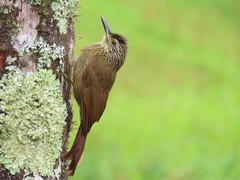
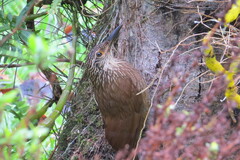
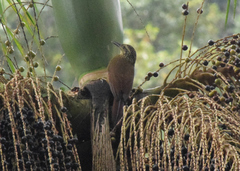
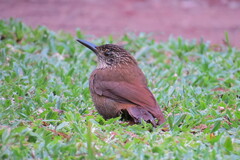
The planalto woodcreeper (Dendrocolaptes platyrostris) is a sub-oscine passerine bird in subfamily Dendrocolaptinae of the ovenbird family Furnariidae. It is found in Argentina, Brazil, Paraguay, and Uruguay. The planalto woodcreeper is most closely related to the black-banded woodcreeper (D. picumnus) and Hoffmanns's woodcreeper (D. hoffmannsi) and several authors have suggested that they are conspecific. At least one work has suggested that vocal differences between them warrant their treatment as separate species, but later work does not support that separation.

The planalto woodcreeper is one of the larger members of its subfamily. It is slim, with a long tail and a medium-length straight bill. It is 25 to 27 cm (9.8 to 11 in) long and weighs 43 to 69 g (1.5 to 2.4 oz). The sexes have the same plumage. Adults of the nominate subspecies have a dusky face with bold buffy streaks and a faint supercilium. Their forehead, crown, and nape are black with bold buff streaks on the crown and nape. Their back and rump are olive-brown... Wikipedia →

Sounds

Song0:29

Paraguay · 2025

© Guillermo Menéndez (gmmv80) · XC1047398 · CC BY-NC-SA 4.0

Call0:10

Brazil · 2025

© JAYRSON ARAUJO DE OLIVEIRA · XC974401 · CC BY-NC-SA 4.0

Dawn song0:18

Brazil · 2010

© Marcos Melo · XC76244 · CC BY-NC-ND 2.5

Global Distribution

Parks Where Found

# Park Country Daily sighting probability
1 Itatiaia National Park 🇧🇷 Brazil
~10%
2 Iguazú National Park 🇦🇷 Argentina
~10%
3 Serra dos Órgãos National Park 🇧🇷 Brazil
~10%
4 Iguaçu National Park 🇧🇷 Brazil
~10%
5 Chapada Diamantina National Park 🇧🇷 Brazil
<5%
6 Emas National Park 🇧🇷 Brazil
<5%
7 Chapada dos Guimarães National Park 🇧🇷 Brazil
<5%
8 Parque Estadual Encontro das Águas 🇧🇷 Brazil
<5%

Cities Where Found

# City Country Daily sighting probability
1 Campo Grande 🇧🇷 Brazil
~10%
2 Curitiba 🇧🇷 Brazil
<5%
3 São Paulo 🇧🇷 Brazil
<5%

Before you go

What are the chances of seeing a Planalto Woodcreeper in Iguazú National Park?

With luck

About 10% of wildlife watchers report a Planalto Woodcreeper sighting in Iguazú National Park on a given day, based on 379 verified sightings from GBIF citizen-science data from 2019 to 2026. It is the 138th most-seen of the 343 birds we can rate there. Over three days the chance rises to about 20%, and over a week to about 40%, if each day is a fresh chance.

When is the best time to see a Planalto Woodcreeper in Iguazú National Park?

March to November

In those months about 10% of wildlife watchers report a Planalto Woodcreeper in Iguazú National Park on a given day, against under 5% in December to February, the lowest months.

What time of day is best to see a Planalto Woodcreeper?

Between 8 and 11 am

Across all the parks we cover, that three-hour window holds the most Planalto Woodcreeper sightings with a recorded time, and about 9 in 10 of them come between 6 am and 6 pm: it is a daytime animal.

Is Iguazú National Park the best place to see a Planalto Woodcreeper?

Among the best

Of the 8 parks where we can rate Planalto Woodcreeper sightings, Iguazú National Park ranks 2nd at about 10%, level with the leaders once rounded. The best odds are in Itatiaia National Park (Brazil, about 10%).

Where does the Planalto Woodcreeper sighting chance come from?

GBIF citizen-science records

It is estimated from how often the Planalto Woodcreeper is recorded against all the birds logged in Iguazú National Park (379 verified sightings from 2019 to 2026), calibrated against known sighting rates. Figures are rounded to the nearest 10% because citizen-science data supports honest approximations, not decimals, and months with records from fewer than five people show "—". How it works.

← Back to Iguazú National Park