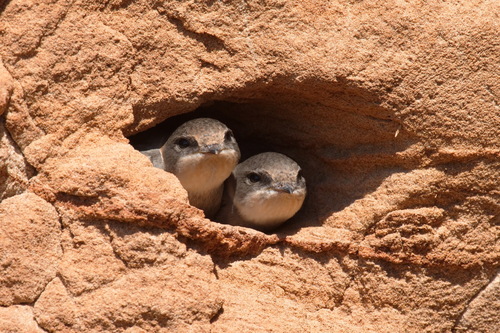
White-rumped Swallow

White-rumped Swallow

Tachycineta leucorrhoa

Silhouette: Andy Wilson · PhyloPic

LCLeast ConcernNTVUENCR
Daily sighting probability <5% · Rare
at Iguazú National Park

In 3 days ~10%

98 Verified sightings at Iguazú National Park From 2019 to 2026
1,313 In all 9 parks
September Best month
☀️ Diurnal When it's spotted

About the White-rumped Swallow

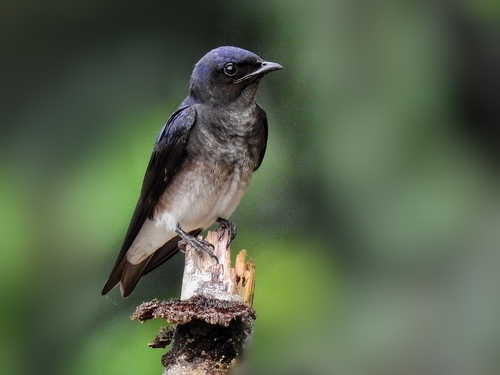
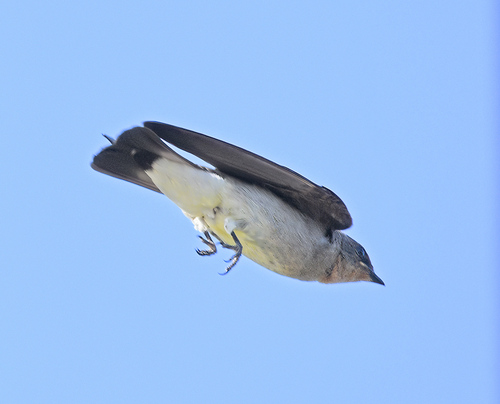
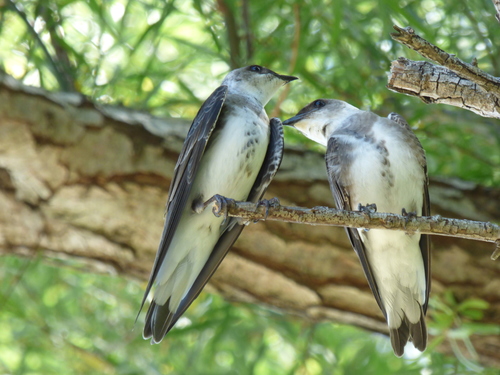
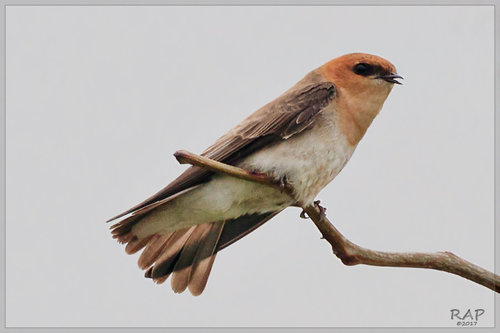
The white-rumped swallow (Tachycineta leucorrhoa) is a species of bird in the family Hirundinidae. First described and given its binomial name by French ornithologist Louis Pierre Vieillot in 1817, it was for many years considered a subspecies of the Chilean swallow. The species is monotypic with no known population variations. It has a white supraloral streak, or streak above its lores (the region between a bird's eye and nostrils), which can be used to differentiate it from the Chilean swallow. The lores, ear coverts, tail, and wings are black, with white tips on the inner secondaries, tertials, and greater coverts of the wings. The rest of the upperparts are a glossy blue. Its underparts and underwing-coverts are white, in addition to the rump, as the name suggests. The sexes are similar, and the juvenile is duller and browner with a dusky breast.

This species usually builds its nest in holes in trees or dead snags or under or in artificial structures like fence posts and the eaves of buildings. The white-rumped swallow is solitary and nests in distributed pairs during the breeding season. The breeding season is from October to December in Brazil and from October to February in neighboring Argentina. Usually, only one brood with four to seven eggs is laid, although a second one will occasionally be laid. The female incubates the eggs over a period usually between 15 and 16 days, with the fledging usually occurring between 21 and 25 days after hatching.

This swallow is found in Argentina, Bolivia, Brazil, Paraguay, Peru, and Uruguay. Its natural habitats are: dry savanna, pastureland, the edge of forests, subtropical or tropical seasonally wet or flooded lowland grassland.

It is classified as a least-concern species by the International Union for Conservation of Nature (IUCN). Its population is increasing and it may benefit from the increase in availability of artificial nest sites. The shiny cowbird is an occasional brood parasite of the white-rumped swallow. Wikipedia →

Sounds

Flight call0:07

Brazil · 2019

© Fernando Igor de Godoy · XC705468 · CC BY-NC-SA 4.0

Song0:45

Brazil · 2021

© JAYRSON ARAUJO DE OLIVEIRA · XC674587 · CC BY-NC-SA 4.0

Call0:17

Brazil · 2020

© Luiz Fernando Matos · XC656898 · CC BY-NC-SA 4.0

Global Distribution

Parks Where Found

# Park Country Daily sighting probability
1 Emas National Park 🇧🇷 Brazil
~50%
2 Iberá National Park 🇦🇷 Argentina
~30%
3 Serra da Canastra National Park 🇧🇷 Brazil
~30%
4 El Palmar National Park 🇦🇷 Argentina
~10%
5 El Impenetrable National Park 🇦🇷 Argentina
~10%
6 Parque Estadual Encontro das Águas 🇧🇷 Brazil
~10%
7 Iguaçu National Park 🇧🇷 Brazil
<5%
8 Iguazú National Park 🇦🇷 Argentina
<5%
9 Serra dos Órgãos National Park 🇧🇷 Brazil
<5%

Cities Where Found

# City Country Daily sighting probability
1 Buenos Aires 🇦🇷 Argentina
~30%
2 Montevideo 🇺🇾 Uruguay
~20%
3 Rosario 🇦🇷 Argentina
~20%
4 Curitiba 🇧🇷 Brazil
~10%
5 Porto Alegre 🇧🇷 Brazil
<5%
6 Vitória 🇧🇷 Brazil
<5%
7 Campo Grande 🇧🇷 Brazil
<5%
8 Salvador 🇧🇷 Brazil
<5%
9 São Paulo 🇧🇷 Brazil
<5%
10 Asuncion 🇵🇾 Paraguay
<5%

Before you go

What are the chances of seeing a White-rumped Swallow in Iguazú National Park?

Rare

Under 5% of wildlife watchers report a White-rumped Swallow sighting in Iguazú National Park on a given day, based on 98 verified sightings from GBIF citizen-science data from 2019 to 2026. It is the 220th most-seen of the 343 birds we can rate there. Over three days the chance rises to about 10%, if each day is a fresh chance.

When is the best time to see a White-rumped Swallow in Iguazú National Park?

Any time of year

In every month with enough records, under 5% of wildlife watchers report a White-rumped Swallow in Iguazú National Park on a given day, so our monthly data shows no clear season.

What time of day is best to see a White-rumped Swallow?

Between 9 am and noon

Across all the parks we cover, that three-hour window holds the most White-rumped Swallow sightings with a recorded time, and nearly all of them come between 6 am and 6 pm: it is a daytime animal.

Is Iguazú National Park the best place to see a White-rumped Swallow?

8th of 9

Of the 9 parks where we can rate White-rumped Swallow sightings, Iguazú National Park ranks 8th at under 5%. The best odds are in Emas National Park (Brazil, about 50%), Iberá National Park (Argentina, about 30%) and Serra da Canastra National Park (Brazil, about 30%).

Where does the White-rumped Swallow sighting chance come from?

GBIF citizen-science records

It is estimated from how often the White-rumped Swallow is recorded against all the birds logged in Iguazú National Park (98 verified sightings from 2019 to 2026), calibrated against known sighting rates. Figures are rounded to the nearest 10% because citizen-science data supports honest approximations, not decimals, and months with records from fewer than five people show "—". How it works.

← Back to Iguazú National Park