Sirkeer Malkoha

Sirkeer Malkoha

Taccocua leschenaultii

Silhouette: Nicolas Huet le Jeune and Jean-Gabriel Prêtre (vectorized by T. Michael Keesey) · PhyloPic

LCLeast ConcernNTVUENCR
Daily sighting probability <5% · Rare
at Jim Corbett National Park

In 3 days <5%

10 Verified sightings at Jim Corbett National Park From 2019 to 2026
628 In all 10 parks
January Best month
☀️ Diurnal When it's spotted

About the Sirkeer Malkoha

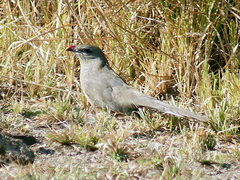
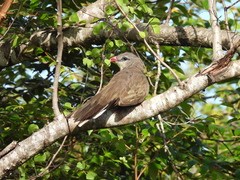
The sirkeer malkoha or sirkeer cuckoo (Taccocua leschenaultii), is a non-parasitic cuckoo found in dry scrub forest and open woodland habitats in the Indian subcontinent. The species is long-tailed, largely olive brown on the upper side with a distinctive curved red beak tipped in yellow. They forage singly or in pairs mainly on or close to the ground creeping between grasses and bushes, often on rocky habitats where they feed on small lizards, insects, and sometimes berries and seeds. They are very silent and the sexes are identical in plumage.

The sirkeer cuckoo is about 42–44 centimetres (16+1⁄2–17+1⁄4 in) long with dark olive brown on the back, wings and the central tail feathers. The underside is rufous. A greenish gloss is visible on the wing and dark parts of the tail feathers. The feathers have dark shafts which are especially prominent on the breast as streaks. The tail is graduated (with outer feathers being sequentially shorter) and tipped broadly in white. The upper tail coverts are long. The chin, throat and breast are pale. The most distinctive feature is the curved red bill with a yellow tip. The eyes have curved and long bristles around the eye but... Wikipedia →

Sounds

Call0:10

India · 2025

© Peter Boesman · XC1030912 · CC BY-NC-ND 4.0

Alarm call0:05

India · 2020

© Prashant Kumar · XC536090 · CC BY-NC-SA 4.0

Call0:08

India · 2022

© Ramesh Desai · XC746707 · CC BY-NC-SA 4.0

Global Distribution

Parks Where Found

# Park Country Daily sighting probability
1 Udawalawe National Park 🇱🇰 Sri Lanka
~30%
2 Yala National Park 🇱🇰 Sri Lanka
~10%
3 Bandhavgarh National Park 🇮🇳 India
~10%
4 Satpura National Park 🇮🇳 India
~10%
5 Royal Bardia National Park 🇳🇵 Nepal
<5%
6 Kanha National Park 🇮🇳 India
<5%
7 Bandipur National Park 🇮🇳 India
<5%
8 Ranthambore National Park 🇮🇳 India
<5%
9 Jim Corbett National Park 🇮🇳 India
<5%
10 Keoladeo National Park 🇮🇳 India
<5%

Cities Where Found

# City Country Daily sighting probability
1 Jaipur 🇮🇳 India
<5%
2 New Delhi 🇮🇳 India
<5%
3 Visakhapatnam 🇮🇳 India
<5%
4 Nagpur 🇮🇳 India
<5%
5 Bengaluru 🇮🇳 India
<5%

Before you go

What are the chances of seeing a Sirkeer Malkoha in Jim Corbett National Park?

Rare

Under 5% of wildlife watchers report a Sirkeer Malkoha sighting in Jim Corbett National Park on a given day, based on 10 verified sightings from GBIF citizen-science data from 2019 to 2026. It is the 328th most-seen of the 368 birds we can rate there. Over three days the chance rises to under 5%, if each day is a fresh chance.

When is the best time to see a Sirkeer Malkoha in Jim Corbett National Park?

Any time of year

In every month with enough records, under 5% of wildlife watchers report a Sirkeer Malkoha in Jim Corbett National Park on a given day, so our monthly data shows no clear season.

What time of day is best to see a Sirkeer Malkoha?

Between 6 and 9 am

Across all the parks we cover, that three-hour window holds the most Sirkeer Malkoha sightings with a recorded time, and about 9 in 10 of them come between 6 am and 6 pm: it is a daytime animal.

Is Jim Corbett National Park the best place to see a Sirkeer Malkoha?

9th of 10

Of the 10 parks where we can rate Sirkeer Malkoha sightings, Jim Corbett National Park ranks 9th at under 5%. The best odds are in Udawalawe National Park (Sri Lanka, about 30%), Yala National Park (Sri Lanka, about 10%) and Bandhavgarh National Park (India, about 10%).

Which relatives of the Sirkeer Malkoha live in Jim Corbett National Park?

Same family: Cuculidae

The closest relatives of the Sirkeer Malkoha that you can see in Jim Corbett National Park (family Cuculidae, Cuckoos) are Common Hawk-Cuckoo (about 20%), Greater Coucal (about 10%) and Asian Koel (about 10%), with each one's daily chance of a sighting.

Where does the Sirkeer Malkoha sighting chance come from?

GBIF citizen-science records

It is estimated from how often the Sirkeer Malkoha is recorded against all the birds logged in Jim Corbett National Park (10 verified sightings from 2019 to 2026), calibrated against known sighting rates. Figures are rounded to the nearest 10% because citizen-science data supports honest approximations, not decimals, and months with records from fewer than five people show "—". How it works.

← Back to Jim Corbett National Park