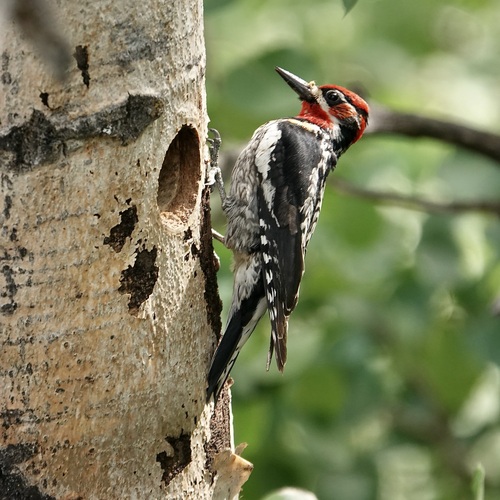
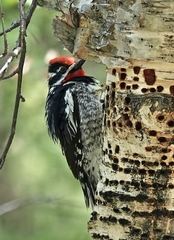
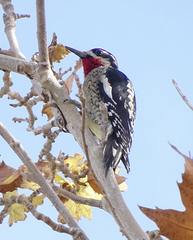
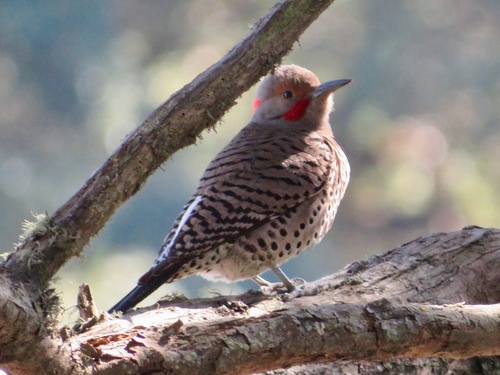
Red-naped Sapsucker

Red-naped Sapsucker

Sphyrapicus nuchalis

Silhouette: Nancy Wyman (photo), John E. McCormack, Michael G. Harvey, Brant C. Faircloth, Nicholas G. Crawford, Travis C. Glenn, Robb T. Brumfield & T. Michael Keesey · PhyloPic

LCLeast ConcernNTVUENCR
Daily sighting probability <5% · Rare
at Joshua Tree National Park

In 3 days ~10%

43 Verified sightings at Joshua Tree National Park From 2019 to 2026
3,915 In all 14 parks
October Best month
☀️ Diurnal When it's spotted

About the Red-naped Sapsucker

The red-naped sapsucker (Sphyrapicus nuchalis) is a medium-sized North American woodpecker. Long thought to be a subspecies of the yellow-bellied sapsucker, it is now known to be a distinct species. The red-naped sapsucker is one of four North American woodpeckers in the genus Sphyrapicus. It has no subspecies. First described by Spencer Fullerton Baird in 1858, it was initially thought to be a subspecies of the yellow-bellied sapsucker. However, there are significant genetic differences between this species and the yellow-bellied sapsucker, and the American Ornithologists' Union recognized it as a distinct species in the seventh edition of its North American birds checklist, published in 1998. Genetic analysis has shown that the red-naped sapsucker is a sister species with (and very closely related to) the red-breasted sapsucker, and that these two species form a superspecies with the yellow-bellied sapsucker. All three species are known to hybridize with each other, with hybrids between red-naped and red-breasted sapsuckers proving particularly common.

The genus name Sphyrapicus is a combination of the Greek words sphura, meaning "hammer" and pikos, meaning "woodpecker... Wikipedia →

Sounds

Begging call0:23

United States · 2022

© Bobby Wilcox · XC806284 · CC BY-NC-SA 4.0

Call1:04

United States · 2020

© Richard E. Webster · XC663248 · CC BY-NC-SA 4.0

Drumming0:04

United States · 2019

© Bruce Lagerquist · XC482570 · CC BY-NC-SA 4.0

Global Distribution

Parks Where Found

# Park Country Daily sighting probability
1 Glacier National Park 🇺🇸 United States
~20%
2 Grand Teton National Park 🇺🇸 United States
~20%
3 Rocky Mountain National Park 🇺🇸 United States
~20%
4 Guadalupe Mountains National Park 🇺🇸 United States
~10%
5 Zion National Park 🇺🇸 United States
~10%
6 Grand Canyon National Park 🇺🇸 United States
~10%
7 Yellowstone National Park 🇺🇸 United States
<5%
8 Saguaro National Park 🇺🇸 United States
<5%
9 Big Bend National Park 🇺🇸 United States
<5%
10 Death Valley National Park 🇺🇸 United States
<5%
11 Joshua Tree National Park 🇺🇸 United States
<5%
12 Banff National Park 🇨🇦 Canada
<5%
13 Cumbres de Monterrey National Park 🇲🇽 Mexico
<5%
14 El Vizcaíno Biosphere Reserve 🇲🇽 Mexico
<5%

Cities Where Found

# City Country Daily sighting probability
1 Dallas 🇺🇸 United States
<5%
2 Salt Lake City 🇺🇸 United States
<5%
3 Torreón 🇲🇽 México
<5%
4 Phoenix 🇺🇸 United States
<5%
5 Las Vegas 🇺🇸 United States
<5%
6 Mesa 🇺🇸 United States
<5%
7 San Diego 🇺🇸 United States
<5%
8 San Francisco 🇺🇸 United States
<5%
9 Houston 🇺🇸 United States
<5%
10 Los Angeles 🇺🇸 United States
<5%

Before you go

What are the chances of seeing a Red-naped Sapsucker in Joshua Tree National Park?

Rare

Under 5% of wildlife watchers report a Red-naped Sapsucker sighting in Joshua Tree National Park on a given day, based on 43 verified sightings from GBIF citizen-science data from 2019 to 2026. It is the 93rd most-seen of the 141 birds we can rate there. Over three days the chance rises to about 10%, if each day is a fresh chance.

When is the best time to see a Red-naped Sapsucker in Joshua Tree National Park?

October and November

In those months about 10% of wildlife watchers report a Red-naped Sapsucker in Joshua Tree National Park on a given day, against under 5% in December to September, the lowest months.

What time of day is best to see a Red-naped Sapsucker?

Between 10 am and 1 pm

Across all the parks we cover, that three-hour window holds the most Red-naped Sapsucker sightings with a recorded time, and about 9 in 10 of them come between 6 am and 6 pm: it is a daytime animal.

Is Joshua Tree National Park the best place to see a Red-naped Sapsucker?

11th of 14

Of the 14 parks where we can rate Red-naped Sapsucker sightings, Joshua Tree National Park ranks 11th at under 5%. The best odds are in Glacier National Park (United States, about 20%), Grand Teton National Park (United States, about 20%) and Rocky Mountain National Park (United States, about 20%).

Where does the Red-naped Sapsucker sighting chance come from?

GBIF citizen-science records

It is estimated from how often the Red-naped Sapsucker is recorded against all the birds logged in Joshua Tree National Park (43 verified sightings from 2019 to 2026), calibrated against known sighting rates. Figures are rounded to the nearest 10% because citizen-science data supports honest approximations, not decimals, and months with records from fewer than five people show "—". How it works.

← Back to Joshua Tree National Park