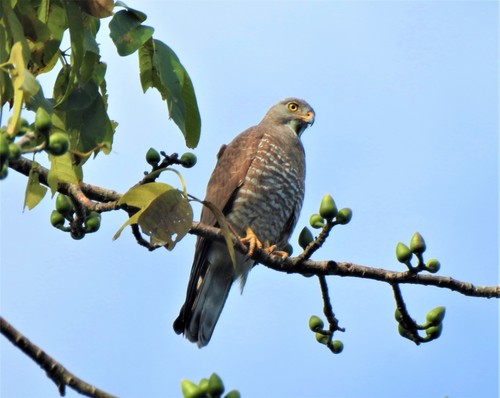
Jerdon's Baza

Jerdon's Baza

Aviceda jerdoni

Silhouette: Sheatherius · PhyloPic

LCLeast ConcernNTVUENCR
Daily sighting probability ~10% · With luck
at Kaeng Krachan National Park

In 3 days ~20% in a week ~30%

234 Verified sightings at Kaeng Krachan National Park From 2019 to 2026
969 In all 14 parks
August Best month
☀️ Diurnal When it's spotted

About the Jerdon's Baza

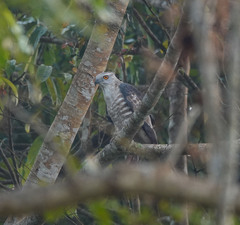
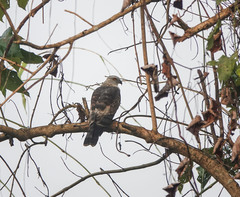
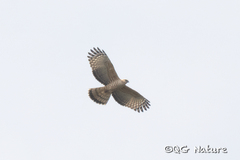
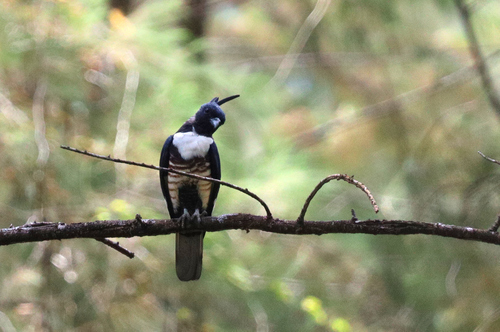
Jerdon's baza (Aviceda jerdoni) is a moderate sized brown hawk with a thin white-tipped black crest usually held erect. It is found in South-east Asia. It inhabits foothills in the terai and is rarer in evergreen forests and tea estates.

The common name and Latin binomial commemorate the surgeon-naturalist Thomas C. Jerdon. It is about 41–48 cm long with a wingspan of 117 cm (46 in). The bird weighs around 350 grams (.77 lb). It is confusable with crested goshawk or the changeable hawk-eagle in flight, but can be distinguished by the longer upright crest, very broad and rounded paddle-shaped wings and mostly plain and pale underparts. It has a white chin and a bold black mesial stripe.

Several subspecies are recognized within its large distribution range. These include: It is a resident of the terai of North India and foothills of the Eastern Himalayas... Wikipedia →

Sounds

Call0:16

Malaysia · 2023

© Daan Drukker · XC829220 · CC BY-NC-SA 4.0

Flight call0:09

Malaysia · 2015

© Mike Nelson · XC294058 · CC BY-NC-SA 4.0

Begging call0:23

China · 2024

© Vincent · XC919641 · CC BY-NC-SA 4.0

Global Distribution

Parks Where Found

# Park Country Daily sighting probability
1 Kinabatangan Wildlife Sanctuary 🇲🇾 Malaysia
~10%
2 Manas National Park 🇮🇳 India
~10%
3 Kaeng Krachan National Park 🇹🇭 Thailand
~10%
4 Khao Yai National Park 🇹🇭 Thailand
~10%
5 Khao Sok National Park 🇹🇭 Thailand
<5%
6 Khao Luang National Park 🇹🇭 Thailand
<5%
7 Namdapha National Park 🇮🇳 India
<5%
8 Royal Manas National Park 🇧🇹 Bhutan
<5%
9 Danum Valley Conservation Area 🇲🇾 Malaysia
<5%
10 Doi Inthanon National Park 🇹🇭 Thailand
<5%
11 Sinharaja Forest Reserve 🇱🇰 Sri Lanka
<5%
12 Kanha National Park 🇮🇳 India
<5%
13 Cat Tien National Park 🇻🇳 Vietnam
<5%
14 Kaziranga National Park 🇮🇳 India
<5%

Cities Where Found

# City Country Daily sighting probability
1 Singapore 🇸🇬 Singapore
<5%
2 Phnom Penh 🇰🇭 Cambodia
<5%

Before you go

What are the chances of seeing a Jerdon's Baza in Kaeng Krachan National Park?

With luck

About 10% of wildlife watchers report a Jerdon's Baza sighting in Kaeng Krachan National Park on a given day, based on 234 verified sightings from GBIF citizen-science data from 2019 to 2026. It is the 173rd most-seen of the 360 birds we can rate there. Over three days the chance rises to about 20%, and over a week to about 30%, if each day is a fresh chance.

When is the best time to see a Jerdon's Baza in Kaeng Krachan National Park?

March–April, July–August and October–January

In those months about 10% of wildlife watchers report a Jerdon's Baza in Kaeng Krachan National Park on a given day, against under 5% in February, May–June and September, the lowest months.

What time of day is best to see a Jerdon's Baza?

Between 7 and 10 am

Across all the parks we cover, that three-hour window holds the most Jerdon's Baza sightings with a recorded time, and about 9 in 10 of them come between 6 am and 6 pm: it is a daytime animal.

Is Kaeng Krachan National Park the best place to see a Jerdon's Baza?

Among the best

Of the 14 parks where we can rate Jerdon's Baza sightings, Kaeng Krachan National Park ranks 3rd at about 10%, level with the leaders once rounded. The best odds are in Kinabatangan Wildlife Sanctuary (Malaysia, about 10%) and Manas National Park (India, about 10%).

Where does the Jerdon's Baza sighting chance come from?

GBIF citizen-science records

It is estimated from how often the Jerdon's Baza is recorded against all the birds logged in Kaeng Krachan National Park (234 verified sightings from 2019 to 2026), calibrated against known sighting rates. Figures are rounded to the nearest 10% because citizen-science data supports honest approximations, not decimals, and months with records from fewer than five people show "—". How it works.

← Back to Kaeng Krachan National Park