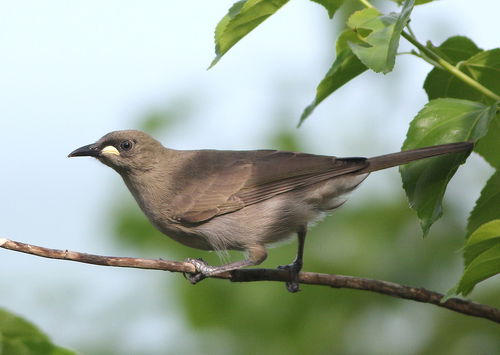
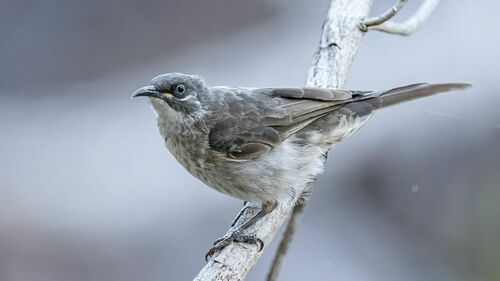
Banded Honeyeater

Banded Honeyeater

Cissomela pectoralis

Silhouette: Rachael Joakim · PhyloPic

LCLeast ConcernNTVUENCR Endemic
Daily sighting probability <5% · Rare
at Kakadu National Park

In 3 days ~10% in a week ~20%

44 Verified sightings at Kakadu National Park From 2019 to 2026
93 In all 2 parks
March Best month
☀️ Diurnal When it's spotted

About the Banded Honeyeater

The banded honeyeater (Cissomela pectoralis) is a species of honeyeater in the family Meliphagidae with a characteristic narrow black band across its white underparts. It is endemic to tropical northern Australia. The scientific name for the banded honeyeater is Cissomela pectoralis (Gould, 1841). The holotype was Holotype ANSP 18224 male, Australia: north coast, held in the Academy of Natural Sciences of Drexel University, Philadelphia.

The banded honeyeater was previously placed in the genus Certhionyx, but was moved to the monotypic genus Cissomela after a molecular phylogenetic analysis, published in 2011, showed that the original genus was polyphyletic.

The genus name Cissomela (Bonaparte, 1854) means "honey magpie" from the Greek kissa for 'magpie', thus referring to the black and white colouring, and mela meaning 'honey' for its feeding habits. The specific epithet pectoralis comes from the Latin pectoris for 'breast', referring to the distinctive banded breast of this bird.

The banded honeyeater is a small, pied honeyeater with a distinctive black breast band across white underparts. It has a black back, tail and head, a long... Wikipedia →

Sounds

Call0:20

Australia · 2022

© James Lambert · XC759726 · CC BY-NC-ND 4.0

Call0:37

Australia · 2018

© Marc Anderson · XC439102 · CC BY-NC-ND 4.0

Call0:14

Australia · 2015

© Andrew Spencer · XC328842 · CC BY-NC-ND 4.0

Global Distribution

Parks Where Found

# Park Country Daily sighting probability
1 Nitmiluk National Park 🇦🇺 Australia
~10%
2 Kakadu National Park 🇦🇺 Australia
<5%

Before you go

What are the chances of seeing a Banded Honeyeater in Kakadu National Park?

Rare

Under 5% of wildlife watchers report a Banded Honeyeater sighting in Kakadu National Park on a given day, based on 44 verified sightings from GBIF citizen-science data from 2019 to 2026. It is the 137th most-seen of the 186 birds we can rate there. Over three days the chance rises to about 10%, and over a week to about 20%, if each day is a fresh chance.

When is the best time to see a Banded Honeyeater in Kakadu National Park?

March and September

In those months about 10% of wildlife watchers report a Banded Honeyeater in Kakadu National Park on a given day, against under 5% in April–August and October–January, the lowest months. February has too few records to rate.

What time of day is best to see a Banded Honeyeater?

Between 3 and 6 pm

Across all the parks we cover, that three-hour window holds the most Banded Honeyeater sightings with a recorded time, and about 9 in 10 of them come between 6 am and 6 pm: it is a daytime animal.

Is Kakadu National Park the best place to see a Banded Honeyeater?

2nd of 2

Of the 2 parks where we can rate Banded Honeyeater sightings, Kakadu National Park ranks 2nd at under 5%. The best odds are in Nitmiluk National Park (Australia, about 10%).

Where does the Banded Honeyeater sighting chance come from?

GBIF citizen-science records

It is estimated from how often the Banded Honeyeater is recorded against all the birds logged in Kakadu National Park (44 verified sightings from 2019 to 2026), calibrated against known sighting rates. Figures are rounded to the nearest 10% because citizen-science data supports honest approximations, not decimals, and months with records from fewer than five people show "—". How it works.

← Back to Kakadu National Park