Glauert's Monitor

Glauert's Monitor

Varanus glauerti

Silhouette: Steven Traver · PhyloPic

LCLeast ConcernNTVUENCR Endemic
Daily sighting probability ~10% · With luck
at Kakadu National Park

In 3 days ~40% in a week ~70%

8 Verified sightings at Kakadu National Park From 2019 to 2026
8 In 1 park
February Best month
☀️ Diurnal When it's spotted

About the Glauert's Monitor

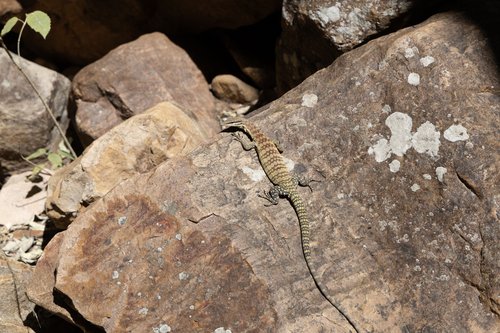
The Kimberley rock monitor (Varanus glauerti) is a medium-sized species of monitor lizard in the family Varanidae. The species is native to Northern Australia. Also known commonly as Glauert's monitor, Quinkan rock monitor and the Kakadu sand goanna, it belongs to the subgenus Odatria.

The specific name, glauerti, is in honor of English-born Australian herpetologist Ludwig Glauert. V. glauerti is found in the extreme northwestern part of the Australian state of Western Australia, and in the northern tip of Northern Territory.

V. glauerti grows up to 80 cm (31 in) long, and three-quarters of its length is the long tail. V. glauerti lives almost exclusively on rocky cliff faces, but is also found in humid forests. It is rupicolous, and prefers humid conditions.

V. glauerti preys upon insects such as caterpillars, cockroaches, and orthopterans, and also upon small lizards such as geckos and their eggs. V. glauerti is oviparous, and sometimes parthenogenetic. Cogger HG (2014). Reptiles and Amphibians of Australia, Seventh... Wikipedia →
Global Distribution

Parks Where Found

# Park Country Daily sighting probability
1 Kakadu National Park 🇦🇺 Australia
~10%

More parks will be added in future updates.

Before you go

What are the chances of seeing a Glauert's Monitor in Kakadu National Park?

With luck

About 10% of wildlife watchers report a Glauert's Monitor sighting in Kakadu National Park on a given day, based on 8 verified sightings from GBIF citizen-science data from 2019 to 2026. It is the 34th most-seen of the 54 reptiles we can rate there. Over three days the chance rises to about 40%, and over a week to about 70%, if each day is a fresh chance.

When is the best time to see a Glauert's Monitor in Kakadu National Park?

February

In that month about 30% of wildlife watchers report a Glauert's Monitor in Kakadu National Park on a given day, against under 5% in March, June, August and December–January, the lowest months. That is one of Kakadu National Park's wettest months, with about 290 mm of rain against almost none in August.

What time of day is best to see a Glauert's Monitor?

Between 11 am and 2 pm

Across all the parks we cover, that three-hour window holds the most Glauert's Monitor sightings with a recorded time, and about 9 in 10 of them come between 6 am and 6 pm: it is a daytime animal.

Where else can you see a Glauert's Monitor?

Only Kakadu National Park, in our data

Kakadu National Park is the only park on Wallace's Line with enough records to rate Glauert's Monitor sightings: about 10% of wildlife watchers there report one on a given day.

Which relatives of the Glauert's Monitor live in Kakadu National Park?

Same genus: Varanus

The closest relatives of the Glauert's Monitor that you can see in Kakadu National Park (genus Varanus, Monitor Lizards) are Argus Monitor (about 30%), Mertens's Water Monitor (about 30%) and Black-headed Monitor (about 20%), with each one's daily chance of a sighting.

Where does the Glauert's Monitor sighting chance come from?

GBIF citizen-science records

It is estimated from how often the Glauert's Monitor is recorded against all the reptiles logged in Kakadu National Park (8 verified sightings from 2019 to 2026), calibrated against known sighting rates. Figures are rounded to the nearest 10% because citizen-science data supports honest approximations, not decimals, and months with records from fewer than five people show "—". How it works.

← Back to Kakadu National Park