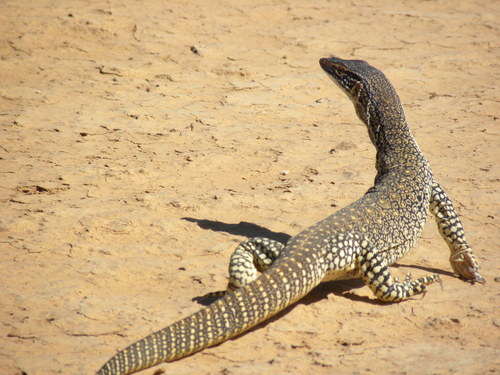
Gould's Goanna

Gould's Goanna

Varanus gouldii

Silhouette: Rachel T Mason · PhyloPic

LCLeast ConcernNTVUENCR
Daily sighting probability ~20% · Possible
at Kakadu National Park

In 3 days ~40% in a week ~80%

12 Verified sightings at Kakadu National Park From 2019 to 2026
168 In all 6 parks
May Best month
☀️ Diurnal When it's spotted

About the Gould's Goanna

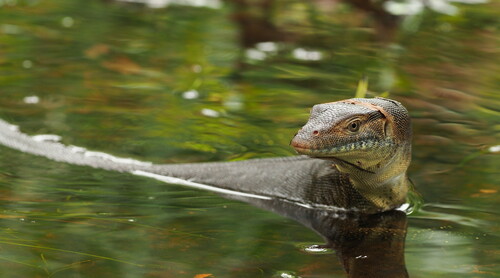
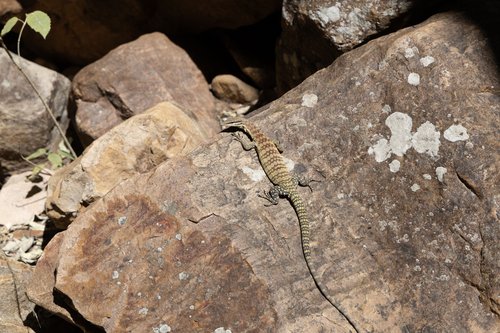
The sand goanna (Varanus gouldii), also known commonly as Gould's monitor, the racehorse goanna, and the sand monitor, is a species of large Australian monitor lizard in the family Varanidae. John Edward Gray described the species in 1838 as Hydrosaurus gouldii, noting the source of the type specimen as "New Holland" and distinguishing the new varanid by "two yellow streaks on the sides of the neck" and small flat scales at the orbits.

An earlier description, Tupinambis endrachtensis Péron, F. 1807, was determined as likely to refer to this animal, but the epithet gouldii was conserved and a new specimen designated as the type. This neotype was obtained in 1997 at the near coastal Western Australian suburb of Karrakatta, and placed with the British Museum of Natural History. The decision of a nomenclatural commission (ICZN) was to issue an opinion suppressing the earlier name Tupinambis endrachtensis and the name Hydrosaurus ocellarius Blyth, 1868, that were unsatisfactory to some who had commented on the case, but provided taxonomic certainty for future revisions of the associated taxa.

The specific name, gouldii, is assumed to be a Latinised form of... Wikipedia →
Global Distribution

Parks Where Found

# Park Country Daily sighting probability
1 Uluru-Kata Tjuta National Park 🇦🇺 Australia
~50%
2 Hattah-Kulkyne National Park 🇦🇺 Australia
~50%
3 Flinders Ranges National Park 🇦🇺 Australia
~50%
4 Cape Range 🇦🇺 Australia
~30%
5 Ningaloo Marine Park 🇦🇺 Australia
~20%
6 Kakadu National Park 🇦🇺 Australia
~20%

Zoos & Centres Where Found

# Zoo / Centre Country
1 Silesian Zoological Garden 🇵🇱 Poland In captivity
2 Taronga Zoo 🇦🇺 Australia In captivity
3 Featherdale Sydney Wildlife Park 🇦🇺 Australia In captivity
4 Sea Life Sydney Aquarium 🇦🇺 Australia In captivity
5 Wild Life Sydney 🇦🇺 Australia In captivity
6 Reptile House 🇭🇰 Hong Kong SAR China In captivity

Before you go

What are the chances of seeing a Gould's Goanna in Kakadu National Park?

Possible

About 20% of wildlife watchers report a Gould's Goanna sighting in Kakadu National Park on a given day, based on 12 verified sightings from GBIF citizen-science data from 2019 to 2026. It is the 25th most-seen of the 54 reptiles we can rate there. Over three days the chance rises to about 40%, and over a week to about 80%, if each day is a fresh chance.

When is the best time to see a Gould's Goanna in Kakadu National Park?

February, April–May and October–December

In those months about 30% of wildlife watchers report a Gould's Goanna in Kakadu National Park on a given day, against under 5% in January, March and July–September, the lowest months.

What time of day is best to see a Gould's Goanna?

Between 11 am and 2 pm

Across all the parks we cover, that three-hour window holds the most Gould's Goanna sightings with a recorded time, and about 9 in 10 of them come between 6 am and 6 pm: it is a daytime animal.

Which relatives of the Gould's Goanna live in Kakadu National Park?

Same genus: Varanus

The closest relatives of the Gould's Goanna that you can see in Kakadu National Park (genus Varanus, Monitor Lizards) are Argus Monitor (about 30%), Mertens's Water Monitor (about 30%) and Black-headed Monitor (about 20%), with each one's daily chance of a sighting.

Where does the Gould's Goanna sighting chance come from?

GBIF citizen-science records

It is estimated from how often the Gould's Goanna is recorded against all the reptiles logged in Kakadu National Park (12 verified sightings from 2019 to 2026), calibrated against known sighting rates. Figures are rounded to the nearest 10% because citizen-science data supports honest approximations, not decimals, and months with records from fewer than five people show "—". How it works.

← Back to Kakadu National Park