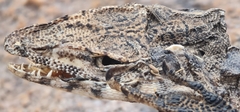
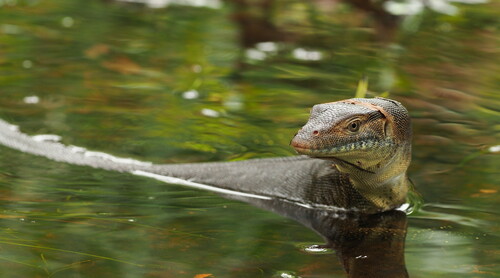
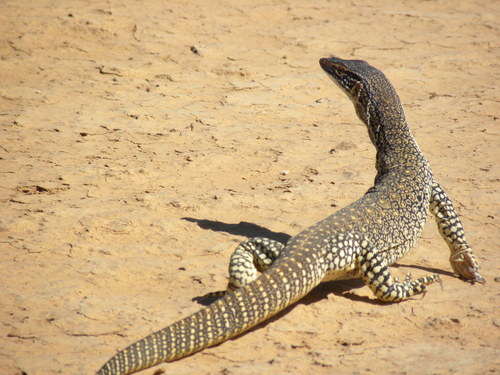
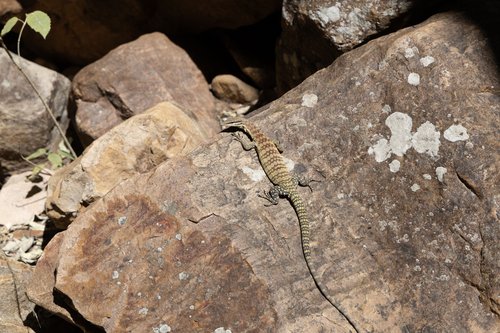
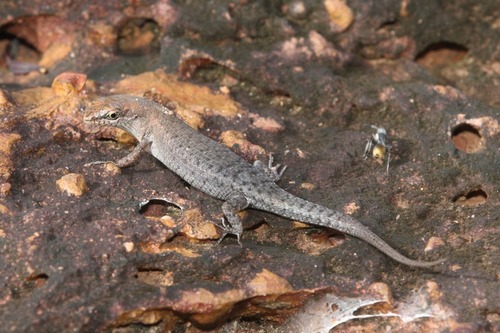
Black-palmed Rock Monitor

Black-palmed Rock Monitor

Varanus glebopalma

Silhouette: Steven Traver · PhyloPic

LCLeast ConcernNTVUENCR Endemic
Daily sighting probability ~10% · With luck
at Kakadu National Park

In 3 days ~30% in a week ~60%

7 Verified sightings at Kakadu National Park From 2019 to 2026
17 In all 2 parks
December Best month
☀️ Diurnal When it's spotted

About the Black-palmed Rock Monitor

The black-palmed rock monitor (Varanus glebopalma) is a member of the Varanidae family found in Australia. Also known as the twilight monitor or the long-tailed rock monitor, it is a member of the subgenus Odatria, and is found in the northern part of Australia in the Northern Territory and Western Australia, as well as Queensland. Specifically, its distribution extends from Mount Isa in the east to the Kimberleys in the west. Its habitat is areas of rock escarpment, and large populations may be found in small areas.

A species first described in 1955 by South Australian curator Francis John Mitchell, nominating the holotype as a specimen obtained at Lake Hubert in the Northern Territory. Mitchell's specimen was the only example available, and was shot by R. R. Miller near a sandstone outcrop during the 1948 American-Australian Scientific Expedition to Arnhem Land.

The new species was allied to the infrageneric classification Varanus (Odatria). Common names for the species include black-palmed and long-tailed rock monitor. The specific epithet glebopalma refers to the shiny black pads found on the undersides of their feet.

The black-palmed rock monitor... Wikipedia →

Global Distribution

Parks Where Found

# Park Country Daily sighting probability
1 Nitmiluk National Park 🇦🇺 Australia
~40%
2 Kakadu National Park 🇦🇺 Australia
~10%

Before you go

What are the chances of seeing a Black-palmed Rock Monitor in Kakadu National Park?

With luck

About 10% of wildlife watchers report a Black-palmed Rock Monitor sighting in Kakadu National Park on a given day, based on 7 verified sightings from GBIF citizen-science data from 2019 to 2026. It is the 39th most-seen of the 54 reptiles we can rate there. Over three days the chance rises to about 30%, and over a week to about 60%, if each day is a fresh chance.

When is the best time to see a Black-palmed Rock Monitor in Kakadu National Park?

December

In that month about 30% of wildlife watchers report a Black-palmed Rock Monitor in Kakadu National Park on a given day, against under 5% in January–April, July and September–November, the lowest months. That is one of Kakadu National Park's wettest months, with about 250 mm of rain against almost none in August.

What time of day is best to see a Black-palmed Rock Monitor?

Between 8 and 11 am

Across all the parks we cover, that three-hour window holds the most Black-palmed Rock Monitor sightings with a recorded time, and about 8 in 10 of them come between 6 am and 6 pm: it is a daytime animal.

Is Kakadu National Park the best place to see a Black-palmed Rock Monitor?

2nd of 2

Of the 2 parks where we can rate Black-palmed Rock Monitor sightings, Kakadu National Park ranks 2nd at about 10%. The best odds are in Nitmiluk National Park (Australia, about 40%).

Which relatives of the Black-palmed Rock Monitor live in Kakadu National Park?

Same genus: Varanus

The closest relatives of the Black-palmed Rock Monitor that you can see in Kakadu National Park (genus Varanus, Monitor Lizards) are Argus Monitor (about 30%), Mertens's Water Monitor (about 30%) and Black-headed Monitor (about 20%), with each one's daily chance of a sighting.

Where does the Black-palmed Rock Monitor sighting chance come from?

GBIF citizen-science records

It is estimated from how often the Black-palmed Rock Monitor is recorded against all the reptiles logged in Kakadu National Park (7 verified sightings from 2019 to 2026), calibrated against known sighting rates. Figures are rounded to the nearest 10% because citizen-science data supports honest approximations, not decimals, and months with records from fewer than five people show "—". How it works.

← Back to Kakadu National Park