Red-breasted Parakeet

Red-breasted Parakeet

Psittacula alexandri

Silhouette: Farelli (photo), John E. McCormack, Michael G. Harvey, Brant C. Faircloth, Nicholas G. Crawford, Travis C. Glenn, Robb T. Brumfield & T. Michael Keesey · PhyloPic

LCNTNear ThreatenedVUENCR
Daily sighting probability ~50% · Likely
at Kaziranga National Park

In 3 days ~90% in a week >90%

1,139 Verified sightings at Kaziranga National Park From 2019 to 2026
3,194 In all 7 parks
February Best month
🌅 Crepuscular When it's spotted

About the Red-breasted Parakeet

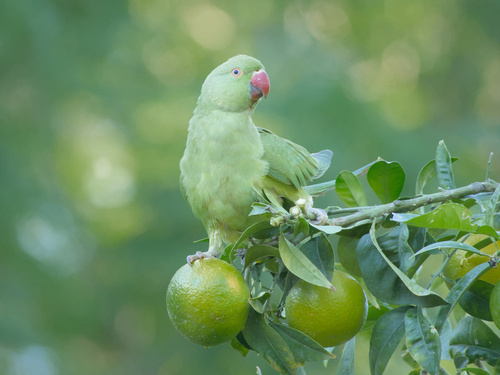
The red-breasted parakeet (Psittacula alexandri) is a parrot native to Southeast Asia. It is among the more widespread species of the genus and is the species which has the most geographical variations. It is easily identified by the large red patch on its breast. An alternative name is the moustached parakeet depending on subspecies. Most of the subspecies are confined to minuscule islands or a cluster of islands in Indonesia. One subspecies occurs in the Andaman Islands, and one subspecies occurs in continental Southeast Asia and partly extending to northeastern parts of South Asia along the foothills of the Himalayas. Some of the island races may be threatened by the wild bird trade. The nominate race, which occurs in Java, is close to extinction.

Feral populations of this species have now established themselves in cities like Mumbai and Singapore. Small numbers occur in other cities such as Chennai and Bangalore in India. The red-breasted parakeet was formally described in 1758 by the Swedish naturalist Carl Linnaeus in the tenth edition of his Systema Naturae. He placed it with all the other parrots in the genus Psittacus and coined the binomial name Psittacus alexandri... Wikipedia →

Sounds

Call0:52

Singapore · 2025

© Ding Li Yong · XC1031838 · CC BY-NC-ND 4.0

Flight call0:06

India · 2025

© Lim Ying Hien · XC991527 · CC BY-NC-ND 4.0

Uncertain0:25

Thailand · 2020

© Peter Ericsson · XC611152 · CC BY-NC-SA 4.0

Global Distribution

Parks Where Found

# Park Country Daily sighting probability
1 Kaziranga National Park 🇮🇳 India
~50%
2 Manas National Park 🇮🇳 India
~40%
3 Cat Tien National Park 🇻🇳 Vietnam
~30%
4 Chitwan National Park 🇳🇵 Nepal
~20%
5 Khao Yai National Park 🇹🇭 Thailand
~20%
6 Jim Corbett National Park 🇮🇳 India
~10%
7 Royal Manas National Park 🇧🇹 Bhutan
~10%

Cities Where Found

# City Country Daily sighting probability
1 Jakarta 🇮🇩 Indonesia
~40%
2 Singapore 🇸🇬 Singapore
~30%
3 Bandung 🇮🇩 Indonesia
~10%
4 Phnom Penh 🇰🇭 Cambodia
~10%
5 Bangkok 🇹🇭 Thailand
~10%
6 Guwahati 🇮🇳 India
<5%
7 Dhaka 🇧🇩 Bangladesh
<5%
8 Kolkata 🇮🇳 India
<5%
9 Denpasar 🇮🇩 Indonesia
<5%
10 Mumbai 🇮🇳 India
<5%

Zoos & Centres Where Found

# Zoo / Centre Country
1 Bangladesh National Zoo 🇧🇩 Bangladesh In captivity
2 Shenzhen Safari Park 🇨🇳 China In captivity
3 Nanning Zoo 🇨🇳 China In captivity
4 Twycross Zoo 🇬🇧 United Kingdom In captivity
5 Wilhelma 🇩🇪 Germany In captivity
6 Warangal Zoo 🇮🇳 India In captivity
7 Samphran Elephant Ground & Zoo 🇹🇭 Thailand In captivity
8 Saigon Zoo and Botanical Gardens 🇻🇳 Vietnam In captivity
9 Paphos Zoo 🇨🇾 Cyprus In captivity
10 Loro Parque 🇪🇸 Spain In captivity
11 Bird Park Steinen 🇩🇪 Germany In captivity
12 Rainforestation Nature Park 🇦🇺 Australia In captivity
13 Zoo Balneário Camboriú 🇧🇷 Brazil In captivity
14 Rainbow Jungle Birdpark (closed) 🇦🇺 Australia In captivity
15 Sea World Indonesia 🇮🇩 Indonesia In captivity
16 Jakarta Aquarium 🇮🇩 Indonesia In captivity
17 Singapore Miniature Zoo 🇸🇬 Singapore In captivity
18 Wild Kingdom Train Zoo 🇺🇸 United States In captivity

Before you go

What are the chances of seeing a Red-breasted Parakeet in Kaziranga National Park?

Likely

About 50% of wildlife watchers report a Red-breasted Parakeet sighting in Kaziranga National Park on a given day, based on 1,139 verified sightings from GBIF citizen-science data from 2019 to 2026. It is the 36th most-seen of the 323 birds we can rate there. Over three days the chance rises to about 90%, and over a week to over 90%, if each day is a fresh chance.

When is the best time to see a Red-breasted Parakeet in Kaziranga National Park?

February to April

In those months about 70% of wildlife watchers report a Red-breasted Parakeet in Kaziranga National Park on a given day, against about 20% in November, the lowest month. June and July have too few records to rate.

What time of day is best to see a Red-breasted Parakeet?

Between 1 and 4 am

Across all the parks we cover, that three-hour window holds the most Red-breasted Parakeet sightings with a recorded time, and about 6 in 10 of them come between 6 pm and 6 am: it is most active around dawn and dusk.

Is Kaziranga National Park the best place to see a Red-breasted Parakeet?

Yes

Of the 7 parks where we can rate Red-breasted Parakeet sightings, Kaziranga National Park has the highest daily chance: about 50%. Next come Manas National Park (India, about 40%) and Cat Tien National Park (Vietnam, about 30%). All parks ranked.

Which relatives of the Red-breasted Parakeet live in Kaziranga National Park?

Same genus: Psittacula

The closest relatives of the Red-breasted Parakeet that you can see in Kaziranga National Park (genus Psittacula, Old World Parakeets) are Rose-ringed Parakeet (about 70%), Alexandrine Parakeet (about 50%) and Blossom-headed Parakeet (about 40%), with each one's daily chance of a sighting.

Where does the Red-breasted Parakeet sighting chance come from?

GBIF citizen-science records

It is estimated from how often the Red-breasted Parakeet is recorded against all the birds logged in Kaziranga National Park (1,139 verified sightings from 2019 to 2026), calibrated against known sighting rates. Figures are rounded to the nearest 10% because citizen-science data supports honest approximations, not decimals, and months with records from fewer than five people show "—". How it works.

← Back to Kaziranga National Park