Russet Percher

Russet Percher

Neurothemis fulvia

Daily sighting probability ~50% · Likely
at Kaziranga National Park

In 3 days ~80% in a week >90%

11 Verified sightings at Kaziranga National Park From 2019 to 2026
349 In all 12 parks
October Best month
☀️ Diurnal When it's spotted

About the Russet Percher

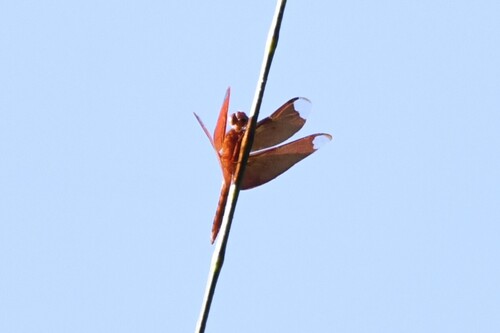
Neurothemis fulvia, the fulvous forest skimmer, is a species of dragonfly found in Asia. It is a medium-sized rusty dragonfly with transparent wing tips. Male has a reddish-brown face with eyes which are dark reddish brown above, golden brown below. Thorax, abdomen and legs are reddish brown. Wings are dark reddish brown with an irregular triangular transparent area at the tip of the wing. The wing spots are dark reddish brown. Many forms of females are found. Color of head, thorax and abdomen paler than males or rusty brown. Wings are clear amber yellow with a dark ray extending to the tip in fore wing. Many of them have an irregular triangular transparent area at the tip of the wing. The wings vary in size, shape, width and coloration. The clear uncoloured apices of wings will help to distinguish it from other red Asian dragonflies.

It is a dragonfly of wet forests, usually perches on fallen logs and shrubs. A large number of them can be found together in canopy gaps and forest edges. It breeds in marshes associated with forest streams, marshes and ponds. They are also found in local parks, gardens, etc.

List of odonates... Wikipedia →
Global Distribution

Parks Where Found

# Park Country Daily sighting probability
1 Kaziranga National Park 🇮🇳 India
~50%
2 Khao Yai National Park 🇹🇭 Thailand
~40%
3 Cat Tien National Park 🇻🇳 Vietnam
~40%
4 Kanha National Park 🇮🇳 India
~30%
5 Khao Sok National Park 🇹🇭 Thailand
~30%
6 Royal Bardia National Park 🇳🇵 Nepal
~30%
7 Kaeng Krachan National Park 🇹🇭 Thailand
~30%
8 Chitwan National Park 🇳🇵 Nepal
~20%
9 Cuc Phuong National Park 🇻🇳 Vietnam
~20%
10 Periyar National Park 🇮🇳 India
~20%
11 Doi Inthanon National Park 🇹🇭 Thailand
~20%
12 Taman Negara National Park 🇲🇾 Malaysia
~20%

Cities Where Found

# City Country Daily sighting probability
1 Kathmandu 🇳🇵 Nepal
~40%
2 Guwahati 🇮🇳 India
~30%
3 Dehradun 🇮🇳 India
~30%
4 Kozhikode 🇮🇳 India
~20%
5 Kolkata 🇮🇳 India
~20%
6 Dhaka 🇧🇩 Bangladesh
~20%
7 Tuen Mun 🇨🇳 China
~20%
8 Ho Chi Minh City 🇻🇳 Vietnam
~20%
9 Ponnani 🇮🇳 India
~20%
10 Thrissur 🇮🇳 India
~20%

Before you go

What are the chances of seeing a Russet Percher in Kaziranga National Park?

Likely

About 50% of wildlife watchers report a Russet Percher sighting in Kaziranga National Park on a given day, based on 11 verified sightings from GBIF citizen-science data from 2019 to 2026. It is the most-seen of the 5 insects we can rate there. Over three days the chance rises to about 80%, and over a week to over 90%, if each day is a fresh chance.

When is the best time to see a Russet Percher in Kaziranga National Park?

April–May and October

In those months about 60% of wildlife watchers report a Russet Percher in Kaziranga National Park on a given day, against about 10% in December to February, the lowest months. June to September have too few records to rate.

What time of day is best to see a Russet Percher?

Between 10 am and 1 pm

Across all the parks we cover, that three-hour window holds the most Russet Percher sightings with a recorded time, and about 9 in 10 of them come between 6 am and 6 pm: it is a daytime animal.

Is Kaziranga National Park the best place to see a Russet Percher?

Yes

Of the 12 parks where we can rate Russet Percher sightings, Kaziranga National Park has the highest daily chance: about 50%. Next come Khao Yai National Park (Thailand, about 40%) and Cat Tien National Park (Vietnam, about 40%). All parks ranked.

Where does the Russet Percher sighting chance come from?

GBIF citizen-science records

It is estimated from how often the Russet Percher is recorded against all the insects logged in Kaziranga National Park (11 verified sightings from 2019 to 2026), calibrated against known sighting rates. Figures are rounded to the nearest 10% because citizen-science data supports honest approximations, not decimals, and months with records from fewer than five people show "—". How it works.

← Back to Kaziranga National Park