Grey Pansy
Daily sighting probability ~50% · Likely
at Kaziranga National Park

In 3 days ~80% in a week >90%

11 Verified sightings at Kaziranga National Park From 2019 to 2026
281 In all 16 parks
December Best month
☀️ Diurnal When it's spotted

About the Grey Pansy

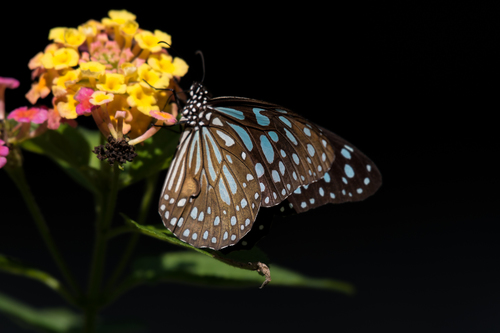
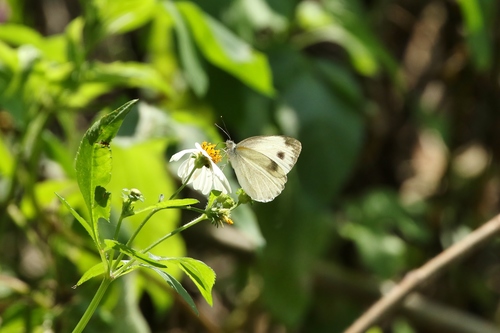
Junonia atlites, the grey pansy, is a species of nymphalid butterfly found in South Asia. J. atlites is found in Bangladesh, India, southern China, Cambodia, Indochina, the Malay Peninsula, western and central Indonesia, and the Philippines.

Upperside of both sexes pale lavender brown, apical half of wings paler. Forewing: cell with, three transverse, short, sinuous black bands, the outermost defining the discocellulars; a similar short, somewhat broader band beyond the apex of the cell; two transverse discal dusky black fasciae, the inner highly sinuous and outward, angulate above vein 4, the outer straighter, somewhat lunular, bordered by a series of whitish ovals with dusky or black centers. The black-centered spots in the ovals in interspaces 2, 5, and 6 margined posteriorly with rich ocherous yellow. Beyond this series of ovals is a lunular, narrow, transverse dark band, followed by sinuous subterminal and terminal broad dark lines. Apex of wing slightly fuliginous. Hindwing: a short slender black loop from veins 6 to 4 at apex of cell-area; two discal sinuous transverse dark, fasciae in continuation of those on the forewing: followed by a series... Wikipedia →

Global Distribution

Parks Where Found

# Park Country Daily sighting probability
1 Kaziranga National Park 🇮🇳 India
~50%
2 Bako National Park 🇲🇾 Malaysia
~50%
3 Cuc Phuong National Park 🇻🇳 Vietnam
~40%
4 Khao Sok National Park 🇹🇭 Thailand
~30%
5 Chitwan National Park 🇳🇵 Nepal
~30%
6 Keoladeo National Park 🇮🇳 India
~30%
7 Cat Tien National Park 🇻🇳 Vietnam
~30%
8 Royal Bardia National Park 🇳🇵 Nepal
~30%
9 Kanha National Park 🇮🇳 India
~30%
10 Kinabatangan Wildlife Sanctuary 🇲🇾 Malaysia
~20%
11 Sinharaja Forest Reserve 🇱🇰 Sri Lanka
~20%
12 Sepilok 🇲🇾 Malaysia
~20%
13 Gunung Leuser National Park 🇮🇩 Indonesia
~20%
14 Doi Inthanon National Park 🇹🇭 Thailand
~10%
15 Minneriya National Park 🇱🇰 Sri Lanka
~10%
16 Khao Yai National Park 🇹🇭 Thailand
~10%

Cities Where Found

# City Country Daily sighting probability
1 Raipur 🇮🇳 India
~40%
2 Dhaka 🇧🇩 Bangladesh
~40%
3 Jabalpur 🇮🇳 India
~40%
4 Phnom Penh 🇰🇭 Cambodia
~40%
5 Kalyan-Dombivli 🇮🇳 India
~40%
6 Mumbai 🇮🇳 India
~30%
7 Kochi 🇮🇳 India
~30%
8 Ponnani 🇮🇳 India
~30%
9 Guwahati 🇮🇳 India
~30%
10 Ho Chi Minh City 🇻🇳 Vietnam
~30%

Before you go

What are the chances of seeing a Grey Pansy in Kaziranga National Park?

Likely

About 50% of wildlife watchers report a Grey Pansy sighting in Kaziranga National Park on a given day, based on 11 verified sightings from GBIF citizen-science data from 2019 to 2026. It is the most-seen of the 5 insects we can rate there. Over three days the chance rises to about 80%, and over a week to over 90%, if each day is a fresh chance.

When is the best time to see a Grey Pansy in Kaziranga National Park?

December

In that month about 70% of wildlife watchers report a Grey Pansy in Kaziranga National Park on a given day, against about 10% in January, May and October, the lowest months. That is one of Kaziranga National Park's driest months, with about 10 mm of rain against 520 mm in June. June to September have too few records to rate.

What time of day is best to see a Grey Pansy?

Between 9 am and noon

Across all the parks we cover, that three-hour window holds the most Grey Pansy sightings with a recorded time, and about 8 in 10 of them come between 6 am and 6 pm: it is a daytime animal.

Is Kaziranga National Park the best place to see a Grey Pansy?

Yes

Of the 16 parks where we can rate Grey Pansy sightings, Kaziranga National Park has the highest daily chance: about 50%. Next come Bako National Park (Malaysia, about 50%) and Cuc Phuong National Park (Vietnam, about 40%). All parks ranked.

Where does the Grey Pansy sighting chance come from?

GBIF citizen-science records

It is estimated from how often the Grey Pansy is recorded against all the insects logged in Kaziranga National Park (11 verified sightings from 2019 to 2026), calibrated against known sighting rates. Figures are rounded to the nearest 10% because citizen-science data supports honest approximations, not decimals, and months with records from fewer than five people show "—". How it works.

← Back to Kaziranga National Park