Desert Wheatear

Desert Wheatear

Oenanthe deserti

Silhouette: PhyloPic

LCLeast ConcernNTVUENCR
Daily sighting probability <5% · Rare
at Keoladeo National Park

In 3 days <5%

15 Verified sightings at Keoladeo National Park From 2019 to 2026
290 In all 4 parks
December Best month
☀️ Diurnal When it's spotted

About the Desert Wheatear

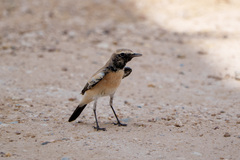
The desert wheatear (Oenanthe deserti) is a wheatear, a small passerine bird that was formerly classed as a member of the thrush family Turdidae, but is now more generally considered to be an Old World flycatcher (Muscicapidae). It is a migratory insectivorous species, 14.5 to 15 cm (5.7 to 5.9 in) in length. Both western and eastern forms of the desert wheatear are rare vagrants to western Europe. The western desert wheatear breeds in the Sahara and the northern Arabian Peninsula. The eastern race is found in the semi-deserts of Central Asia and in winter in Pakistan and northeast Africa.

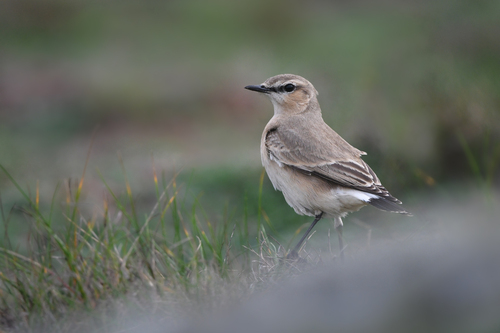
The plumage of the upper parts of the male in summer is buff. The underparts are white with a buff tinge on the breast. The black on the face and throat extends to the shoulders, and there is distinct white superciliary stripe. The female is greyer above and buffer below and has no black on the throat, and in the winter plumage the black on the throat of the male is partially obscured by the white tips of the feathers. A distinguishing characteristic, in both sexes of all ages, is that the entire tail is black to the level of the upper tail-coverts.

The desert wheatear feeds largely on insects which it picks up off the ground. It breeds in the spring when a clutch of usually four pale blue, slightly speckled eggs is laid in a well-concealed nest made of grasses, mosses and stems. Wikipedia →

Sounds

Call1:01

Mongolia · 2025

© Richard E. Webster · XC1028178 · CC BY-NC-SA 4.0

Song0:24

Kazakhstan · 2023

© Peter Boesman · XC813525 · CC BY-NC-ND 4.0

Subsong0:31

Mongolia · 2022

© Stanislas Wroza · XC765594 · CC BY-NC-SA 4.0

Global Distribution

Parks Where Found

# Park Country Daily sighting probability
1 Gobi Gurvansaikhan National Park 🇲🇳 Mongolia
~50%
2 Ranthambore National Park 🇮🇳 India
<5%
3 Keoladeo National Park 🇮🇳 India
<5%
4 Wadden Sea National Park 🇩🇪 Germany
<5%

Cities Where Found

# City Country Daily sighting probability
1 Vasai-Virar 🇮🇳 India
~10%
2 Kuwait City 🇰🇼 Kuwait
~10%
3 Manama 🇧🇭 Bahrain
~10%
4 Abu Dhabi 🇦🇪 United Arab Emirates
<5%
5 Doha 🇶🇦 Qatar
<5%
6 Tel Aviv 🇮🇱 Israel
<5%
7 Ahmedabad 🇮🇳 India
<5%
8 Jerusalem 🇮🇱 Israel
<5%
9 Taipei 🇹🇼 Taiwan
<5%
10 Pune 🇮🇳 India
<5%

Before you go

What are the chances of seeing a Desert Wheatear in Keoladeo National Park?

Rare

Under 5% of wildlife watchers report a Desert Wheatear sighting in Keoladeo National Park on a given day, based on 15 verified sightings from GBIF citizen-science data from 2019 to 2026. It is the 242nd most-seen of the 278 birds we can rate there. Over three days the chance rises to under 5%, if each day is a fresh chance.

When is the best time to see a Desert Wheatear in Keoladeo National Park?

Any time of year

In every month with enough records, under 5% of wildlife watchers report a Desert Wheatear in Keoladeo National Park on a given day, so our monthly data shows no clear season.

What time of day is best to see a Desert Wheatear?

Between 11 am and 2 pm

Across all the parks we cover, that three-hour window holds the most Desert Wheatear sightings with a recorded time, and about 7 in 10 of them come between 6 am and 6 pm: it is a daytime animal.

Is Keoladeo National Park the best place to see a Desert Wheatear?

3rd of 4

Of the 4 parks where we can rate Desert Wheatear sightings, Keoladeo National Park ranks 3rd at under 5%. The best odds are in Gobi Gurvansaikhan National Park (Mongolia, about 50%) and Ranthambore National Park (India, under 5%).

Where does the Desert Wheatear sighting chance come from?

GBIF citizen-science records

It is estimated from how often the Desert Wheatear is recorded against all the birds logged in Keoladeo National Park (15 verified sightings from 2019 to 2026), calibrated against known sighting rates. Figures are rounded to the nearest 10% because citizen-science data supports honest approximations, not decimals, and months with records from fewer than five people show "—". How it works.

← Back to Keoladeo National Park