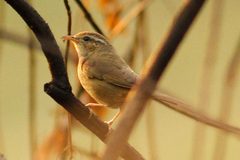
Aberrant Bush-Warbler

Aberrant Bush-Warbler

Horornis flavolivaceus

Silhouette: Sheatherius · PhyloPic

LCLeast ConcernNTVUENCR
Daily sighting probability ~10% · With luck
at Kerinci Seblat National Park

In 3 days ~30% in a week ~60%

67 Verified sightings at Kerinci Seblat National Park From 2019 to 2026
1,139 In all 6 parks
July Best month
🌅 Crepuscular When it's spotted

About the Aberrant Bush-Warbler

The aberrant bush warbler (Horornis flavolivaceus) is a species in the bush warbler family, Cettiidae. It was formerly included in the "Old World warbler" assemblage. It is found in central and southern China, and the northern extremes of Myanmar and Vietnam. It occurs in the countries of Bhutan, China, India, Indonesia, Laos, Malaysia, Myanmar, Nepal, Philippines, Thailand, Timor-Leste and Vietnam and also may occur in northeastern and southeastern Bangladesh.

The aberrant bush warbler was formally described in 1845 by the English zoologist Edward Blyth based on a specimen collected in Nepal. He placed the species in the genus Neornis and coined the binomial name Neornis flavolivacea. The specific epithet flavolivaceus combines the Latin flavus meaning "yellow" with the Modern Latin olivaceus meaning "olive-green". The aberrant bush warbler is now placed in the genus Horornis that was introduced in 1845 by Brian Hodgson.

Thirteen subspecies are recognised: H. f... Wikipedia →

Sounds

Call0:08

China · 2025

© Jelle Scharringa · XC1019766 · CC BY-NC-SA 4.0

Song0:15

Malaysia · 2024

© Lim Ying Hien · XC953606 · CC BY-NC-ND 4.0

Call0:39

Thailand · 2024

© Peter Ericsson · XC955228 · CC BY-NC-SA 4.0

Global Distribution

Parks Where Found

# Park Country Daily sighting probability
1 Kinabalu Park 🇲🇾 Malaysia
~40%
2 Langtang National Park 🇳🇵 Nepal
~10%
3 Kerinci Seblat National Park 🇮🇩 Indonesia
~10%
4 Chitwan National Park 🇳🇵 Nepal
<5%
5 Jim Corbett National Park 🇮🇳 India
<5%
6 Doi Inthanon National Park 🇹🇭 Thailand
<5%

Cities Where Found

# City Country Daily sighting probability
1 Kathmandu 🇳🇵 Nepal
<5%
2 Dehradun 🇮🇳 India
<5%

Before you go

What are the chances of seeing an Aberrant Bush-Warbler in Kerinci Seblat National Park?

With luck

About 10% of wildlife watchers report an Aberrant Bush-Warbler sighting in Kerinci Seblat National Park on a given day, based on 67 verified sightings from GBIF citizen-science data from 2019 to 2026. It is the 81st most-seen of the 203 birds we can rate there. Over three days the chance rises to about 30%, and over a week to about 60%, if each day is a fresh chance.

When is the best time to see an Aberrant Bush-Warbler in Kerinci Seblat National Park?

July and December

In those months about 20% of wildlife watchers report an Aberrant Bush-Warbler in Kerinci Seblat National Park on a given day, against under 5% in March and October, the lowest months. January has too few records to rate.

What time of day is best to see an Aberrant Bush-Warbler?

Between 2 and 5 am

Across all the parks we cover, that three-hour window holds the most Aberrant Bush-Warbler sightings with a recorded time, and about 6 in 10 of them come between 6 pm and 6 am: it is most active around dawn and dusk.

Is Kerinci Seblat National Park the best place to see an Aberrant Bush-Warbler?

3rd of 6

Of the 6 parks where we can rate Aberrant Bush-Warbler sightings, Kerinci Seblat National Park ranks 3rd at about 10%. The best odds are in Kinabalu Park (Malaysia, about 40%) and Langtang National Park (Nepal, about 10%).

Which relatives of the Aberrant Bush-Warbler live in Kerinci Seblat National Park?

Same family: Cettiidae

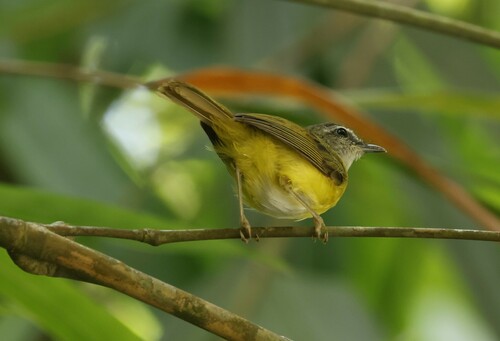
The closest relatives of the Aberrant Bush-Warbler that you can see in Kerinci Seblat National Park (family Cettiidae, Bush Warblers and Allies) are Mountain Tailorbird (about 30%) and Yellow-bellied Warbler (about 20%), with each one's daily chance of a sighting.

Where does the Aberrant Bush-Warbler sighting chance come from?

GBIF citizen-science records

It is estimated from how often the Aberrant Bush-Warbler is recorded against all the birds logged in Kerinci Seblat National Park (67 verified sightings from 2019 to 2026), calibrated against known sighting rates. Figures are rounded to the nearest 10% because citizen-science data supports honest approximations, not decimals, and months with records from fewer than five people show "—". How it works.

← Back to Kerinci Seblat National Park