Olive Sunbird

Olive Sunbird

Cyanomitra olivacea

Silhouette: Sheatherius · PhyloPic

LCLeast ConcernNTVUENCR
Daily sighting probability ~30% · Possible
at Kibale National Park

In 3 days ~60% in a week ~90%

458 Verified sightings at Kibale National Park From 2019 to 2026
2,215 In all 14 parks
October Best month
☀️ Diurnal When it's spotted

About the Olive Sunbird

The olive sunbird (Cyanomitra olivacea) is a large African species of sunbird belonging to the family Nectariniidae which encompasses species of sunbirds, spiderhunters, and flowerpeckers, and sugarbirds. It has a large distribution that spans across central Africa from western countries including Senegal, Guinea, and Angola towards eastern countries including Ethiopia, Kenya, and Mozambique. This range also extends to southern African countries including South Africa and Zimbabwe. It is mainly nectarivorous and lives in a variety of forest, scrubland, and modified habitats.

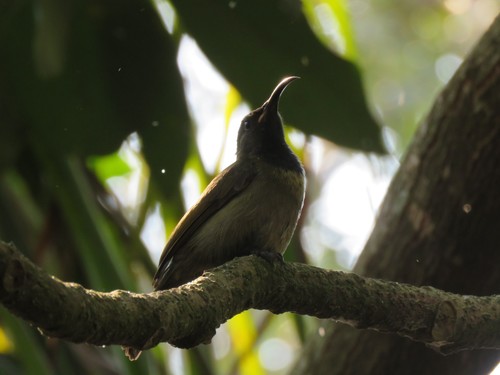
The olive sunbird is a large sunbird that ranges from 6.2-15 g in mass, 50–73 mm in wing length, 20–29 mm in bill length, 35–66 mm in tail length, and 12–15 cm in overall body size depending on the subspecies and sex. Its body colouration can vary from fully dark-olive to dull-olive with a paler olive-yellow or olive-grey underside. It has a long beak that curves downward and varies in colour from solid black to mottled grey, beige, and yellow-orange depending on the subspecies. Yellowish-orange pectoral tufts can be present in the males and females found in eastern subspecies while only males... Wikipedia →

Sounds

Dawn song0:34

Ivory Coast · 2026

© Étienne Leroy · XC1186483 · CC BY-NC-SA 4.0

Call0:37

Kenya · 2024

© Peter Boesman · XC948151 · CC BY-NC-ND 4.0

Song0:12

Kenya · 2020

© Colin Jackson · XC594595 · CC BY-NC-SA 4.0

Global Distribution

Parks Where Found

# Park Country Daily sighting probability
1 Semuliki National Park 🇺🇬 Uganda
~40%
2 iSimangaliso Wetland Park 🇿🇦 South Africa
~40%
3 Kibale National Park 🇺🇬 Uganda
~30%
4 Arusha National Park 🇹🇿 Tanzania
~30%
5 Bwindi Impenetrable National Park 🇺🇬 Uganda
~30%
6 Taï National Park 🇨🇮 Ivory Coast
~20%
7 Nyungwe National Park 🇷🇼 Rwanda
~10%
8 Mkomazi National Park 🇹🇿 Tanzania
~10%
9 Hluhluwe-Imfolozi Park 🇿🇦 South Africa
<5%
10 Virunga National Park 🇨🇩 Democratic Republic of the Congo
<5%
11 uMkhuze Game Reserve 🇿🇦 South Africa
<5%
12 Murchison Falls National Park 🇺🇬 Uganda
<5%
13 Queen Elizabeth National Park 🇺🇬 Uganda
<5%
14 Ngorongoro Conservation Area 🇹🇿 Tanzania
<5%

Cities Where Found

# City Country Daily sighting probability
1 Mombasa 🇰🇪 Kenya
~30%
2 Durban 🇿🇦 South Africa
~20%
3 Yaoundé 🇨🇲 Cameroon
~10%
4 Kampala 🇺🇬 Uganda
~10%
5 Abidjan 🇨🇮 Côte d'Ivoire
~10%
6 Dar es-Salaam 🇹🇿 Tanzania
~10%
7 Zanzibar City 🇹🇿 Tanzania
<5%

Before you go

What are the chances of seeing an Olive Sunbird in Kibale National Park?

Possible

About 30% of wildlife watchers report an Olive Sunbird sighting in Kibale National Park on a given day, based on 458 verified sightings from GBIF citizen-science data from 2019 to 2026. It is the 51st most-seen of the 366 birds we can rate there. Over three days the chance rises to about 60%, and over a week to about 90%, if each day is a fresh chance.

When is the best time to see an Olive Sunbird in Kibale National Park?

October

In that month about 50% of wildlife watchers report an Olive Sunbird in Kibale National Park on a given day, against about 20% in June and November–April, the lowest months. That is one of Kibale National Park's wettest months, with about 140 mm of rain against 20 mm in February.

What time of day is best to see an Olive Sunbird?

Between 8 and 11 am

Across all the parks we cover, that three-hour window holds the most Olive Sunbird sightings with a recorded time, and nearly all of them come between 6 am and 6 pm: it is a daytime animal.

Which relatives of the Olive Sunbird live in Kibale National Park?

Same genus: Cyanomitra

The closest relatives of the Olive Sunbird that you can see in Kibale National Park (genus Cyanomitra, Brownish Sunbirds) are Green-headed Sunbird (about 30%) and Blue-throated Brown Sunbird (about 30%), with each one's daily chance of a sighting.

Where does the Olive Sunbird sighting chance come from?

GBIF citizen-science records

It is estimated from how often the Olive Sunbird is recorded against all the birds logged in Kibale National Park (458 verified sightings from 2019 to 2026), calibrated against known sighting rates. Figures are rounded to the nearest 10% because citizen-science data supports honest approximations, not decimals, and months with records from fewer than five people show "—". How it works.

← Back to Kibale National Park