Great Frigatebird

Great Frigatebird

Fregata minor

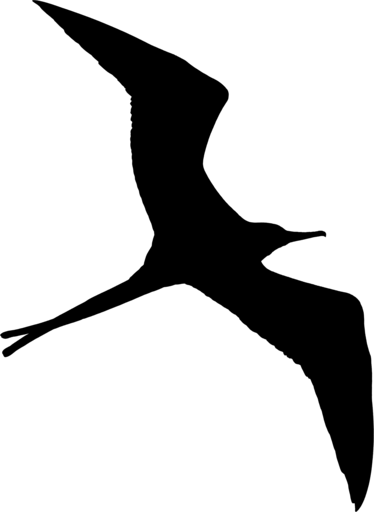
Silhouette: Emily Willoughby · PhyloPic

LCLeast ConcernNTVUENCR
Daily sighting probability ~90% · Very likely
at Kilauea Point National Wildlife Refuge

In 3 days >90%

1,478 Verified sightings at Kilauea Point National Wildlife Refuge From 2019 to 2026
6,519 In all 8 parks
November Best month
☀️ Diurnal When it's spotted

About the Great Frigatebird

The great frigatebird (Fregata minor) is a large seabird in the frigatebird family. There are major nesting populations in the tropical Pacific Ocean, such as Hawaii and the Galápagos Islands; in the Indian Ocean, colonies can be found in the Seychelles (on Aldabra and Aride Islands) and Mauritius, and there is a tiny population in the South Atlantic, mostly on and around St. Helena and Boatswain Bird Island (Ascension Island).

The great frigatebird is a large and lightly built seabird up to 105 cm long with predominantly black plumage. The species exhibits sexual dimorphism; the female is larger than the adult male and has a white throat and breast, and the male's scapular feathers have a purple-green sheen. In the breeding season, the male is able to distend his striking red gular sac. The species feeds on fish taken in flight from the ocean's surface (mostly flying fish), and indulges in kleptoparasitism less frequently than other frigatebirds. They feed in pelagic waters within 80 km (50 mi) of their breeding colony or roosting areas.

The great frigatebird was formally described in 1789 by the German naturalist Johann Friedrich Gmelin in his revised and expanded edition...

Wikipedia →

Sounds

Begging call1:06

France · 2021

© AUDEVARD Aurélien · XC619655 · CC BY-NC-SA 4.0

Call0:06

Ecuador · 2016

© Oscar Campbell · XC332851 · CC BY-NC-SA 4.0

Song0:52

Ecuador · 2011

© Eric DeFonso · XC114150 · CC BY-NC-SA 3.0

Global Distribution

Parks Where Found

# Park Country Daily sighting probability
1 Isla del Coco National Park 🇨🇷 Costa Rica
>90%
2 Kilauea Point National Wildlife Refuge 🇺🇸 United States
~90%
3 Galápagos Islands 🇪🇨 Ecuador
~30%
4 Raja Ampat 🇮🇩 Indonesia
~10%
5 Komodo National Park 🇮🇩 Indonesia
~10%
6 Haleakala National Park 🇺🇸 United States
<5%
7 Tangkoko Nature Reserve 🇮🇩 Indonesia
<5%
8 Bali Barat National Park 🇮🇩 Indonesia
<5%

Zoos & Centres Where Found

# Zoo / Centre Country
1 Sea Life Park Hawaii 🇺🇸 United States In captivity

Before you go

What are the chances of seeing a Great Frigatebird in Kilauea Point National Wildlife Refuge?

Very likely

About 90% of wildlife watchers report a Great Frigatebird sighting in Kilauea Point National Wildlife Refuge on a given day, based on 1,478 verified sightings from GBIF citizen-science data from 2019 to 2026. It is the 3rd most-seen of the 44 birds we can rate there. Over three days the chance rises to over 90%, if each day is a fresh chance.

When is the best time to see a Great Frigatebird in Kilauea Point National Wildlife Refuge?

October and November

In those months over 90% of wildlife watchers report a Great Frigatebird in Kilauea Point National Wildlife Refuge on a given day, against about 70% in January and February, the lowest months.

What time of day is best to see a Great Frigatebird?

Between 9 am and noon

Across all the parks we cover, that three-hour window holds the most Great Frigatebird sightings with a recorded time, and about 9 in 10 of them come between 6 am and 6 pm: it is a daytime animal.

Is Kilauea Point National Wildlife Refuge the best place to see a Great Frigatebird?

2nd of 8

Of the 8 parks where we can rate Great Frigatebird sightings, Kilauea Point National Wildlife Refuge ranks 2nd at about 90%. The best odds are in Isla del Coco National Park (Costa Rica, over 90%).

Where does the Great Frigatebird sighting chance come from?

GBIF citizen-science records

It is estimated from how often the Great Frigatebird is recorded against all the birds logged in Kilauea Point National Wildlife Refuge (1,478 verified sightings from 2019 to 2026), calibrated against known sighting rates. Figures are rounded to the nearest 10% because citizen-science data supports honest approximations, not decimals, and months with records from fewer than five people show "—". How it works.

← Back to Kilauea Point National Wildlife Refuge