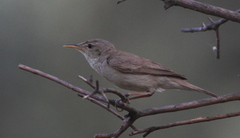
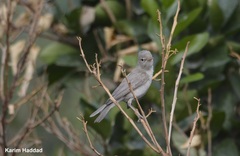
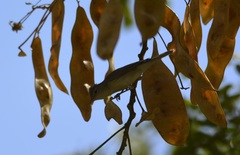
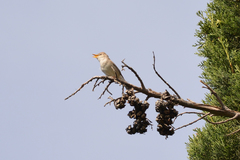
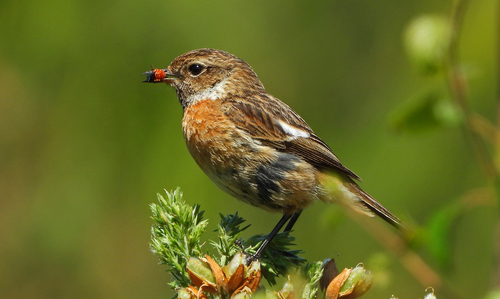
Eastern Olivaceous Warbler

Eastern Olivaceous Warbler

Iduna pallida

Silhouette: Sheatherius · PhyloPic

LCLeast ConcernNTVUENCR
Daily sighting probability <5% · Rare
at Kiskunság National Park

In 3 days <5% in a week ~10%

10 Verified sightings at Kiskunság National Park From 2019 to 2026
423 In all 16 parks
May Best month
☀️ Diurnal When it's spotted

About the Eastern Olivaceous Warbler

The eastern olivaceous warbler (Iduna pallida), known simply as the olivaceous warbler when its western relative is referred to as the 'isabelline warbler', is a small passerine bird with drab plumage tones, that is native to the Old World. For the most part it breeds in southeastern Europe, the Middle East and adjacent western Asia, and winters in the northern Afrotropics.

The eastern olivaceous warbler is a "warbler", formerly placed in the Old World warblers when these were a paraphyletic wastebin taxon. It is now considered a member of the acrocephaline warblers, Acrocephalidae, in the tree warbler genus Iduna. It was formerly regarded as part of a wider "olivaceous warbler" species, but as a result of modern taxonomic developments, this species is now usually considered distinct from the western olivaceous warbler, Iduna opaca.

Keyserling and Blasius gave no explanation of the genus name Iduna. The specific pallida is Latin for "pale". This small passerine bird is found in dry open country, including cultivation, with bushes or some trees. Like most warblers it is insectivorous.

It is migratory, wintering in sub-Saharan Africa... Wikipedia →

Sounds

Song0:37

Cyprus · 2025

© Alain Verneau · XC1049001 · CC BY-NC-SA 4.0

Call0:46

Uzbekistan · 2025

© Frank Lambert · XC1029834 · CC BY-NC-ND 4.0

Alarm call0:11

Greece · 2023

© Manuel Tacke · XC819413 · CC BY-NC-SA 4.0

Global Distribution

Parks Where Found

# Park Country Daily sighting probability
1 Awash National Park 🇪🇹 Ethiopia
~10%
2 Tsavo West National Park 🇰🇪 Kenya
~10%
3 Tsavo East National Park 🇰🇪 Kenya
~10%
4 Samburu National Reserve 🇰🇪 Kenya
~10%
5 Mkomazi National Park 🇹🇿 Tanzania
<5%
6 Lake Manyara National Park 🇹🇿 Tanzania
<5%
7 Nairobi National Park 🇰🇪 Kenya
<5%
8 Tarangire National Park 🇹🇿 Tanzania
<5%
9 Kidepo Valley National Park 🇺🇬 Uganda
<5%
10 Arusha National Park 🇹🇿 Tanzania
<5%
11 Murchison Falls National Park 🇺🇬 Uganda
<5%
12 Lake Mburo National Park 🇺🇬 Uganda
<5%
13 Amboseli National Park 🇰🇪 Kenya
<5%
14 Kiskunság National Park 🇭🇺 Hungary
<5%
15 Serengeti National Park 🇹🇿 Tanzania
<5%
16 Queen Elizabeth National Park 🇺🇬 Uganda
<5%

Cities Where Found

# City Country Daily sighting probability
1 N'Djamena 🇹🇩 Chad
~30%
2 Jerusalem 🇮🇱 Israel
~30%
3 Abu Dhabi 🇦🇪 United Arab Emirates
~20%
4 Tehran 🇮🇷 Iran
~20%
5 Antalya 🇹🇷 Turkey
~10%
6 Athens 🇬🇷 Greece
~10%
7 Doha 🇶🇦 Qatar
~10%
8 Ramallah 🇵🇸 Palestine
~10%
9 Istanbul 🇹🇷 Turkey
~10%
10 Yerevan 🇦🇲 Armenia
~10%

Before you go

What are the chances of seeing an Eastern Olivaceous Warbler in Kiskunság National Park?

Rare

Under 5% of wildlife watchers report an Eastern Olivaceous Warbler sighting in Kiskunság National Park on a given day, based on 10 verified sightings from GBIF citizen-science data from 2019 to 2026. It is the 211th most-seen of the 222 birds we can rate there. Over three days the chance rises to under 5%, and over a week to about 10%, if each day is a fresh chance.

When is the best time to see an Eastern Olivaceous Warbler in Kiskunság National Park?

Any time of year

In every month with enough records, under 5% of wildlife watchers report an Eastern Olivaceous Warbler in Kiskunság National Park on a given day, so our monthly data shows no clear season.

What time of day is best to see an Eastern Olivaceous Warbler?

Between 6 and 9 am

Across all the parks we cover, that three-hour window holds the most Eastern Olivaceous Warbler sightings with a recorded time, and about 8 in 10 of them come between 6 am and 6 pm: it is a daytime animal.

Is Kiskunság National Park the best place to see an Eastern Olivaceous Warbler?

14th of 16

Of the 16 parks where we can rate Eastern Olivaceous Warbler sightings, Kiskunság National Park ranks 14th at under 5%. The best odds are in Awash National Park (Ethiopia, about 10%), Tsavo West National Park (Kenya, about 10%) and Tsavo East National Park (Kenya, about 10%).

Which relatives of the Eastern Olivaceous Warbler live in Kiskunság National Park?

Same family: Acrocephalidae

The closest relatives of the Eastern Olivaceous Warbler that you can see in Kiskunság National Park (family Acrocephalidae, Reed Warblers and Allies) are Eurasian Reed-Warbler (about 30%), Great Reed-Warbler (about 30%) and Sedge Warbler (about 30%), with each one's daily chance of a sighting.

Where does the Eastern Olivaceous Warbler sighting chance come from?

GBIF citizen-science records

It is estimated from how often the Eastern Olivaceous Warbler is recorded against all the birds logged in Kiskunság National Park (10 verified sightings from 2019 to 2026), calibrated against known sighting rates. Figures are rounded to the nearest 10% because citizen-science data supports honest approximations, not decimals, and months with records from fewer than five people show "—". How it works.

← Back to Kiskunság National Park