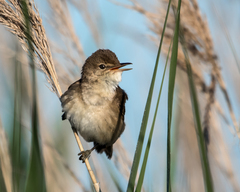
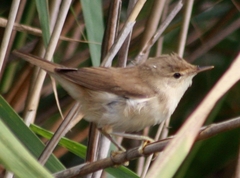
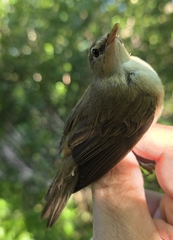

Eurasian Reed-Warbler

Eurasian Reed-Warbler

Acrocephalus scirpaceus

Silhouette: Roger Culos · PhyloPic

LCLeast ConcernNTVUENCR
Daily sighting probability ~30% · Possible
at Kiskunság National Park

In 3 days ~60% in a week ~90%

308 Verified sightings at Kiskunság National Park From 2019 to 2026
4,285 In all 31 parks
April Best month
☀️ Diurnal When it's spotted

About the Eurasian Reed-Warbler

The common reed warbler or Eurasian reed-warbler (Acrocephalus scirpaceus) is an Old World warbler in the genus Acrocephalus. It breeds across Europe into the temperate western Palaearctic where it is migratory, wintering in sub-Saharan Africa. It is also a resident species over large parts of Africa.

The common reed warbler was formally described in 1804 by the French naturalist Johann Hermann under the binomial name Turdus scirpaceus. The type locality is Alsace. The common reed warbler is now one of around 40 species placed in the genus Acrocephalus that was introduced by Johann Andreas Naumann and his son Johann Friedrich Naumann in 1811. The genus name Acrocephalus is from Ancient Greek akros, "highest", and kephalē, "head". It is possible that the Naumanns thought akro- meant "sharp-pointed," as in ἄκρα (akra, 'end, point'). The specific scirpaceus is from Latin and means "belonging to the bulrushes" (scirpus).

Ten subspecies are recognised: Wikipedia →

Sounds

Song1:15

Poland · 2026

© Romuald Mikusek · XC1152109 · CC BY-NC-SA 4.0

Call0:20

Sweden · 2025

© Lars Edenius · XC1009422 · CC BY-NC-SA 4.0

Aberrant0:54

France · 2023

© Olivier SWIFT · XC862814 · CC BY-NC-SA 4.0

Global Distribution

Parks Where Found

# Park Country Daily sighting probability
1 Hortobágy National Park 🇭🇺 Hungary
~40%
2 Fertő-Hanság National Park 🇭🇺 Hungary
~30%
3 Kiskunság National Park 🇭🇺 Hungary
~30%
4 Doñana National Park 🇪🇸 Spain
~20%
5 Camargue 🇫🇷 France
~20%
6 Sierra Nevada National Park 🇪🇸 Spain
~20%
7 Monfragüe National Park 🇪🇸 Spain
~10%
8 Białowieża National Park 🇵🇱 Poland
~10%
9 Snowdonia National Park 🇬🇧 United Kingdom
~10%
10 Biebrza National Park 🇵🇱 Poland
~10%
11 Bavarian Forest National Park 🇩🇪 Germany
~10%
12 Wadden Sea National Park 🇩🇪 Germany
~10%
13 Namib-Naukluft National Park 🇳🇦 Namibia
~10%
14 Garden Route National Park 🇿🇦 South Africa
~10%
15 Niokolo-Koba National Park 🇸🇳 Senegal
<5%
16 Murchison Falls National Park 🇺🇬 Uganda
<5%
17 iSimangaliso Wetland Park 🇿🇦 South Africa
<5%
18 Queen Elizabeth National Park 🇺🇬 Uganda
<5%
19 Ngorongoro Conservation Area 🇹🇿 Tanzania
<5%
20 Lake Mburo National Park 🇺🇬 Uganda
<5%
21 Addo Elephant National Park 🇿🇦 South Africa
<5%
22 uMkhuze Game Reserve 🇿🇦 South Africa
<5%
23 Nairobi National Park 🇰🇪 Kenya
<5%
24 Tsavo West National Park 🇰🇪 Kenya
<5%
25 West Coast National Park 🇿🇦 South Africa
<5%
26 Chobe National Park 🇧🇼 Botswana
<5%
27 Tarangire National Park 🇹🇿 Tanzania
<5%
28 Table Mountain National Park 🇿🇦 South Africa
<5%
29 Sierra de Guadarrama National Park 🇪🇸 Spain
<5%
30 Kruger National Park 🇿🇦 South Africa
<5%
31 Etosha National Park 🇳🇦 Namibia
<5%

Cities Where Found

# City Country Daily sighting probability
1 Jerusalem 🇮🇱 Israel
~40%
2 Antalya 🇹🇷 Turkey
~20%
3 Sincan 🇹🇷 Turkey
~20%
4 Zanzibar City 🇹🇿 Tanzania
~20%
5 Kuwait City 🇰🇼 Kuwait
~10%
6 Liverpool 🇬🇧 United Kingdom
~10%
7 Rabat 🇲🇦 Morocco
~10%
8 London 🇬🇧 United Kingdom
~10%
9 Helsinki 🇫🇮 Finland
~10%
10 Tunis 🇹🇳 Tunisia
~10%

Before you go

What are the chances of seeing a Eurasian Reed-Warbler in Kiskunság National Park?

Possible

About 30% of wildlife watchers report a Eurasian Reed-Warbler sighting in Kiskunság National Park on a given day, based on 308 verified sightings from GBIF citizen-science data from 2019 to 2026. It is the 61st most-seen of the 222 birds we can rate there. Over three days the chance rises to about 60%, and over a week to about 90%, if each day is a fresh chance.

When is the best time to see a Eurasian Reed-Warbler in Kiskunság National Park?

April

In that month about 60% of wildlife watchers report a Eurasian Reed-Warbler in Kiskunság National Park on a given day, against under 5% in November, the lowest month.

What time of day is best to see a Eurasian Reed-Warbler?

Between 8 and 11 am

Across all the parks we cover, that three-hour window holds the most Eurasian Reed-Warbler sightings with a recorded time, and about 9 in 10 of them come between 6 am and 6 pm: it is a daytime animal.

Is Kiskunság National Park the best place to see a Eurasian Reed-Warbler?

3rd of 31

Of the 31 parks where we can rate Eurasian Reed-Warbler sightings, Kiskunság National Park ranks 3rd at about 30%. The best odds are in Hortobágy National Park (Hungary, about 40%) and Fertő-Hanság National Park (Hungary, about 30%).

Which relatives of the Eurasian Reed-Warbler live in Kiskunság National Park?

Same genus: Acrocephalus

The closest relatives of the Eurasian Reed-Warbler that you can see in Kiskunság National Park (genus Acrocephalus, Reed Warblers) are Great Reed-Warbler (about 30%), Sedge Warbler (about 30%) and Marsh Warbler (about 10%), with each one's daily chance of a sighting.

Where does the Eurasian Reed-Warbler sighting chance come from?

GBIF citizen-science records

It is estimated from how often the Eurasian Reed-Warbler is recorded against all the birds logged in Kiskunság National Park (308 verified sightings from 2019 to 2026), calibrated against known sighting rates. Figures are rounded to the nearest 10% because citizen-science data supports honest approximations, not decimals, and months with records from fewer than five people show "—". How it works.

← Back to Kiskunság National Park