About the Nine-Spotted Moth
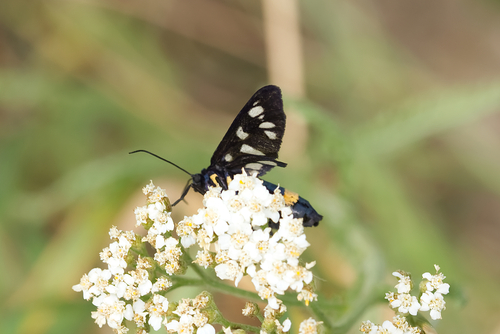
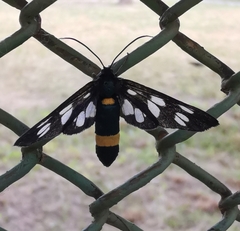
The nine-spotted moth or yellow belted burnet (Amata phegea, formerly Syntomis phegea) is a moth in the family Erebidae ("tiger moths"). The species was first described by Carl Linnaeus in his 1758 10th edition of Systema Naturae.
The nine-spotted moth is chiefly found in southern Europe but also seen up to northern Germany, and in the east to Anatolia and the Caucasus, and there are some populations in the south-eastern Dutch nature reserves of Leudal and Meinweg. It does not breed in the United Kingdom, but it is a very rare immigrant. It is also found In India these days. The species prefers drier areas, open ranges with shrubs and trees as well as open forests and warm, sunny slopes.
Amata phegea reaches a wingspan of 35–40 millimetres (1.4–1.6 in). Males are smaller than females and have thicker antennae. Wings are blueish black or greenish black with white spots and metallic sheen. The number and the size of spots are quite variable. Usually there are six white spots on the forewings and two or three spots on the hindwings. The body is quite long, with a yellow spot on the second segment of the abdomen. A further feature is the... Wikipedia →