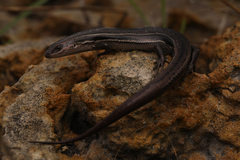
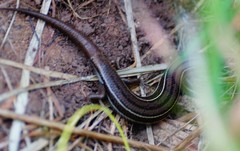
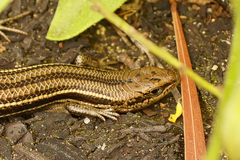
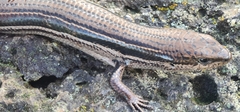
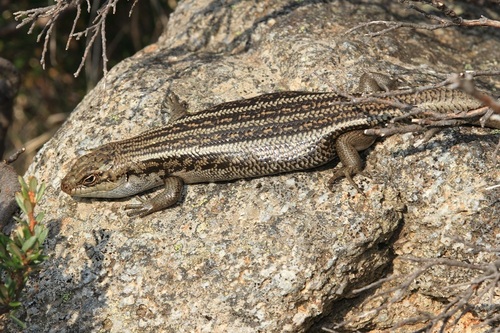
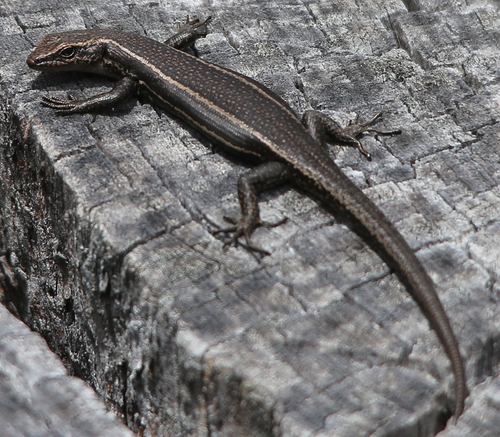
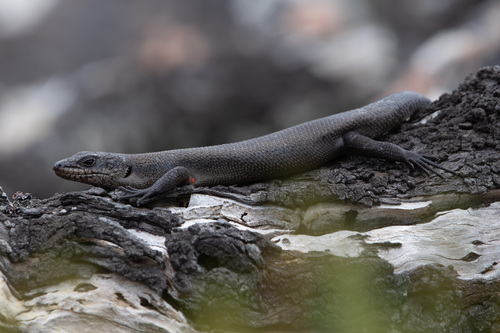
Eastern Three-lined Skink

Eastern Three-lined Skink

Acritoscincus duperreyi

Silhouette: David Orr · PhyloPic

LCLeast ConcernNTVUENCR Endemic
Daily sighting probability ~10% · With luck
at Kosciuszko National Park

In 3 days ~30% in a week ~60%

5 Verified sightings at Kosciuszko National Park From 2019 to 2026
22 In all 3 parks
November Best month
☀️ Diurnal When it's spotted

About the Eastern Three-lined Skink

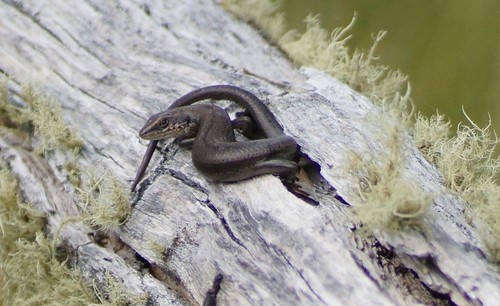
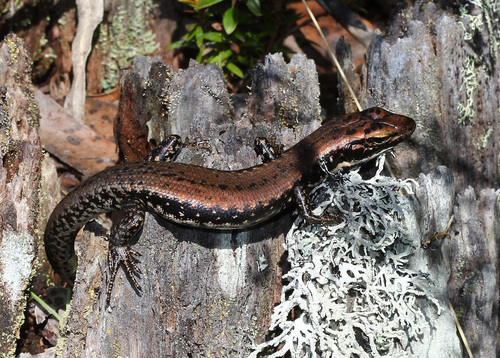
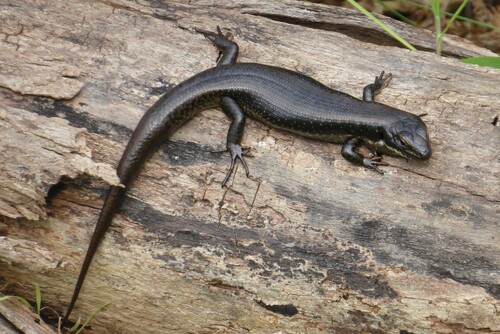
The eastern three-lined skink (Acritoscincus duperreyi), also known commonly as the bold-striped cool-skink, is a species of skink, a lizard in the family Scincidae. The species is endemic to Australia. A. duperreyi has been extensively studied in the context of understanding the evolution of learning, viviparity in lizards, and temperature- and genetic-sex determination. A. duperreyi is classified as a species of "Least Concern" by the IUCN.

The species has also been placed in the genus Bassiana, with two other species of skink: B. trilineata and B. palynota. Micro-genetic analyses have revealed that the genus Bassiana began to diversify during the Miocene, suggesting that these three lineages started to form between 16.2 and 9.7 million years ago. Individual species in the genus began to diversify as well through the Miocene and into the Early Pleistocene. Within A. duperreyi, population-level diversification between the population on Tasmania, Kangaroo Island, and mainland Australia likely took place during the Upper Pliocene through the Early Pleistocene. Genetic evidence suggests that there are seven distinct lineages of A. duperreyi: five on mainland Australia,... Wikipedia →

Global Distribution

Parks Where Found

# Park Country Daily sighting probability
1 Wilsons Promontory National Park 🇦🇺 Australia
~20%
2 Kosciuszko National Park 🇦🇺 Australia
~10%
3 Great Otway National Park 🇦🇺 Australia
~10%

Cities Where Found

# City Country Daily sighting probability
1 Melbourne 🇦🇺 Australia
<5%

Closest Relatives at Kosciuszko National Park

Before you go

What are the chances of seeing an Eastern Three-lined Skink in Kosciuszko National Park?

With luck

About 10% of wildlife watchers report an Eastern Three-lined Skink sighting in Kosciuszko National Park on a given day, based on 5 verified sightings from GBIF citizen-science data from 2019 to 2026. It is the 19th most-seen of the 20 reptiles we can rate there. Over three days the chance rises to about 30%, and over a week to about 60%, if each day is a fresh chance.

When is the best time to see an Eastern Three-lined Skink in Kosciuszko National Park?

February and November

In those months about 20% of wildlife watchers report an Eastern Three-lined Skink in Kosciuszko National Park on a given day, against under 5% in April to October, the lowest months.

What time of day is best to see an Eastern Three-lined Skink?

Between 10 am and 1 pm

Across all the parks we cover, that three-hour window holds the most Eastern Three-lined Skink sightings with a recorded time, and about 9 in 10 of them come between 6 am and 6 pm: it is a daytime animal.

Is Kosciuszko National Park the best place to see an Eastern Three-lined Skink?

2nd of 3

Of the 3 parks where we can rate Eastern Three-lined Skink sightings, Kosciuszko National Park ranks 2nd at about 10%. The best odds are in Wilsons Promontory National Park (Australia, about 20%).

Which relatives of the Eastern Three-lined Skink live in Kosciuszko National Park?

Same family: Scincidae

The closest relatives of the Eastern Three-lined Skink that you can see in Kosciuszko National Park (family Scincidae, Skinks) are Blotched Bluetongue (about 40%), Entrecasteaux's Skink (about 40%) and Cunningham's Skink (about 40%), with each one's daily chance of a sighting.

Where does the Eastern Three-lined Skink sighting chance come from?

GBIF citizen-science records

It is estimated from how often the Eastern Three-lined Skink is recorded against all the reptiles logged in Kosciuszko National Park (5 verified sightings from 2019 to 2026), calibrated against known sighting rates. Figures are rounded to the nearest 10% because citizen-science data supports honest approximations, not decimals, and months with records from fewer than five people show "—". How it works.

← Back to Kosciuszko National Park