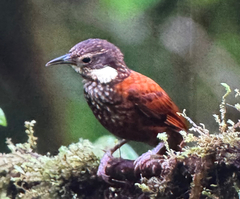
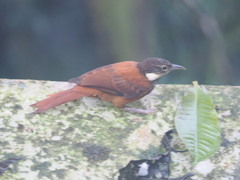

Buffy Tuftedcheek

Buffy Tuftedcheek

Pseudocolaptes lawrencii

Silhouette: Sheatherius · PhyloPic

LCLeast ConcernNTVUENCR
Daily sighting probability <5% · Rare
at La Amistad International Park (Panama)

In 3 days ~10% in a week ~20%

321 Verified sightings at La Amistad International Park (Panama) From 2019 to 2026
2,337 In all 9 parks
June Best month
☀️ Diurnal When it's spotted

About the Buffy Tuftedcheek

The buffy tuftedcheek (Pseudocolaptes lawrencii) or Lawrence's tuftedcheek, is a passerine bird in the Furnariinae subfamily of the ovenbird family Furnariidae. It is found in Costa Rica and Panama. The buffy tuftedcheek and the Pacific tuftedcheek (Pseudocolaptes johnsoni) were previously considered subspecies of the streaked tuftedcheek (P. boissonneautii). The buffy tuftedcheek was then separated with the Pacific as a subspecies of it. Though some authors in the early twentieth century treated the Pacific as a species, major taxonomic systems did not begin treating the buffy and Pacific tuftedcheeks as separate species until the mid-2010s. The American Ornithological Society and the Clements taxonomy were the last; they implemented the split in 2022.

The buffy tuftedcheek's alternative English name and it specific epithet commemorate the American amateur ornithologist George Newbold Lawrence. The buffy tuftedcheek is monotypic. The buffy tuftedcheek is 20 to 21 cm (7.9 to 8.3 in) long and weighs about 35 to 50 g (1.2 to 1.8 oz). The sexes' plumages are alike but the female has a significantly longer bill than the male. The species... Wikipedia →

Sounds

Song0:18

Ecuador · 2021

© Francisco Sornoza · XC647263 · CC BY-NC-SA 4.0

Call0:16

Costa Rica · 2011

© Andrew Spencer · XC71512 · CC BY-NC-ND 2.5

Song0:16

Costa Rica · 2021

© Jorge Gabriel Campos · XC627615 · CC BY-NC-SA 4.0

Global Distribution

Parks Where Found

# Park Country Daily sighting probability
1 Volcán Barú National Park 🇵🇦 Panama
~10%
2 Los Quetzales National Park 🇨🇷 Costa Rica
~10%
3 Tapantí-Macizo de la Muerte National Park 🇨🇷 Costa Rica
~10%
4 La Amistad International Park (Panama) 🇵🇦 Panama
<5%
5 Braulio Carrillo National Park 🇨🇷 Costa Rica
<5%
6 Chirripó National Park 🇨🇷 Costa Rica
<5%
7 Monteverde Cloud Forest Reserve 🇨🇷 Costa Rica
<5%
8 Poás Volcano National Park 🇨🇷 Costa Rica
<5%
9 Arenal Volcano National Park 🇨🇷 Costa Rica
<5%

Before you go

What are the chances of seeing a Buffy Tuftedcheek in La Amistad International Park (Panama)?

Rare

Under 5% of wildlife watchers report a Buffy Tuftedcheek sighting in La Amistad International Park (Panama) on a given day, based on 321 verified sightings from GBIF citizen-science data from 2019 to 2026. It is the 325th most-seen of the 657 birds we can rate there. Over three days the chance rises to about 10%, and over a week to about 20%, if each day is a fresh chance.

When is the best time to see a Buffy Tuftedcheek in La Amistad International Park (Panama)?

June

In that month about 10% of wildlife watchers report a Buffy Tuftedcheek in La Amistad International Park (Panama) on a given day, against under 5% in July to May, the lowest months.

What time of day is best to see a Buffy Tuftedcheek?

Between 9 am and noon

Across all the parks we cover, that three-hour window holds the most Buffy Tuftedcheek sightings with a recorded time, and about 9 in 10 of them come between 6 am and 6 pm: it is a daytime animal.

Which relatives of the Buffy Tuftedcheek live in La Amistad International Park (Panama)?

Same family: Furnariidae

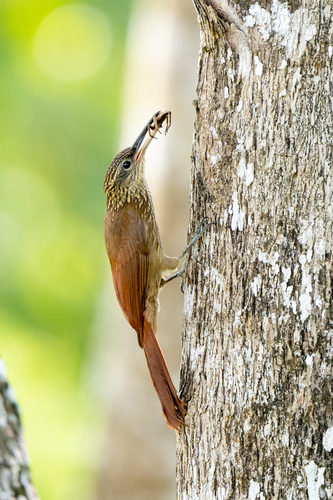
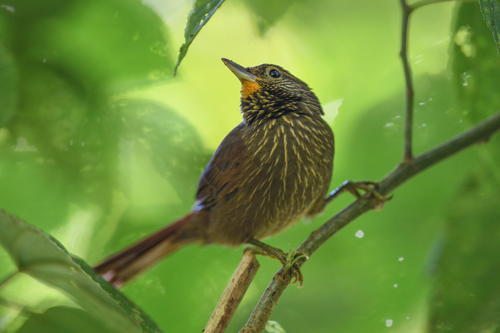
The closest relatives of the Buffy Tuftedcheek that you can see in La Amistad International Park (Panama) (family Furnariidae, Ovenbirds and Woodcreepers) are Spot-crowned Woodcreeper (about 20%), Streak-headed Woodcreeper (about 10%) and Red-faced Spinetail (about 10%), with each one's daily chance of a sighting.

Where does the Buffy Tuftedcheek sighting chance come from?

GBIF citizen-science records

It is estimated from how often the Buffy Tuftedcheek is recorded against all the birds logged in La Amistad International Park (Panama) (321 verified sightings from 2019 to 2026), calibrated against known sighting rates. Figures are rounded to the nearest 10% because citizen-science data supports honest approximations, not decimals, and months with records from fewer than five people show "—". How it works.

← Back to La Amistad International Park (Panama)