
Ruddy Treerunner

Ruddy Treerunner

Margarornis rubiginosus

Silhouette: Sheatherius · PhyloPic

LCLeast ConcernNTVUENCR
Daily sighting probability ~10% · With luck
at La Amistad International Park (Panama)

In 3 days ~20% in a week ~30%

591 Verified sightings at La Amistad International Park (Panama) From 2019 to 2026
8,748 In all 10 parks
June Best month
☀️ Diurnal When it's spotted

About the Ruddy Treerunner

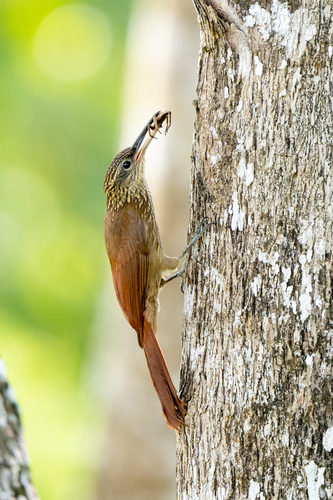
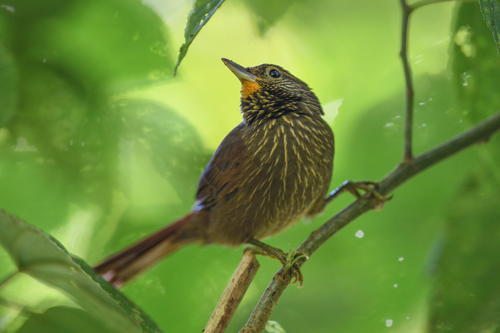
The ruddy treerunner (Margarornis rubiginosus) is a passerine bird in the Furnariinae subfamily of the ovenbird family Furnariidae. It is found in Costa Rica and Panama. The ruddy treerunner is 15 to 16 cm (5.9 to 6.3 in) long and weighs 17 to 24 g (0.60 to 0.85 oz). The sexes have the same plumage. Adults of the nominate subspecies have a buffy whitish supercilium and eyering on an otherwise dull rufescent brown face. Their crown is dull reddish brown and they have a narrow, paler reddish, collar. Their upperparts and wing coverts are reddish chestnut. Their flight feathers are dark fuscous with rufescent edges. Their tail is a slightly paler reddish chestnut than the back; the ends of the tail feathers lack barbs, giving a spiny appearance. Their throat is whitish with a buffy white lower edge. Their breast is dull rufescent brown with pale buff "Vees" on its upper part and darker buff spots on the lower. Their belly is almost unmarked dull rufescent brown and their flanks and undertail coverts are a darker chestnut... Wikipedia →

Sounds

Call0:28

Costa Rica · 2011

© Andrew Spencer · XC72492 · CC BY-NC-ND 2.5

Song0:07

Costa Rica · 2024

© Paul Driver · XC955549 · CC BY-NC-SA 4.0

Call0:34

Costa Rica · 2010

© Scott Olmstead · XC52418 · CC BY-NC-ND 2.5

Global Distribution

Parks Where Found

# Park Country Daily sighting probability
1 Los Quetzales National Park 🇨🇷 Costa Rica
~40%
2 Tapantí-Macizo de la Muerte National Park 🇨🇷 Costa Rica
~20%
3 Volcán Barú National Park 🇵🇦 Panama
~20%
4 Braulio Carrillo National Park 🇨🇷 Costa Rica
~10%
5 Monteverde Cloud Forest Reserve 🇨🇷 Costa Rica
~10%
6 Irazú Volcano National Park 🇨🇷 Costa Rica
~10%
7 La Amistad International Park (Panama) 🇵🇦 Panama
~10%
8 Chirripó National Park 🇨🇷 Costa Rica
<5%
9 Poás Volcano National Park 🇨🇷 Costa Rica
<5%
10 Arenal Volcano National Park 🇨🇷 Costa Rica
<5%

Before you go

What are the chances of seeing a Ruddy Treerunner in La Amistad International Park (Panama)?

With luck

About 10% of wildlife watchers report a Ruddy Treerunner sighting in La Amistad International Park (Panama) on a given day, based on 591 verified sightings from GBIF citizen-science data from 2019 to 2026. It is the 229th most-seen of the 657 birds we can rate there. Over three days the chance rises to about 20%, and over a week to about 30%, if each day is a fresh chance.

When is the best time to see a Ruddy Treerunner in La Amistad International Park (Panama)?

January–June and August

In those months about 10% of wildlife watchers report a Ruddy Treerunner in La Amistad International Park (Panama) on a given day, against under 5% in July and September–December, the lowest months.

What time of day is best to see a Ruddy Treerunner?

Between 9 am and noon

Across all the parks we cover, that three-hour window holds the most Ruddy Treerunner sightings with a recorded time, and about 9 in 10 of them come between 6 am and 6 pm: it is a daytime animal.

Which relatives of the Ruddy Treerunner live in La Amistad International Park (Panama)?

Same family: Furnariidae

The closest relatives of the Ruddy Treerunner that you can see in La Amistad International Park (Panama) (family Furnariidae, Ovenbirds and Woodcreepers) are Spot-crowned Woodcreeper (about 20%), Streak-headed Woodcreeper (about 10%) and Red-faced Spinetail (about 10%), with each one's daily chance of a sighting.

Where does the Ruddy Treerunner sighting chance come from?

GBIF citizen-science records

It is estimated from how often the Ruddy Treerunner is recorded against all the birds logged in La Amistad International Park (Panama) (591 verified sightings from 2019 to 2026), calibrated against known sighting rates. Figures are rounded to the nearest 10% because citizen-science data supports honest approximations, not decimals, and months with records from fewer than five people show "—". How it works.

← Back to La Amistad International Park (Panama)