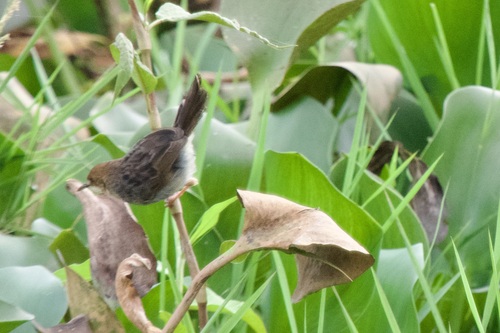
Siffling Cisticola

Siffling Cisticola

Cisticola brachypterus

Silhouette: Sheatherius · PhyloPic

LCLeast ConcernNTVUENCR
Daily sighting probability <5% · Rare
at Lake Mburo National Park

In 3 days <5%

5 Verified sightings at Lake Mburo National Park From 2019 to 2026
634 In all 10 parks
February Best month
☀️ Diurnal When it's spotted

About the Siffling Cisticola

The short-winged cisticola (Cisticola brachypterus), also known as the siffling cisticola, is a species of bird in the family Cisticolidae. It is found in Angola, Benin, Burkina Faso, Burundi, Cameroon, Central African Republic, Chad, Republic of the Congo, Democratic Republic of the Congo, Ivory Coast, Eritrea, Ethiopia, Gabon, Gambia, Ghana, Guinea, Guinea-Bissau, Kenya, Liberia, Malawi, Mali, Mozambique, Niger, Nigeria, Rwanda, Senegal, Sierra Leone, Somalia, South Sudan, Tanzania, Togo, Uganda, Zambia, and Zimbabwe.

The short-winged cisticola resembles the neddicky, a similar member of the genus Cisticola, but lacks the rufous crown with a shorter tail and clear buff underparts. The short-winged cisticola was formally described in 1870 by the English ornithologist Richard Bowdler Sharpe based on a specimen collected near the Volta River in Ghana and sent to him by the colonial administrator Herbert Taylor Ussher. Sharpe coined the binomial name Drymoeca brachyptera where the specific epithet is from Ancient Greek βραχυπτερος/brakhupteros meaning "short-winged", from βραχυς/brakhus meaning "short" and -πτερος/'-pteros' meaning "-winged". The short-winged cisticola... Wikipedia →

Sounds

Song1:06

Ivory Coast · 2026

© Étienne Leroy · XC1186906 · CC BY-NC-SA 4.0

Call0:54

Ghana · 2022

© Peter Boesman · XC719020 · CC BY-NC-ND 4.0

Alarm call0:34

Guinea · 2016

© Bram Piot · XC335058 · CC BY-NC-SA 4.0

Global Distribution

Parks Where Found

# Park Country Daily sighting probability
1 Nairobi National Park 🇰🇪 Kenya
~20%
2 Kidepo Valley National Park 🇺🇬 Uganda
~20%
3 Nyungwe National Park 🇷🇼 Rwanda
~10%
4 Arusha National Park 🇹🇿 Tanzania
~10%
5 Murchison Falls National Park 🇺🇬 Uganda
~10%
6 Queen Elizabeth National Park 🇺🇬 Uganda
<5%
7 Kafue National Park 🇿🇲 Zambia
<5%
8 Gorongosa National Park 🇲🇿 Mozambique
<5%
9 Lake Mburo National Park 🇺🇬 Uganda
<5%
10 Ngorongoro Conservation Area 🇹🇿 Tanzania
<5%

Cities Where Found

# City Country Daily sighting probability
1 Mombasa 🇰🇪 Kenya
~20%
2 Freetown 🇸🇱 Sierra Leone
~10%
3 Accra 🇬🇭 Ghana
<5%
4 Kigali 🇷🇼 Rwanda
<5%

Before you go

What are the chances of seeing a Siffling Cisticola in Lake Mburo National Park?

Rare

Under 5% of wildlife watchers report a Siffling Cisticola sighting in Lake Mburo National Park on a given day, based on 5 verified sightings from GBIF citizen-science data from 2019 to 2026. It is the 350th most-seen of the 362 birds we can rate there. Over three days the chance rises to under 5%, if each day is a fresh chance.

When is the best time to see a Siffling Cisticola in Lake Mburo National Park?

Any time of year

In every month with enough records, under 5% of wildlife watchers report a Siffling Cisticola in Lake Mburo National Park on a given day, so our monthly data shows no clear season.

What time of day is best to see a Siffling Cisticola?

Between 7 and 10 am

Across all the parks we cover, that three-hour window holds the most Siffling Cisticola sightings with a recorded time, and about 9 in 10 of them come between 6 am and 6 pm: it is a daytime animal.

Is Lake Mburo National Park the best place to see a Siffling Cisticola?

9th of 10

Of the 10 parks where we can rate Siffling Cisticola sightings, Lake Mburo National Park ranks 9th at under 5%. The best odds are in Nairobi National Park (Kenya, about 20%), Kidepo Valley National Park (Uganda, about 20%) and Nyungwe National Park (Rwanda, about 10%).

Which relatives of the Siffling Cisticola live in Lake Mburo National Park?

Same genus: Cisticola

The closest relatives of the Siffling Cisticola that you can see in Lake Mburo National Park (genus Cisticola, Cisticolas) are Trilling Cisticola (about 60%), Tabora Cisticola (about 20%) and Winding Cisticola (about 10%), with each one's daily chance of a sighting.

Where does the Siffling Cisticola sighting chance come from?

GBIF citizen-science records

It is estimated from how often the Siffling Cisticola is recorded against all the birds logged in Lake Mburo National Park (5 verified sightings from 2019 to 2026), calibrated against known sighting rates. Figures are rounded to the nearest 10% because citizen-science data supports honest approximations, not decimals, and months with records from fewer than five people show "—". How it works.

← Back to Lake Mburo National Park