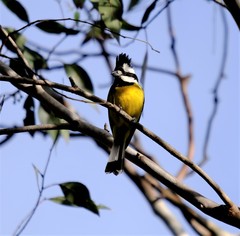
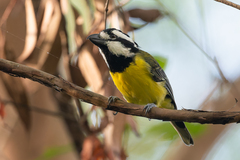

Eastern Shrike-tit

Eastern Shrike-tit

Falcunculus frontatus

Silhouette: Sheatherius · PhyloPic

LCLeast ConcernNTVUENCR Endemic
Daily sighting probability ~10% · With luck
at Lamington National Park

In 3 days ~20% in a week ~30%

186 Verified sightings at Lamington National Park From 2019 to 2026
606 In all 6 parks
October Best month
☀️ Diurnal When it's spotted

About the Eastern Shrike-tit

The eastern shriketit (Falcunculus frontatus) is a species of passerine bird in the family Falcunculidae. It is also known as bark tit, crested tit or yellow-bellied tit. It is found in south-eastern Australia from the southeast of South Australia, throughout Victoria, eastern New South Wales to southeastern Queensland, with some scattered occurrences further north and west in Queensland.

The eastern shriketit was first described by the English ornithologist John Latham in 1801 under the binomial name Lanius frontatus. It was named Falcunculus flavigulus by John Gould, which he quickly realised was a frontatus in female plumage.

Three subspecies of the crested shriketit (Falcunculus frontatus) were recognised as distinct species based on their widely disjunct distributions and plumage differences, so that F. frontatus was split from F. whitei and F. leucogaster following Schodde and Mason (1999). In appearance, the eastern shriketit differs from the northern shriketit (F. whitei), which has broad yellow wing-margins and brownish-grey wing coverts, and the western shriketit (F. leucogaster), which has a white belly, olive-grey wing-coverts and yellow-edged remiges.

The... Wikipedia →

Sounds

Call0:59

Australia · 2025

© Marc Anderson · XC1087421 · CC BY-NC-ND 4.0

Recording0:46

Australia · 2023

© Drew Davison · XC815605 · CC BY-NC-ND 4.0

Subsong0:20

Australia · 2014

© Ding Li Yong · XC963980 · CC BY-NC-ND 4.0

Global Distribution

Parks Where Found

# Park Country Daily sighting probability
1 Great Otway National Park 🇦🇺 Australia
~10%
2 Lamington National Park 🇦🇺 Australia
~10%
3 Kosciuszko National Park 🇦🇺 Australia
<5%
4 Blue Mountains National Park 🇦🇺 Australia
<5%
5 Grampians National Park 🇦🇺 Australia
<5%
6 Royal National Park 🇦🇺 Australia
<5%

Cities Where Found

# City Country Daily sighting probability
1 Melbourne 🇦🇺 Australia
<5%
2 Sydney 🇦🇺 Australia
<5%

Before you go

What are the chances of seeing an Eastern Shrike-tit in Lamington National Park?

With luck

About 10% of wildlife watchers report an Eastern Shrike-tit sighting in Lamington National Park on a given day, based on 186 verified sightings from GBIF citizen-science data from 2019 to 2026. It is the 71st most-seen of the 171 birds we can rate there. Over three days the chance rises to about 20%, and over a week to about 30%, if each day is a fresh chance.

When is the best time to see an Eastern Shrike-tit in Lamington National Park?

February and October–December

In those months about 10% of wildlife watchers report an Eastern Shrike-tit in Lamington National Park on a given day, against under 5% in January and March–September, the lowest months.

What time of day is best to see an Eastern Shrike-tit?

Between 11 am and 2 pm

Across all the parks we cover, that three-hour window holds the most Eastern Shrike-tit sightings with a recorded time, and nearly all of them come between 6 am and 6 pm: it is a daytime animal.

Is Lamington National Park the best place to see an Eastern Shrike-tit?

Among the best

Of the 6 parks where we can rate Eastern Shrike-tit sightings, Lamington National Park ranks 2nd at about 10%, level with the leaders once rounded. The best odds are in Great Otway National Park (Australia, about 10%).

Which relatives of the Eastern Shrike-tit live in Lamington National Park?

Same family: Pachycephalidae

The closest relatives of the Eastern Shrike-tit that you can see in Lamington National Park (family Pachycephalidae, Whistlers and Allies) are Gray Shrikethrush (about 70%), Golden Whistler (about 60%) and Arafura Shrikethrush (about 10%), with each one's daily chance of a sighting.

Where does the Eastern Shrike-tit sighting chance come from?

GBIF citizen-science records

It is estimated from how often the Eastern Shrike-tit is recorded against all the birds logged in Lamington National Park (186 verified sightings from 2019 to 2026), calibrated against known sighting rates. Figures are rounded to the nearest 10% because citizen-science data supports honest approximations, not decimals, and months with records from fewer than five people show "—". How it works.

← Back to Lamington National Park