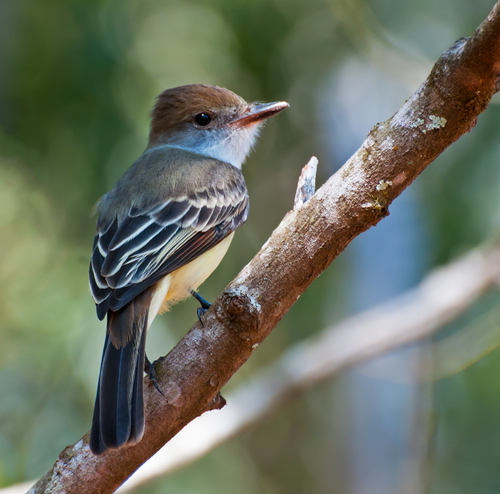
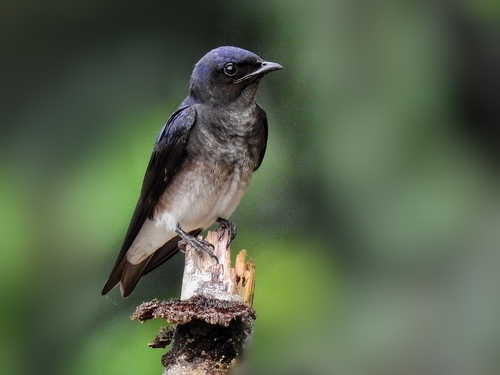
Long-tailed Manakin

Long-tailed Manakin

Chiroxiphia linearis

Silhouette: Edwin Price · PhyloPic

LCLeast ConcernNTVUENCR
Daily sighting probability <5% · Rare
at Las Baulas Marine National Park

In 3 days ~10% in a week ~30%

39 Verified sightings at Las Baulas Marine National Park From 2019 to 2026
6,319 In all 14 parks
May Best month
☀️ Diurnal When it's spotted

About the Long-tailed Manakin

The long-tailed manakin (Chiroxiphia linearis) is a species of bird in the family Pipridae native to Central America where it inhabits both wet and dry tropical and subtropical forests. It is a small, plump bird about 10 centimetres (4 in) long. Males have black plumage with a blue back and a red crown, and the two central tail feathers are greatly elongated. Females and juveniles are olive-green with paler underparts. At breeding time, males are involved in a cooperative lekking behaviour with a complex coordinated courtship dance. This is a fairly common species with a wide range, and the International Union for Conservation of Nature has rated its conservation status as being of "least concern".

Large for a manakin, the long-tailed measures about 10 cm (3.9 in) long and weighs 18 g (0.63 oz). The male is mostly a rich black. This is contrasted by a bright red crown and legs. The back is bright blue. The two central tail feathers are narrow and greatly elongated. The female is olive green, paler below and on the chin and throat. Some females have a small amount of red in the crown.

It closely resembles the lance-tailed manakin (C. lanceolata), the blue-backed manakin... Wikipedia →

Sounds

Song0:36

Guatemala · 2024

© Manuel Grosselet · XC937869 · CC BY-NC-SA 4.0

Call0:51

Costa Rica · 2022

© Brendan Sloan · XC744316 · CC BY-NC-ND 4.0

Alarm call0:37

Costa Rica · 2019

© Odirlei Vieira da Fonseca · XC498293 · CC BY-NC-SA 4.0

Global Distribution

Parks Where Found

# Park Country Daily sighting probability
1 Rincón de la Vieja National Park 🇨🇷 Costa Rica
~60%
2 Santa Rosa National Park 🇨🇷 Costa Rica
~50%
3 Cabo Blanco Absolute Nature Reserve 🇨🇷 Costa Rica
~40%
4 El Triunfo 🇲🇽 Mexico
~30%
5 Ostional Wildlife Refuge 🇨🇷 Costa Rica
~30%
6 Monteverde Cloud Forest Reserve 🇨🇷 Costa Rica
~20%
7 Tenorio Volcano National Park 🇨🇷 Costa Rica
~20%
8 Carara National Park 🇨🇷 Costa Rica
~10%
9 Las Baulas Marine National Park 🇨🇷 Costa Rica
<5%
10 Palo Verde National Park 🇨🇷 Costa Rica
<5%
11 Masaya Volcano National Park 🇳🇮 Nicaragua
<5%
12 Poás Volcano National Park 🇨🇷 Costa Rica
<5%
13 Braulio Carrillo National Park 🇨🇷 Costa Rica
<5%
14 Arenal Volcano National Park 🇨🇷 Costa Rica
<5%

Cities Where Found

# City Country Daily sighting probability
1 San José 🇨🇷 Costa Rica
<5%

Zoos & Centres Where Found

# Zoo / Centre Country
1 Dallas World Aquarium 🇺🇸 United States In captivity

Before you go

What are the chances of seeing a Long-tailed Manakin in Las Baulas Marine National Park?

Rare

Under 5% of wildlife watchers report a Long-tailed Manakin sighting in Las Baulas Marine National Park on a given day, based on 39 verified sightings from GBIF citizen-science data from 2019 to 2026. It is the 113th most-seen of the 206 birds we can rate there. Over three days the chance rises to about 10%, and over a week to about 30%, if each day is a fresh chance.

When is the best time to see a Long-tailed Manakin in Las Baulas Marine National Park?

May

In that month about 20% of wildlife watchers report a Long-tailed Manakin in Las Baulas Marine National Park on a given day, against under 5% in July and September–April, the lowest months.

What time of day is best to see a Long-tailed Manakin?

Between 8 and 11 am

Across all the parks we cover, that three-hour window holds the most Long-tailed Manakin sightings with a recorded time, and about 8 in 10 of them come between 6 am and 6 pm: it is a daytime animal.

Which relatives of the Long-tailed Manakin live in Las Baulas Marine National Park?

Same order: Passeriformes

The closest relatives of the Long-tailed Manakin that you can see in Las Baulas Marine National Park (order Passeriformes, Perching Birds) are Great Kiskadee (about 80%), Great-tailed Grackle (about 80%) and Tropical Kingbird (about 70%), with each one's daily chance of a sighting.

Where does the Long-tailed Manakin sighting chance come from?

GBIF citizen-science records

It is estimated from how often the Long-tailed Manakin is recorded against all the birds logged in Las Baulas Marine National Park (39 verified sightings from 2019 to 2026), calibrated against known sighting rates. Figures are rounded to the nearest 10% because citizen-science data supports honest approximations, not decimals, and months with records from fewer than five people show "—". How it works.

← Back to Las Baulas Marine National Park