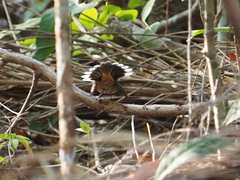
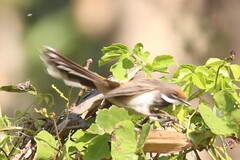
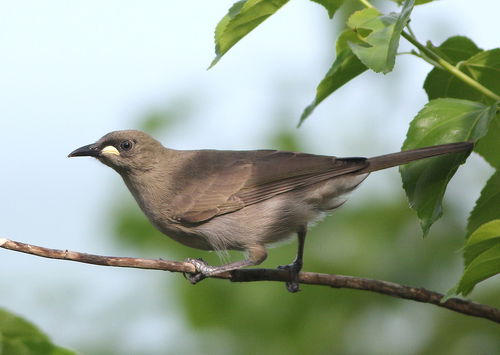
Arafura Fantail

Arafura Fantail

Rhipidura dryas

Silhouette: Michael Scroggie · PhyloPic

LCLeast ConcernNTVUENCR
Daily sighting probability <5% · Rare
at Litchfield National Park

In 3 days ~10% in a week ~30%

14 Verified sightings at Litchfield National Park From 2019 to 2026
362 In all 3 parks
May Best month
☀️ Diurnal When it's spotted

About the Arafura Fantail

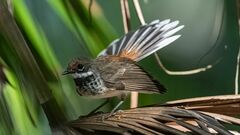
The Arafura fantail (Rhipidura dryas), sometimes known as the wood fantail, inhabits the Lesser Sunda Islands, the northern coast of Australia from the Kimberley to the western side of the Cape York Peninsula, including subcoastally in the Top End of the Northern Territory, and southern New Guinea. It is similar to the rufous fantail, from which it has been split taxonomically but, apart from minor overlap in the eastern Moluccas, their geographic ranges are discrete. It is generally duller than the rufous fantail with the rufous colouration more restricted.

The species is typically found in mangroves and other coastal woodland, alongside primary and secondary low-level forest. The species tolerates a wide altitudinal range, from near sea level to around 2000 metres in the Timor part of its range.

It is one of over 60 member species of the genus Rhipidura, commonly known as the fantails.... Wikipedia →

Sounds

Song1:24

Australia · 2022

© James Lambert · XC759525 · CC BY-NC-ND 4.0

Call0:10

Indonesia · 2017

© Ross Gallardy · XC417514 · CC BY-NC-SA 4.0

Song0:32

East Timor · 2005

© Frank Lambert · XC605579 · CC BY-NC-ND 4.0

Global Distribution

Parks Where Found

# Park Country Daily sighting probability
1 Kakadu National Park 🇦🇺 Australia
~20%
2 Litchfield National Park 🇦🇺 Australia
<5%
3 Nitmiluk National Park 🇦🇺 Australia
<5%

Before you go

What are the chances of seeing an Arafura Fantail in Litchfield National Park?

Rare

Under 5% of wildlife watchers report an Arafura Fantail sighting in Litchfield National Park on a given day, based on 14 verified sightings from GBIF citizen-science data from 2019 to 2026. It is the 87th most-seen of the 110 birds we can rate there. Over three days the chance rises to about 10%, and over a week to about 30%, if each day is a fresh chance.

When is the best time to see an Arafura Fantail in Litchfield National Park?

May

In that month about 20% of wildlife watchers report an Arafura Fantail in Litchfield National Park on a given day, against under 5% in June–July and September–April, the lowest months. That is one of Litchfield National Park's driest months, with about 10 mm of rain against 400 mm in January.

What time of day is best to see an Arafura Fantail?

Between 8 and 11 am

Across all the parks we cover, that three-hour window holds the most Arafura Fantail sightings with a recorded time, and about 9 in 10 of them come between 6 am and 6 pm: it is a daytime animal.

Is Litchfield National Park the best place to see an Arafura Fantail?

2nd of 3

Of the 3 parks where we can rate Arafura Fantail sightings, Litchfield National Park ranks 2nd at under 5%. The best odds are in Kakadu National Park (Australia, about 20%).

Which relatives of the Arafura Fantail live in Litchfield National Park?

Same genus: Rhipidura

The closest relatives of the Arafura Fantail that you can see in Litchfield National Park (genus Rhipidura, Fantails) are Northern Fantail (about 30%) and Willie Wagtail (about 20%), with each one's daily chance of a sighting.

Where does the Arafura Fantail sighting chance come from?

GBIF citizen-science records

It is estimated from how often the Arafura Fantail is recorded against all the birds logged in Litchfield National Park (14 verified sightings from 2019 to 2026), calibrated against known sighting rates. Figures are rounded to the nearest 10% because citizen-science data supports honest approximations, not decimals, and months with records from fewer than five people show "—". How it works.

← Back to Litchfield National Park